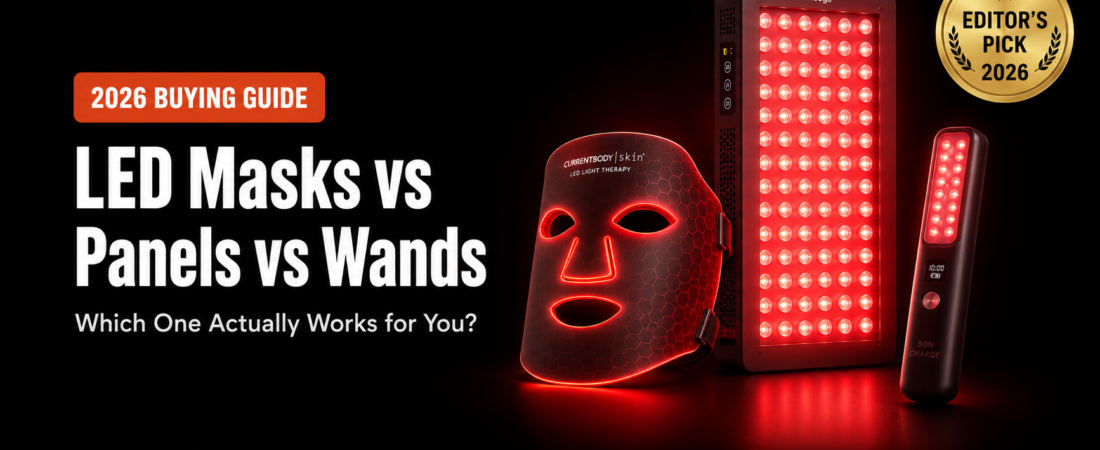
LED Masks vs Panels vs Wands: What’s Actually Different?
Spread the love
Three devices. Same underlying technology. Completely different use cases — and the marketing makes sure you never quite understand why.
This guide explains what actually separates these three formats: not specs on a product page, but the practical realities of using each one over weeks and months. Coverage area, irradiance, compliance, cost per result. The things that determine whether a device ends up on your bathroom shelf or in a drawer.
They All Do the Same Thing — Sort Of
Red light therapy works by delivering specific wavelengths of light — primarily 630–660nm red and 810–850nm near-infrared — to cells. The photons are absorbed by cytochrome c oxidase in the mitochondria, which triggers increased ATP production. More cellular energy means faster repair, more collagen synthesis, and reduced inflammatory signalling.
That mechanism is the same whether the light comes from a mask, a panel, or a wand. What changes is how much light reaches the tissue, how much of the body it covers, and how practical it is to use consistently over time.
Those three variables — irradiance, coverage, and compliance — are what actually determine which format makes sense for a given person.
LED Face Masks
How they work
A mask positions LEDs directly against or within millimetres of the skin across the full face simultaneously. The light delivery is passive — you put it on and do something else for ten minutes while every zone of the face receives the same exposure at the same time.
Most masks on the market operate somewhere between 5–15 mW/cm². That is enough to reach the upper dermis where fibroblasts produce collagen, but not deep enough to affect muscle or joint tissue — which is fine, because that is not what facial masks are designed to do.
What the research says
Studies using 630nm/850nm LED masks have confirmed measurable improvements in skin elasticity, fine line reduction, and collagen density at 8–12 weeks of consistent use. A 2014 controlled trial in Photomedicine and Laser Surgery found significant increases in collagen density and reduced fine lines versus a placebo group using comparable wavelengths. A 2025 clinical study confirmed anti-aging effects using 630nm in sessions of similar duration.
The evidence base for facial LED therapy is solid. The caveats are that most strong studies use medical-grade devices, sessions are 3–5 times per week over at least 8 weeks, and “consistent use” is doing a lot of work in that sentence.
The practical reality
The main thing working in masks’ favour is compliance. A device you put on and forget about for ten minutes while reading or watching television is a device you will actually use daily. That matters more than most spec sheets acknowledge.
The main limitation is obvious: a mask only covers the face. If your goals extend to neck, décolletage, body recovery, or joint pain, a mask alone will not address them.
What to look for
The single most important specification is whether the mask includes genuine 850nm near-infrared light. Masks without it are limited to surface-level red light effects — useful for skin tone and mild acne, but unable to reach the dermal depth where meaningful collagen remodelling occurs. Many budget masks under $40 use shallow RGB blends with no real NIR channel.
Beyond wavelengths, LED count determines coverage uniformity. A mask with 272 high-density LEDs will have fewer dead zones at the jawline and nose edges than one with 80.
Worth knowing
A frequently overlooked limitation: most masks have no published irradiance specification. Brands like CurrentBody use independent verification (Veritace) to confirm their output. Most others do not, which makes genuine comparison difficult.
Representative products:
XSSNVV LED Face Mask — 272 LEDs, 620nm + 850nm + 460nm + 580nm, cordless, 145g — Check price on Amazon
CurrentBody Skin LED Mask Series 2 — 633nm + 830nm, Veritace-verified, FDA cleared — Check price on Amazon
INIA LED Face Mask — 850nm NIR + red + blue, 2600mAh battery — Check price on Amazon
Red Light Therapy Panels
How they work
Panels are freestanding LED boards — typically wall-mounted or on a stand — that emit red and NIR light across a large surface area. Unlike masks, you maintain a distance from the device: usually 6–18 inches depending on the desired irradiance dose. Sessions are 10–20 minutes.
The key difference from masks is power output. Entry-level panels like the Hooga HG300 deliver around 90 mW/cm² at 6 inches. That is roughly 6–18 times the irradiance of a typical LED mask, depending on the mask. High-output panels can reach 150+ mW/cm² at the same distance.
What the research says
The clinical literature on panels is extensive — and broader in scope than for masks. Near-infrared light at 810–850nm from high-irradiance sources has been studied for muscle recovery, joint inflammation, chronic pain, wound healing, and even cognitive function. The depth of penetration at panel-level irradiance reaches muscle, connective tissue, and bone — well beyond what a mask delivers.
For skin specifically, panels used at close distance (6 inches, face-forward) deliver the same or greater dose to facial tissue as a mask, but without the comfort or convenience of a wearable device.
The practical reality
Panels require more commitment than masks or wands. They need a dedicated space, a consistent time slot, and the discipline to stand or sit in front of the device. That is a meaningful barrier for many people.
The reward for that commitment is scope. A mid-size panel can treat face, neck, chest, and hands simultaneously. A full-size panel covers the entire anterior body in one session. For people whose goals extend beyond skin — athletes managing recovery, people dealing with chronic inflammation, anyone interested in systemic effects — a panel is the only format that can realistically address those goals.
Panel size matters enormously and is often underexplained. A compact panel like the HG300 (12″ × 8.5″) is well-suited for face and neck. Treating the full torso requires a mid-size or large panel. Many buyers underestimate the coverage they actually need.
What to look for
Irradiance at a stated distance is the primary specification. Look for brands that publish third-party tested irradiance data, not manufacturer claims. Mito Red is one of the few brands that provides independent lab verification of their output.
Wavelength configuration matters less here than with masks, since most panels use the well-validated 660nm/850nm pairing. Higher-end panels add 630nm and 810nm for a quad-wavelength array, which some research suggests produces superior results to dual-wavelength configurations.
Worth knowing
EMF output is a legitimate concern for some users. Panels operated at close distance for extended sessions generate measurable electromagnetic fields. Reputable brands publish EMF measurements at 6 inches — BestQool, for example, reports zero EMF at that distance. Budget panels typically do not address this.
BestQool 105W — dual-chip 660nm + 850nm, 105W, zero EMF at 6″ — Check price on Amazon
Mito Red MitoMIN 2.0 — 660nm + 850nm, third-party tested, FSA/HSA eligible — Check price on Amazon
Handheld Wands
How they work
Wands are compact, handheld devices designed for targeted spot treatment. The LED head is placed directly on or very close to the skin and moved manually across the treatment area. Coverage per pass is small — typically 2–6 cm² — so treating the full face takes considerably longer than a mask and requires active engagement throughout.
The most widely used wands combine red light with complementary modalities: galvanic current (which uses a low electrical charge to drive serum molecules deeper into skin), therapeutic warmth, and facial massage vibration. This is where wands differentiate from the other two categories — they are multi-modal devices, not pure red light tools.
What the research says
The evidence base for standalone red light wands is thinner than for masks or panels, partly because most wands use a combination of technologies that makes it difficult to isolate the contribution of red light specifically. The Solawave wand uses 630nm at relatively low power — effective for surface stimulation and serum absorption enhancement, but not equivalent to the deeper NIR penetration of a mask with 850nm.
Where wands show consistently good outcomes in user data is in targeted applications: reducing puffiness (massage component), improving serum absorption (galvanic current), and addressing specific fine lines in high-detail areas like around the eyes and lips — areas where a full mask may be less precise.
The practical reality
The honest limitation of wands is time and attention. Using a wand well requires you to stay focused and move it methodically across every zone — 3 minutes per area, consistently. That is fine for a targeted session on the eye area, but impractical as a substitute for a full-face mask routine over weeks.
The honest advantage is portability and versatility. A wand fits in a toiletry bag, works anywhere with a USB port, and combines multiple skin technologies in a format that feels more interactive than passive mask sessions. For people who already use serums and want to enhance their absorption, a galvanic wand adds real value independent of the red light component.
What to look for
Wavelength and power output are less critical here than with panels — most wands operate at surface depth regardless. The more useful questions are: what secondary modalities does it offer, how is the build quality, and does the brand publish clinical evidence for the device itself rather than red light therapy in general.
FDA clearance is a meaningful signal for wands — it indicates the device has been reviewed for safety and basic efficacy claims.
Worth knowing
Many cheap wands on Amazon have no real NIR channel — just visible red LEDs. If deeper collagen work is the goal, a wand is not the most efficient format for it regardless of price.
Representative products:
Solawave 4-in-1 Wand — 630nm, galvanic current, warmth, massage, FDA cleared — Check price on Amazon
Comparing the Three Formats
LED Masks vs Panels vs Wands — Key differences
A practical comparison of the three main red light therapy formats.
There is no universally correct answer here, and anyone who tells you otherwise is selling something.
The most useful frame is to ask what problem you are actually trying to solve, not which device sounds most impressive.
If the goal is facial skin — texture, fine lines, tone, mild acne — a mask is the most practical and cost-efficient format. The hands-free compliance advantage over months of daily use is real and substantial.
If the goal extends to body recovery, joint health, chronic inflammation, or sleep quality, those outcomes require the coverage area and irradiance output that only a panel delivers. A mask cannot address them.
If the primary need is portability, targeted spot work, or pairing red light with serum absorption, a wand serves those specific use cases better than either of the other two. It is not a substitute for a mask or panel for broad therapeutic goals.
Many users end up using more than one format over time — a mask for daily face maintenance and a panel for body sessions, for example. That is a reasonable progression. Starting with the format that most directly addresses the primary goal, then expanding from there, is the more sensible approach than trying to find a single device that does everything adequately.
Frequently Asked Questions
Frequently asked questions
Common questions about choosing between LED masks, panels, and wands.
For full-face anti-aging goals, no. A wand covers 2–6 cm² per pass and requires you to move it manually across every zone — treating the full face takes 10–15 minutes of active attention versus 10 minutes hands-free with a mask. More importantly, most wands use 630nm red light only, without the 850nm NIR channel that drives deeper collagen remodelling. A wand is well-suited for targeted spot work — the eye area, lip lines, specific acne spots — but it is not a practical substitute for a mask as a full-face daily routine.
Handheld wands
A panel used at close range (6 inches, face-forward) can deliver equal or higher irradiance to the face than most masks — the physics work in its favour. The practical problem is compliance. Sitting still in front of a panel for 15–20 minutes, five days a week, over months, is significantly harder to sustain than wearing a mask while doing something else. The mask wins on compliance, which in practice means better long-term results for most people — not because the device is more powerful, but because they actually use it.
Red light panels
Irradiance (measured in mW/cm²) is the power density of light reaching the skin at a given distance. It determines how much energy is delivered per unit of time. Therapeutic red light therapy operates in the range of roughly 5–150 mW/cm² depending on the device and use case. Too little and the dose is insufficient to trigger a cellular response. Too much at close range over extended sessions can theoretically trigger oxidative stress. Most consumer masks operate in the 5–15 mW/cm² range, which is adequate for facial skin at a 10-minute session. Panels at 6 inches deliver 50–150 mW/cm², which is why their sessions can be shorter and still achieve equivalent energy dose.
General
Yes, and it is a common progression for users who start with a mask and want to extend the benefits to the rest of the body. The two formats are complementary rather than redundant: the mask handles daily facial maintenance hands-free, while the panel addresses body recovery, joint inflammation, or sleep quality in a separate session. There is no conflict in using both — they target different tissue areas and different physiological goals.
General
For most first-time buyers with skin-focused goals, a mid-range LED mask is the most sensible starting point. The compliance advantage is real, the cost of entry is manageable, and the results for facial skin are well-documented. A mask with genuine 850nm NIR — not just visible red light — at a price under $150 represents a reasonable test of whether red light therapy fits your routine before investing in a panel. If after several months the primary interest shifts toward body recovery or systemic effects, that is the point to consider adding a panel.
LED face masks
Yes, meaningfully so. Galvanic (microcurrent) technology works on a different mechanism from red light — it uses a low-level electrical current to temporarily increase the permeability of the skin, improving absorption of water-based serums applied during treatment. This is independent of the red light component and has its own evidence base for reducing puffiness and improving skin tone. Multi-modal wands like the Solawave combine both technologies in a single pass, which is part of why their user outcomes tend to be broader than those of simple red-light-only wands.
Handheld wands
Not sure which format to start with?Our top picks across all three categories