660nm vs 850nm Red Light Therapy: Which Wavelength Do You Actually Need?
Spread the love
Most red light therapy devices advertise two numbers: 660nm and 850nm. They appear on product pages, in spec tables, and in marketing copy — usually without much explanation of what the difference actually means or why it matters.
This article explains the physics, the biology, and the practical implications of each wavelength. Not to sell you a particular device, but because buying a red light therapy device without understanding wavelengths is roughly equivalent to buying sunscreen without looking at the SPF.
Table of Contents
What a Wavelength Number Actually Means
Light travels in waves. The wavelength is the distance between two consecutive peaks of that wave, measured in nanometers (nm). Shorter wavelengths sit toward the blue end of the visible spectrum; longer wavelengths sit toward the red and, eventually, infrared end where light becomes invisible to the human eye.
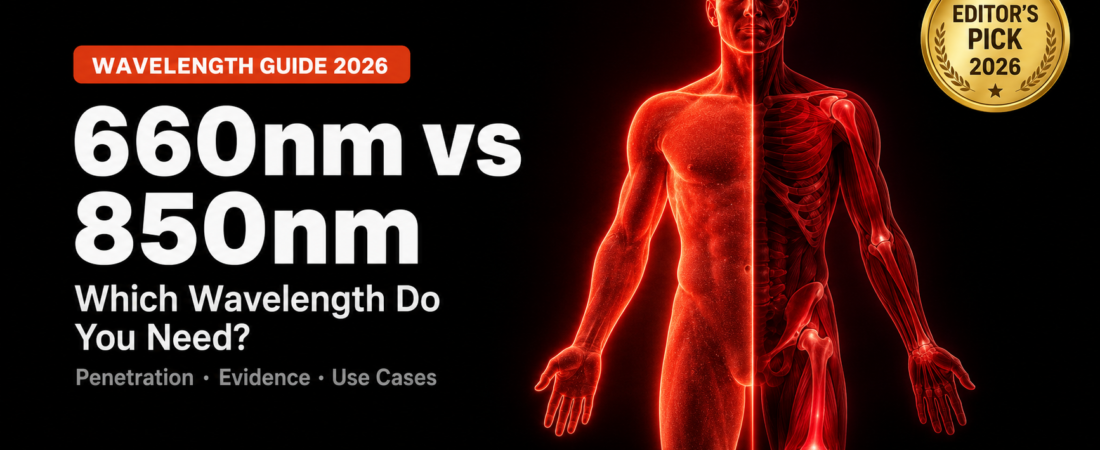
660nm sits within the visible red spectrum — you can see it as a red glow. 850nm sits in the near-infrared range — it is completely invisible, but physically present and active in tissue.
The wavelength number is not arbitrary marketing. It determines two fundamental things: which molecules in the body absorb the light, and how deeply into tissue the light penetrates before being scattered or absorbed. Both of those factors determine what the light can and cannot do therapeutically.
Want the Exact Science?
The Ultimate Guide to Red Light Therapy
by Ari Whitten, MS · Contributor: Michael Hamblin, PhD
★★★★★4.5 out of 5 (4,549 ratings)
This article covers the basics of wavelengths — this book is where we’d send you next if you want the exact dosing math, the difference between good and underpowered devices, and protocols backed by over 6,000 peer-reviewed studies.
As an Amazon Associate we earn from qualifying purchases.
The Mechanism: Why Cells Respond to These Specific Wavelengths
Both 660nm and 850nm fall within what researchers call the “optical window” — the range of wavelengths that penetrate biological tissue with meaningful efficiency. Outside this window, shorter wavelengths (UV, blue, green) are absorbed almost immediately by superficial structures like melanin and water. Longer wavelengths beyond roughly 1000nm generate heat rather than photochemical effects.
Within the optical window, the primary cellular target is cytochrome c oxidase, an enzyme in the mitochondria that plays a central role in the electron transport chain — the process by which cells produce ATP (adenosine triphosphate), their primary energy currency. Both 660nm and 850nm activate this enzyme, triggering increased ATP output, which in turn supports cell repair, collagen synthesis, and the modulation of inflammatory signalling.
Red light is absorbed primarily by hemoglobin and melanin in superficial tissue, while near-infrared light peaks at cytochrome c oxidase absorption in deeper mitochondria. That difference in absorption profile is the root cause of everything else that separates the two wavelengths. Red Light Wellness
660nm Red Light: What It Does and Where It Works
Penetration depth
The 660nm wavelength belongs to the visible red light spectrum and typically penetrates approximately 8–10 millimetres into tissue, reaching layers such as the epidermis and dermis. That range is enough to reach the fibroblasts in the dermis — the cells responsible for producing collagen and elastin — but does not penetrate meaningfully into muscle, joint capsules, or bone. Zack Fitness
What the research shows
The skin-focused evidence base for 660nm is substantial. A controlled trial by Wunsch and Matuschka, frequently cited in the photobiomodulation literature, found that treated subjects experienced significantly improved skin complexion and skin feeling, profilometrically assessed skin roughness, and ultrasonographically measured collagen density compared to controls. A study examining pulsed 660nm LED on skin collagen metabolism found a mean percent difference between LED-treated and non-LED-treated tissue of 31% in levels of type-1 procollagen and -18% in MMP-1 — meaning more collagen precursor and less of the enzyme that breaks collagen down. ResearchGateLED Esthetics
A 2023 meta-analysis substantiated these findings, reporting significant anti-aging outcomes including decreased appearance of wrinkles and improvement in skin texture, though with noted variability in patient response and the need for multiple treatment sessions. ResearchGate
What 660nm is best suited for
Skin texture, tone, and surface-level radiance
Fine lines and wrinkles in the upper dermis
Wound healing and post-procedure skin recovery
Acne and mild inflammatory skin conditions (when combined with blue light)
Hair follicle stimulation (follicles sit 3–5mm below the scalp surface, within 660nm’s reach)
Where 660nm falls short
It does not reach muscle tissue in therapeutically meaningful quantities. Using 660nm for muscle recovery means most of the photonic energy is absorbed in the first 5mm — never reaching the target tissue. For anyone whose goals extend beyond the skin surface, 660nm alone is insufficient. Red Light Wellness
850nm Near-Infrared: What It Does and Where It Works
Penetration depth
850nm light penetrates 30–50mm below the surface, reaching muscles, joints, fascia, and even bone in thinner tissue areas. Unlike visible light, NIR is not easily absorbed by melanin or hemoglobin, allowing it to pass through skin and fat layers with less resistance. Lumi Visage
That is a meaningfully different therapeutic reach. The same mitochondrial mechanism applies — cytochrome c oxidase activation, increased ATP, reduced inflammatory signalling — but now it applies to cell populations that 660nm cannot access.
What the research shows
Near-infrared wavelengths between 800 and 880 nanometers demonstrate stronger penetration into muscle and joint tissues. Randomised controlled trials examining 830nm low-level laser therapy before high-intensity exercise have shown reductions in biochemical markers of muscle damage compared with placebo. Systematic reviews of low-level light therapy for knee osteoarthritis report that photobiomodulation was superior to sham treatment for pain reduction, though effects on function and stiffness were less consistent. Body Lab Studio
The authors of that review note this honestly — benefit potential exists alongside acknowledged limitations in evidence certainty. That is a more accurate framing than the unqualified claims common in device marketing.
What 850nm is best suited for
Muscle recovery after exercise
Joint pain and inflammation (knee, shoulder, wrist)
Neurological applications (an area of active but early-stage research)
Where 850nm falls short
For skin health and anti-aging, 660nm is the gold standard. For deep tissue, joints, and muscle recovery, 850nm leads the evidence. Near-infrared light is not wasted on the skin — it does stimulate collagen there too — but for purely skin-focused goals, it is not as precisely targeted as 660nm, which is absorbed more efficiently by the fibroblasts in the upper dermis. Thelighttherapyinstitute
The Key Differences Side by Side
660nm vs 850nm — key differences at a glance
A practical side-by-side of the two most clinically studied red light therapy wavelengths.
← Scroll to see all →
Property
🔴 660nm Red Light
🔷 850nm Near-Infrared
Visible to the eye
Yes — red glow
No — invisible
Penetration depth
~8–10mm
~30–50mm
Reaches skin / dermis
✓
✓
Reaches muscle tissue
✗
✓
Reaches joint / bone
✗
✓ (thin tissue areas)
Primary chromophore
Hemoglobin, melanin
Cytochrome c oxidase (deeper)
Best for skin anti-aging
✓ Gold standard
△ Secondary benefit
Best for muscle recovery
✗
✓
Best for joint pain
✗
✓
Hair follicle stimulation
✓ (follicles 3–5mm deep)
△ Also studied
Evidence base strength
Strong — skin, wound healing
Strong — recovery, joints, inflammation
Present in most dual-wavelength devices
✓
✓
Why Most Devices Use Both
Using 660nm red and 850nm near-infrared simultaneously treats multiple tissue depths in a single session. This is the reasoning behind the dual-wavelength configuration that has become standard in most reputable consumer devices. Red Light Wellness
The practical difference between similar wavelengths (e.g., 630nm vs. 660nm, or 810nm vs. 850nm) is meaningful but not dramatic. For most users, a dual-wavelength (660nm + 850nm) device represents the best balance of therapeutic coverage, simplicity, and value. Thelighttherapyinstitute
It is worth being clear about what “synergistic” means and does not mean here. The two wavelengths do not chemically interact. They activate the same cellular pathway (cytochrome c oxidase) at different tissue depths in the same session. The benefit of using both is coverage, not amplification — you treat the dermis and the deeper tissue simultaneously rather than choosing one or the other.
A Note on Wavelength Variations: 630nm, 810nm, 830nm
The market is populated with devices citing wavelengths adjacent to 660nm and 850nm — particularly 630nm on the red side and 810nm or 830nm on the NIR side.
Within red wavelengths, 660nm consistently outperforms 630nm for anti-aging in clinical studies. Within NIR wavelengths, 810nm, 830nm, and 850nm all fall within the therapeutic window and all produce positive results. Thelighttherapyinstitute
630nm is not ineffective — it contributes to surface-level outcomes and appears in many multi-wavelength masks with good clinical data. The CurrentBody Series 2, for instance, uses 633nm rather than 660nm and has independent verification behind its output. The difference between 630nm and 660nm is real but not decisive; the difference between having NIR and lacking it entirely is much larger.
What This Means for Buying Decisions
Understanding the wavelength distinction collapses a lot of the confusion around device selection.
A mask that uses only 620nm or 630nm red light with no NIR channel is a surface-treatment device. It may improve skin tone and texture. It will not address anything below the dermis. For users whose goals are purely cosmetic, that may be sufficient. For anyone expecting deeper anti-inflammatory or recovery effects, it is not the right tool regardless of LED count or price.
A mask with both 660nm (or adjacent red) and 850nm NIR covers both depths in the same session. That is the configuration worth looking for in a face mask. The XSSNVV uses 620nm and 850nm; the CurrentBody Series 1 and 2 use 633nm and 830nm. Both represent genuine dual-wavelength devices with real NIR output.
A panel operating at 660nm + 850nm at therapeutic irradiance levels (50–150 mW/cm² at 6 inches) can treat everything from the skin surface to joint depth. It is the format with the widest therapeutic scope, which is also why the research on panels covers the broadest range of outcomes.
Devices that advertise many wavelengths — 7-color, 9-color — are often providing most of them at negligible power. A device with two well-chosen, properly powered wavelengths outperforms a device with seven poorly powered ones. The number of wavelengths listed is less important than whether the primary therapeutic wavelengths (660nm and 850nm) are present and adequately powered.
Common questions about 660nm vs 850nm wavelengths in red light therapy.
It depends entirely on your goals. If your interest is purely facial skin — collagen, fine lines, tone — 660nm alone covers the tissue depth where those outcomes occur. If you want any benefit beyond the skin surface — muscle recovery, joint pain, deeper inflammation — you need 850nm NIR, because 660nm does not penetrate far enough to reach those tissues in therapeutic quantities. For most people, a dual-wavelength device covering both is the practical answer, since it eliminates the need to make that choice and costs little more than a single-wavelength device.
Both wavelengths
Yes. Near-infrared light at 850nm is non-ionising — it does not carry enough energy to damage DNA or cells at the power levels used in consumer and clinical devices. It does not generate meaningful heat at normal session lengths. The main precaution specific to NIR is eye exposure: because 850nm is invisible, you may not instinctively close your eyes or look away. Devices with built-in eye shields (most modern masks) address this. Separate goggles are an option for panel users doing close-range facial sessions. For users on photosensitising medications, the general precaution about red light therapy applies to both wavelengths.
850nm NIR
630nm is not ineffective — it sits within the same therapeutic optical window and has clinical evidence behind it, particularly for skin rejuvenation. The difference between 630nm and 660nm is real but relatively small in practice. 660nm has a larger body of anti-aging research specifically, and is generally considered the stronger choice for collagen-focused outcomes. Some premium mask brands (including CurrentBody) use 633nm and publish independent verification of their output — meaning the exact wavelength matters less than whether the device actually delivers it at the claimed power level. A verified 633nm device outperforms an unverified “660nm” device every time.
660nm red light
Yes, but it is not the optimal wavelength for it. 850nm does stimulate cytochrome c oxidase in skin cells and contributes to collagen synthesis. The issue is efficiency: because 850nm passes through the superficial skin layers with less absorption than 660nm, less of its energy is captured by the fibroblasts in the dermis. For skin-focused goals, 660nm is the more targeted and evidence-backed choice. 850nm NIR is the right primary wavelength when the goal is deeper than the skin — but for surface outcomes, it is better treated as a complement to 660nm rather than a substitute for it.
850nm NIR
Multi-wavelength marketing is common and often misleading. Many devices advertising 7 or 9 wavelengths are providing most of them at negligible power — enough to produce a different-coloured glow, not enough to drive a cellular response. The two wavelengths with the strongest and broadest clinical evidence base are 660nm and 850nm. Some devices add 630nm and 810nm or 830nm meaningfully, which can provide complementary coverage. The practical question is not how many wavelengths a device lists, but whether the therapeutic wavelengths are present and powered adequately — and that information is rarely on the product page.
Both wavelengths
This is one of the harder verification problems in consumer red light therapy. 850nm is invisible, so you cannot confirm it visually. Third-party tested devices — Mito Red publishes independent lab results; CurrentBody uses Veritace verification — provide the highest certainty. For unverified devices, consistent high ratings from thousands of buyers over many months (particularly in a category where disappointed users tend to say so) is a reasonable secondary signal. What to avoid: devices with no irradiance data, no third-party testing, and reviews that read like templates. The XSSNVV’s 4.8-star rating across 4,400+ monthly sales is a more reliable signal than an unverifiable spec sheet.
850nm NIR
Looking for a device with both wavelengths?Our top picks with confirmed 660nm + 850nm NIR output