Best Red Light Therapy Devices for Home Use in 2026
Spread the love
Affiliate disclosure: This article contains affiliate links. If you purchase through our links, we may earn a small commission at no extra cost to you. We only recommend products we’ve researched thoroughly.
Your knees have been stiff since winter. Your skin looks dull no matter what moisturizer you try. You’re waking up sore after workouts that used to feel fine. These aren’t signs of getting old — they’re signs that your cells aren’t recovering as efficiently as they could. Red light therapy was once something you’d only find at sports clinics and high-end dermatologist offices. In 2026, you can get clinical-grade results at home for under $200.
We researched and compared dozens of devices across price ranges from $80 to $400, filtering for three things that most buyers miss: verified irradiance output (how much light energy actually reaches your skin), dual-wavelength coverage (red + near-infrared), and EMF safety at treatment distance. What you’ll find below are seven devices that passed — each with a clear use case so you can skip straight to the one that fits your situation.
Table of Contents
What Makes a Red Light Therapy Device Actually Worth Buying?
Before we get to the products, three specs separate the devices that work from the ones that just glow:
Wavelength is everything. Red light at 630–660nm penetrates the surface layers of skin — this is the wavelength that drives collagen production, reduces inflammation at the dermal level, and improves skin tone. Near-infrared (NIR) at 810–850nm penetrates deeper, reaching muscles, joints, and connective tissue. This is what helps with pain, recovery, and circulation. The best devices deliver both. If a product only lists one wavelength, it has a limited use case. If it doesn’t list wavelengths at all, skip it.
Irradiance matters more than wattage or LED count. Wattage tells you how much power a device draws from the wall. LED count tells you how many bulbs are in the panel. Neither tells you how much light energy actually reaches your skin at the distance you’ll use it. That number is irradiance, measured in milliwatts per square centimeter (mW/cm²) at a stated distance (usually 6 inches). A device with 60 dual-chip LEDs and 100+ mW/cm² at 6 inches will outperform a 300-LED device with half the irradiance. Legitimate brands publish this number. Budget listings that don’t are hiding something.
Form factor determines whether you actually use it. A full-body panel requires you to stand in front of it for 10–20 minutes. A wand requires you to hold it against your skin. A face mask lets you lie down hands-free. None is objectively better — the right one is the one you’ll use consistently three to five times a week. Consistency beats intensity every time with red light therapy.
EMF at treatment distance should be zero. Near-infrared LEDs produce electromagnetic fields. At close range, this matters. Quality devices test and publish EMF readings at 6 inches — the standard treatment distance. Look for 0 EMF at that distance, not just low EMF at the device surface.
The 7 Best Red Light Therapy Devices for Home Use in 2026
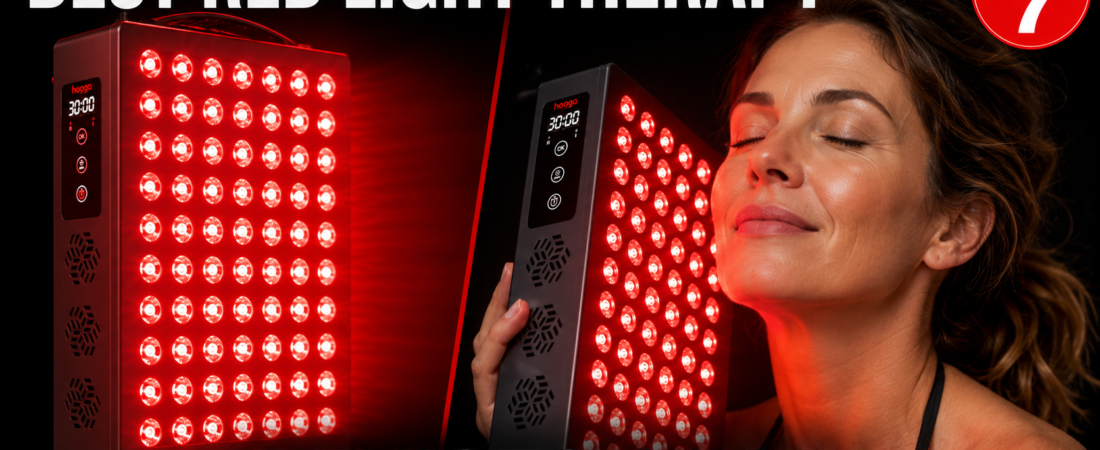
Best for: Adults who want a no-compromise entry into red light therapy without paying premium brand prices. Price: ~$299 Wavelengths: 660nm red + 850nm near-infrared LEDs: 60 dual-chip LEDs Irradiance: 109 mW/cm² at 6 inches EMF: 0 at treatment distance Warranty: 3 years
The PRO300 is the most consistently recommended panel in the $200–$350 range, and the specs explain why. Sixty dual-chip LEDs means each LED contains two separate emitters — one at 660nm, one at 850nm — rather than alternating single-wavelength LEDs. The result is more uniform light distribution and higher irradiance per square inch without needing a larger form factor.
At 109 mW/cm² measured at 6 inches, the PRO300 puts out enough energy for effective sessions in 10–15 minutes. Budget panels with single-chip LEDs often require you to sit within 3 inches for 25 minutes to reach equivalent dosing — a position that’s difficult to hold and leads most people to give up. The PRO300 gives you breathing room.
The panel includes a built-in digital countdown timer, an adjustable tabletop stand, a door-hanging kit, and protective eyewear. Setup takes under five minutes. The flicker-free driver prevents the subtle visual noise that causes headaches during sessions with cheaper panels. Three-year warranty, HSA/FSA eligible.
What we like: ✅ 109 mW/cm² dual-chip irradiance — best in class at this price ✅ Zero EMF at 6-inch treatment distance ✅ 3-year warranty + 60-day trial ✅ Flicker-free driver, silent operation
What could be better: ❌ Coverage area (~9″ x 16″) won’t treat the full back in one session ❌ No app connectivity or brightness control
Bottom line: The best combination of irradiance, dual-wavelength output, and price in its class. If you’re buying your first serious panel and don’t have a specific niche need, start here.
Best for: First-time buyers who want to verify results before committing to a higher-budget panel. Price: ~$149 Wavelengths: 660nm red + 850nm near-infrared LEDs: 60 single-chip LEDs Irradiance: 73 mW/cm² at 6 inches EMF: 0 at treatment distance Warranty: 3 years
The HG300 is the same panel as the PRO300 with one key difference: single-chip rather than dual-chip LEDs. That drops irradiance from 109 to 73 mW/cm² and brings the price down by $150. At 73 mW/cm², the HG300 is still above the functional threshold for skin and recovery work — you’ll need sessions that are 5–7 minutes longer to reach equivalent light doses, but the mechanism is identical.
For someone who wants to establish a consistent routine before spending more, this is the right call. The wavelengths are identical to the PRO300. The warranty is identical. The door-hanging kit and kickstand are included. If after three months you want to upgrade, you’ll know exactly what result you’re chasing and whether a higher-irradiance panel is worth it.
One detail worth noting: the HG300 has a 4.9-star average across 125+ reviews on Amazon, making it one of the most trusted panels in this price tier. Verified reviewers specifically cite joint pain relief and skin improvements with consistent daily use.
What we like: ✅ Same clinical wavelengths as the PRO300 at $150 less ✅ 3-year warranty — unusual for a budget-tier device ✅ Zero EMF at treatment distance, flicker-free ✅ Kickstand + door hook included out of the box
What could be better: ❌ Single-chip LEDs require longer sessions than dual-chip ❌ No digital timer (manual sessions)
Bottom line: The safest entry-level investment in this category. Same technology as the PRO300 at half the price. Buy this if you’re not sure red light therapy is for you yet.
3. CurrentBody Skin LED Face Mask Series 1 — Best for Face & Skin
Best for: Anti-aging protocols, fine lines, skin texture, facial redness, and hands-free daily use. Price: ~$340–$380 Wavelengths: 633nm red + 830nm near-infrared LEDs: 132 LEDs Irradiance: ~30 mW/cm² (contact distance, zero-gap) Warranty: 1 year
Face masks have one major advantage over panels: zero distance. When the device is in direct contact with your skin, light penetration is maximized without any falloff. The CurrentBody Series 1 uses flexible medical-grade silicone that conforms to your face — including the nose bridge, temples, and jawline — rather than leaving the gaps that rigid plastic masks create. Those gaps are not cosmetic problems; they are dead zones where the therapy doesn’t reach.
The 633nm and 830nm wavelengths are among the most studied combinations for collagen stimulation, wrinkle reduction, and skin texture improvement. The auto shut-off at 10 minutes makes it foolproof for daily use. You put it on, lie down, and it turns itself off. For adults over 40 dealing with visible signs of aging — fine lines, uneven skin tone, loss of firmness — this is the most targeted tool on this list.
It does one thing and does it well. It won’t help your back pain or muscle recovery.
What we like: ✅ Flexible silicone conforms to every face shape — no dead zones ✅ 633nm + 830nm — the most clinically validated anti-aging wavelength pair ✅ Hands-free 10-minute sessions with auto shut-off ✅ Proven to deliver visible results in 4 weeks with consistent use
What could be better: ❌ Quality control inconsistency reported across batches — buy with Amazon return window ❌ 1-year warranty is shorter than panel competitors ❌ Face only — doesn’t treat neck or body
Bottom line: The best flexible face mask on the market for pure anti-aging skin work. If red light therapy for the face is your primary goal, this is the device built for it.
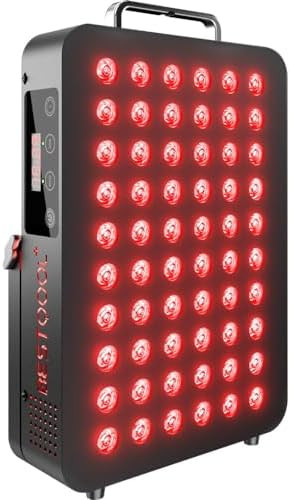
Best for: Buyers who want verified irradiance data and dual-chip output without paying for a name brand. Price: ~$120–$150 Wavelengths: 660nm red + 850nm near-infrared LEDs: 60 dual-chip LEDs Irradiance: 95.6 mW/cm² at 3 inches EMF: 0 at 6 inches Warranty: 1 year
BestQool is a Shenzhen-based manufacturer that built a reputation in a spec-inflated category by doing something unusual: publishing irradiance data that third-party testers have been able to independently verify. One verified Amazon reviewer ran their own wattage measurement and found actual power consumption within 5W of the stated 95W — a level of accuracy that is genuinely rare in this space.
The BQ60 uses dual-chip LEDs at 660nm and 850nm, which puts it in direct competition with the Hooga PRO300 at roughly half the price. The tradeoffs are a shorter warranty (one year vs. three), plastic housing vs. metal build, and lower irradiance at the standard 6-inch distance. The BQ60 performs best used at 3–4 inches rather than 6, which still falls within safe, effective operating range.
For anyone who wants dual-chip performance without the $299 price tag, the BQ60 is the most verifiable budget-premium crossover on this list.
What we like: ✅ Dual-chip 660nm + 850nm at ~$130 — hard to beat on price/performance ✅ Third-party verifiable irradiance data ✅ Zero EMF at 6 inches ✅ Sturdy metal housing despite budget price
What could be better: ❌ 1-year warranty vs. 3 years from Hooga ❌ Best irradiance at 3–4 inches, not standard 6-inch distance ❌ Plastic fan components feel less durable than PRO-tier competitors
Bottom line: The most honest mid-range panel on Amazon. If the Hooga PRO300 is out of budget, this is where to go — with verified specs to back it up.
Best for: Chronic joint pain, muscle recovery, and post-workout inflammation in adults 40+ with lower back, knee, or shoulder issues. Price: ~$179–$219 Wavelengths: 660nm red + 850nm near-infrared LEDs: 60 dual-chip LEDs Irradiance: 130+ mW/cm² at surface EMF: 0 at treatment distance Warranty: 3 years ➡ Check price on Amazon (AS
The KOZE S Series leads with irradiance — 130+ mW/cm² is at the high end of what panels in this size range can achieve — which makes it particularly effective for the use cases where intensity matters most: deep tissue work, joint inflammation, and muscle recovery. Near-infrared at 850nm reaches 2–3 centimeters below the skin surface, deep enough to affect connective tissue and joint capsules.
The S Series includes a digital display timer, adjustable stand, and the option to use red-only, NIR-only, or both simultaneously. This mode flexibility matters for pain-focused protocols: NIR-only at higher intensity is what the evidence base supports for deep joint pain. Being able to isolate that mode without guessing is a practical advantage over panels locked into combined output.
The panel is compact enough for targeted sessions on the knee, shoulder, or lower back and light enough to reposition easily between zones. Three-year warranty at a price that undercuts most competitors with equivalent irradiance.
What we like: ✅ 130+ mW/cm² — highest irradiance in this price range ✅ Selectable modes: Red only, NIR only, or both ✅ Digital display timer with precise session control ✅ 3-year warranty + adjustable stand included
What could be better: ❌ Marketing copy is overpromising — focus on the specs, not the claims ❌ Coverage area suited for spot treatment, not full back ❌ Not third-party tested (specs are manufacturer-stated)
Bottom line: If joint pain and recovery are your primary reason for buying, the KOZE S Series delivers higher irradiance per dollar than most alternatives in this range.
Best for: Users who prioritize independently tested specs and FSA/HSA eligibility over maximum value per dollar. Price: ~$249 Wavelengths: 660nm red + 850nm near-infrared LEDs: 60 LEDs Energy output: 21,720 joules in a 10-minute session (LightLab International certified) Warranty: 2 years
The MitoMIN 2.0 occupies a specific slot: a compact verified panel for people who want third-party lab testing rather than manufacturer-reported specs. It’s one of the few devices under $300 that has been tested by LightLab International — a professional laboratory spectroradiometer test that isolates the actual therapeutic wavelengths emitted, not just total light output. The difference matters because most consumer meters read the full spectrum and inflate the number; LightLab’s methodology matches clinical research standards.
FSA/HSA eligibility is the other differentiator. Devices need to meet specific standards to qualify for pre-tax health account purchases, and for buyers with FSA funds to spend before year-end, this is one of the clearest eligible options in the sub-$300 tier. At 22% tax savings on a $249 purchase, the effective price drops to roughly $194.
Three selectable modes (red only, NIR only, both) allow targeted skin protocols on weekdays and NIR-only recovery sessions after exercise. The whisper-quiet fan keeps LEDs cool enough to extend the rated lifespan to 50,000+ hours.
What we like: ✅ LightLab International third-party certification — not manufacturer self-reported ✅ FSA/HSA eligible — effective price is ~$194 at 22% tax rate ✅ 21,720 joules in 10 minutes — independently verified energy output ✅ 3 selectable modes + whisper-quiet fan
What could be better: ❌ At $249, more expensive than the Hooga PRO300 with comparable irradiance ❌ 2-year warranty vs. Hooga’s 3 years ❌ No dimmer or brightness adjustment
Bottom line: The best choice for buyers who won’t take a brand’s word for its specs. If peace of mind and FSA eligibility matter, this is the one.
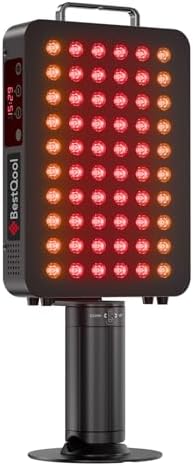
Best for: Buyers who want six wavelengths, a 2026-generation device, and the most versatile setup in the under-$200 tier. Price: ~$140–$170 Wavelengths: 630nm, 660nm, 680nm, 810nm, 850nm, 940nm (6 wavelengths) LEDs: 60 dual-chip LEDs Irradiance: 96.1 mW/cm² at 3 inches EMF: 0 at 6 inches Warranty: 1 year
The BQ60 Pro is the 2026 update to the BQ60 reviewed above, and it changes the value equation significantly by adding six wavelengths rather than two. Most panels in this price range stick to 660nm and 850nm because adding more chips increases cost. The BQ60 Pro includes 630nm (surface collagen), 680nm (wound healing and skin repair), 810nm (additional NIR penetration depth), and 940nm (deep tissue, circulation) on top of the standard pair.
That breadth of spectrum at ~$150 is genuinely unusual. Panels from other brands that offer five or six wavelengths typically cost $400–$700. The trade-off is the same as the BQ60: irradiance peaks at 3 inches rather than 6, and the one-year warranty is shorter than Hooga or Mito Red Light’s standard.
The 2026 model also includes a 3-in-1 multi-functional stand with a 360° rotating panel and a clamp that attaches to beds or desks — making it one of the most flexible setups in this price tier for users who want to do sessions while lying down or at a desk without a dedicated panel wall.
What we like: ✅ 6 wavelengths at ~$150 — widest spectrum in this price range by far ✅ 360° rotating clamp stand — use lying down, at desk, or standing ✅ 4.7-star average with 1,670+ verified reviews on Amazon ✅ Zero EMF at 6 inches
What could be better: ❌ Irradiance peaks at 3 inches, not 6 — requires closer positioning ❌ 1-year warranty ❌ Multi-wavelength claims should be verified by user testing over time
Bottom line: The most versatile device in the under-$200 tier for 2026. If you want to explore a wider spectrum without a four-figure budget, the BQ60 Pro is where to start.
How to Use Red Light Therapy at Home
Buying the device is the easy part. The protocol determines whether it works.
Distance and positioning. For panels, 6 inches is the standard treatment distance. This is where manufacturers measure irradiance and where the evidence base is established. For wands and handheld devices, direct contact or within 1–2 inches. Farther than 12 inches from a panel drops irradiance so significantly that sessions become ineffective.
Session length. 10–20 minutes per treatment zone, three to five times a week. More frequent is not better beyond that threshold. The biological process — photobiomodulation, or light stimulating mitochondrial energy production — has a dose-response curve that plateaus. You are not speeding things up by going longer or more often.
Eye protection is non-negotiable. Red and near-infrared light can cause retinal damage with repeated exposure at close range. Use the protective eyewear included with your device, or close your eyes and face away during NIR-dominant sessions. Standard sunglasses are not a substitute — they do not block NIR.
Skin results timeline. Most users notice improved skin texture and hydration within two to three weeks. Meaningful changes to fine lines and pigmentation take four to eight weeks of consistent use. Firming effects visible to others typically show up at three months or beyond. If you stop at week two because nothing looks different, you are stopping before the mechanism has had time to work.
Pain and recovery timeline. Acute muscle soreness can respond within one to two sessions. Chronic joint issues — arthritis, tendinitis, recurring back pain — require consistent use over four to six weeks before meaningful improvement is typical. Pre-workout use prepares tissue. Post-workout use reduces delayed-onset muscle soreness. For chronic pain, evening sessions tend to work best because anti-inflammatory effects compound with rest.
Frequently Asked Questions
Is red light therapy safe for home use? Yes, when used as directed. The main risks are eye exposure (always use protective eyewear or close eyes) and overuse on sensitive skin. No UV light is involved, so there is no tanning or burning risk. People with photosensitive conditions or on photosensitizing medications should consult a doctor before starting.
How long does it take to see results? For skin: noticeable texture improvement in two to three weeks, more visible anti-aging results at six to eight weeks with daily use. For pain and recovery: acute soreness responds faster, often within a session or two. Chronic joint pain typically requires four to six weeks of consistent use before meaningful improvement.
What is the difference between red light and near-infrared light? Red light (630–660nm) is visible and targets the outer layers of skin. It drives collagen production, reduces surface inflammation, and improves skin tone. Near-infrared (810–850nm) is invisible to the naked eye and penetrates deeper — reaching muscles, joints, and connective tissue. It is the primary wavelength for pain relief, circulation, and deep recovery. Most quality devices deliver both simultaneously.
Can I use red light therapy every day? Yes. Most protocols call for daily sessions of 10–20 minutes per treatment zone. Unlike some skin treatments, red light therapy has no recovery time and does not cause photosensitivity. Daily use is appropriate and often produces faster results than three-times-a-week protocols.
Are cheap red light therapy devices worth it? Some are, most are not. The key is whether the brand publishes verified irradiance data at a stated distance. Devices that market themselves on LED count or total wattage without publishing mW/cm² figures are hiding a performance gap. The BestQool BQ60 and Hooga HG300 on this list are examples of budget devices that publish — and can verify — their numbers.
Is red light therapy good for joint pain? The evidence base is promising. Multiple clinical studies on near-infrared photobiomodulation show statistically significant reductions in pain and inflammation markers for conditions including knee osteoarthritis, lower back pain, and rheumatoid arthritis. The effect is not instant and is not a replacement for medical treatment of serious conditions. At-home devices deliver the same wavelengths used in clinical studies at lower power output — results take longer but the mechanism is identical.
Do I need goggles every time? For face-up sessions and any time the device is pointed toward your eyes, yes. For sessions on the back, legs, or body parts where your eyes are not in the light path, looking away or closing your eyes is sufficient. The protective eyewear included with most panels is designed for this purpose.
Which Red Light Therapy Device Should You Buy?
Here is the short version, by use case:
If you want the best overall panel with no specific constraints → Hooga PRO300 at ~$299. Best irradiance per dollar in the category.
If you’re under $150 and want to test red light therapy before committing → Hooga HG300 at ~$149. Same wavelengths as the PRO300, longer sessions required.
If your goal is anti-aging and skin → CurrentBody LED Face Mask Series 1 at ~$370. The best flexible face mask for daily anti-aging protocols.
If you want dual-chip performance under $150 → BestQool BQ60 at ~$130. Independently verifiable specs at half the price of premium brands.
If chronic pain is your primary reason for buying → KOZE S Series at ~$199. Highest irradiance in this size class, three selectable modes.
If you won’t take a brand’s word for it and want lab-certified specs + FSA/HSA eligibility → MitoMIN 2.0 at ~$249. LightLab International certified.
If you want the widest spectrum for 2026 at under $170 → BestQool BQ60 Pro. Six wavelengths, 1,670+ verified reviews, 360° adjustable stand.
One final note: no device on this list will produce results without consistent use. Three sessions one week and zero the next is how most people conclude that red light therapy “doesn’t work.” The protocol — 10–20 minutes, three to five times per week, for at least four to six weeks — is what the research is built on. The device matters. The consistency matters more.