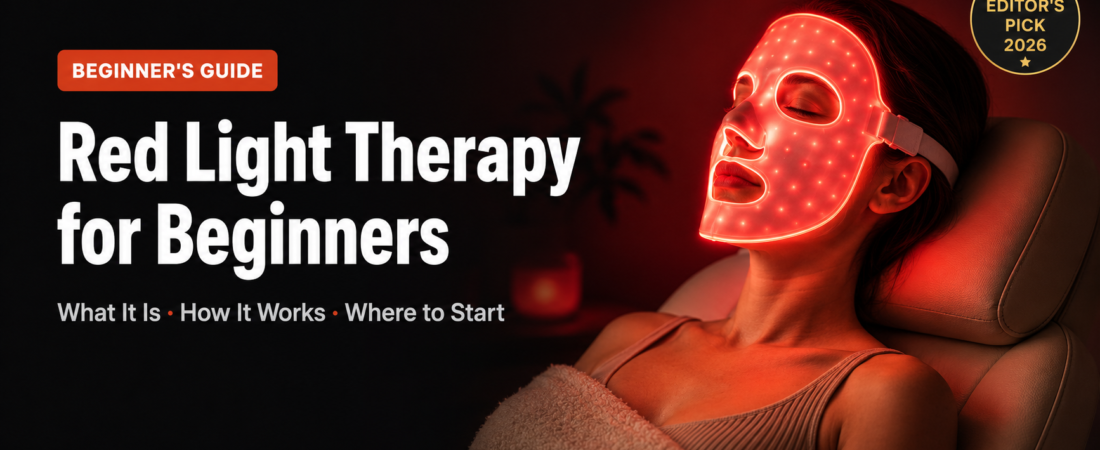
Red Light Therapy for Beginners: Everything You Need to Know
Spread the love
Red light therapy has gone from clinical obscurity to one of the most searched wellness topics of 2026. Dermatologists use it post-procedure. Athletes use it for recovery. Skincare obsessives use it instead of — or alongside — their most expensive serums. And now you’re wondering if it’s actually worth the hype, or just another expensive gadget that will collect dust after two weeks.
This guide is for people at the very beginning of that journey. Not the people who already own three devices and want to optimize their protocol — the people who are still asking the basic questions: What exactly is this? Does it work? Where do I start? What do I actually buy?
We’re going to answer all of it. No jargon, no overselling, no skipping the parts that matter.
Table of Contents
What Is Red Light Therapy, Really?
Red light therapy — also called photobiomodulation (PBM) or low-level light therapy (LLLT) — is the use of specific wavelengths of red and near-infrared light to stimulate biological responses at the cellular level.
That sounds complicated. Here’s the simpler version: your cells absorb light energy and use it to work better. The same way plants use sunlight for photosynthesis, your mitochondria — the energy-producing structures inside your cells — absorb specific wavelengths of red and near-infrared light and convert that energy into more cellular fuel.
The result, across dozens of clinical trials, is measurable: improved collagen production, faster wound healing, reduced inflammation, accelerated muscle recovery, and stimulated hair follicle activity.
What it is not is magic. It’s not heat therapy. It’s not UV. It doesn’t burn, tan, or damage skin. And it doesn’t work overnight.
How Does It Work? The Science in Plain English
Every cell in your body runs on ATP — adenosine triphosphate — the molecule your mitochondria produce from oxygen and nutrients. Think of ATP as the cellular equivalent of charged batteries: when your cells have plenty of it, they repair efficiently, produce collagen readily, and recover from stress quickly. When they don’t, those processes slow down.
Red and near-infrared light at specific wavelengths (630–660nm and 810–850nm) are absorbed by cytochrome c oxidase — a protein complex at the end of your mitochondria’s energy production chain. When this enzyme absorbs the light, it produces more ATP. Cells with more energy available work better, repair faster, and communicate more effectively with surrounding tissue.
The secondary effects are also significant: nitric oxide is released locally, improving microcirculation to treated areas. Reactive oxygen species are temporarily modulated, triggering beneficial adaptive responses. And gene expression shifts — including genes controlling collagen synthesis, inflammation regulation, and cellular repair.
One important nuance that often gets missed in beginner content: the leading explanation for how red light works involves cytochrome c oxidase, which under stress and age can be inhibited by nitric oxide, slowing energy production. Red light therapy may work in part by displacing that inhibition — which is why cells under metabolic stress often respond more noticeably than healthy cells in optimal condition. It’s not a stimulant. It’s a recovery tool.
What Can It Actually Do For You?
Here’s an honest breakdown of what the clinical evidence actually supports for at-home device users.
Skin Anti-Aging and Collagen Production
This is the strongest use case for the devices most people are looking at buying. Clinical trials show participants experienced significant improvement in skin complexion, reduced roughness, less visible fine lines, and a general feeling of healthier skin over several weeks of consistent sessions. The mechanism is direct: red light at 630–660nm stimulates fibroblasts — the cells that manufacture collagen — measurably increasing collagen production within 24 hours of exposure.
The results are real, but gradual. Think improved texture and radiance in weeks 4–6, meaningful fine line reduction by weeks 8–12. Not a facelift — a sustained improvement in skin quality that compounds over months of consistent use.
Hair Loss (Androgenic Alopecia)
An 11-trial meta-analysis found low-level light therapy significantly increased hair density versus sham, in both men and women. Timeline is the catch: plan on 16 weeks or more of consistent use, and know that most trials used dedicated scalp-contact caps. The FDA has cleared multiple devices specifically for this application. If hair loss is your primary goal, this is one of the best-supported applications in the entire field.
Muscle Recovery and Athletic Performance
Pooled randomized-trial data shows red and near-infrared light meaningfully reduces soreness in the days after hard training and speeds the return of strength, while lowering creatine kinase — a blood marker of muscle damage. For athletes or anyone with an active lifestyle, pre- and post-workout sessions targeting trained muscles show consistent results across multiple studies.
Joint Pain and Inflammation
A Cochrane review found low-level light therapy reduced rheumatoid arthritis pain and cut morning stiffness by nearly half an hour. Knee osteoarthritis shows meaningful relief too, best when the light is paired with the movement the joint needs anyway.
Wound Healing and Post-Procedure Recovery
Red light therapy has been included in clinical guidelines since 2020 for certain wound healing applications. Dermatologists increasingly use LED panels post-procedure — after laser treatments, chemical peels, and microneedling — to reduce inflammation, accelerate healing, and improve outcomes. This is one of the most consistently supported medical applications.
What Red Light Therapy Cannot Do
Just as important as what it can do:
It cannot reverse aging overnight — results develop over weeks and months, not sessions
It cannot replace medical care for serious conditions — it’s a wellness tool, not a treatment
It cannot cause fat loss or weight reduction — no credible clinical evidence exists for this claim
It cannot detoxify your body — this claim has no scientific basis whatsoever
It cannot cure cancer, chronic disease, or systemic conditions — if a device claims this, walk away
It cannot compensate for poor skincare, sleep, or nutrition — it works best as part of a consistent health routine, not a shortcut around one
Devices marketing “red light therapy” at 580nm or 700nm are mostly useless — those wavelengths don’t hit the cytochrome c oxidase absorption peaks. If a device doesn’t specify exact wavelengths in nanometers, that is a serious red flag.
Understanding Wavelengths: The Only Spec That Truly Matters
Before you look at price, brand, or LED count, understand this: wavelength determines everything. It controls how deep the light penetrates your skin and which biological processes it can influence.
Red Light: 630–660nm
Penetrates 1–3mm into the skin, primarily affecting the epidermis and superficial dermis. This is the wavelength range with the most clinical evidence for skin anti-aging applications: collagen stimulation, fine line reduction, skin texture improvement, and surface inflammation reduction. If your primary goal is your face and skin, 630–660nm is the foundation.
Near-Infrared (NIR): 810–850nm
Penetrates significantly deeper — 5–10mm — reaching the dermis, subcutaneous tissue, and in some cases underlying muscle. Near-infrared is better suited for deeper structural skin concerns (firmness, laxity), muscle recovery, joint pain, and applications where you need the light to reach tissue below the skin surface.
The Combination Advantage
A proper device includes both wavelengths together — typically in a 1:1 or 1:2 ratio. Devices with only one wavelength miss half the use case. Most quality FDA-cleared LED face masks use both 633nm and 830nm simultaneously for this reason. TheThermoLab
What to Watch Out For
Dose (measured in J/cm²) matters as much as wavelength. The therapeutic range is 3–60 J/cm² — where benefits occur. Too high (above 100 J/cm²) can actually slow healing, following the Arndt-Schulz law. Most clinical studies use 3–10 J/cm² for superficial targets and 10–60 J/cm² for deep tissue. Reputable brands publish this data. Brands that don’t are a warning sign. BestDosage
Types of Red Light Therapy Devices: Which Is Right for You?
Compare all device types by goal, coverage, and ease of use — then find your match below.
Device Type
Best For
Coverage
Ease of Use
Session
Price Range
LED Face Mask Top Pick
Face anti-aging, collagen, skin texture
3–10 min
$150–$470
Handheld Wand Best Entry
Beginners, spot treatment, travel
5–10 min
$60–$200
Full Body Panel
Muscle recovery, joint pain, whole-body
10–20 min
$200–$1,500+
Scalp Cap / Helmet
Hair loss (androgenic alopecia)
15–25 min
$200–$800
Targeted Wrap / Pad
Localized joint or muscle pain
10–20 min
$80–$400
Red Light Mat
Full body skin, recovery, relaxation
15–30 min
$200–$600
Find your device by goal
✨
Face Anti-Aging
→ LED Face Mask
Hands-free, full coverage, 3–10 min
🌱
Just Getting Started
→ Handheld Wand
Low cost, low commitment entry point
💪
Muscle Recovery
→ Panel or Targeted Wrap
NIR 810–850nm, larger coverage area
💇
Hair Loss
→ Scalp Cap / Helmet
FDA cleared for androgenic alopecia
🦵
Joint Pain
→ Targeted Wrap or Panel
NIR penetrates deeper into joints
🧘
Whole Body Wellness
→ Full Body Panel or Mat
Largest coverage, best for daily routines
Ready to choose your first device? See our full tested rankings across all budgets and device types.
FDA Cleared means the device has been reviewed and found substantially equivalent to a legally marketed device with demonstrated safety and efficacy. It is not a guarantee of miraculous results, but it filters out devices that have met no regulatory standard at all. Never buy an at-home red light therapy device that isn’t at minimum FDA Cleared.
Note: “FDA Registered” is not the same thing. It means the manufacturing facility is registered — not that the device has been reviewed or cleared.
2. Specific Wavelengths in nm
The device must state exact wavelengths in nanometers. Acceptable ranges: 630–660nm for red, 810–850nm for near-infrared. Buyers should examine wavelength range, treatment area, and irradiance — not color alone. “Red LED” without an nm value tells you nothing useful. Musculoskeletal Key
3. Irradiance (mW/cm²)
This is the power density — how much light energy hits your skin per unit area. Reputable brands publish this figure. Effective at-home masks typically deliver 30–65 mW/cm². Brands that don’t disclose irradiance should be treated with suspicion.
4. LED Count and Coverage
For full-face treatment, look for at least 100 LEDs with good distribution. For panels targeting larger body areas, look for even LED spacing across the treatment surface.
5. Warranty and Return Policy
Quality devices in this category typically come with 1–2 year warranties. A 30–60 day return window is standard among reputable brands. Be wary of brands with no warranty or no return policy.
How to Use Red Light Therapy at Home: Step-by-Step
Using red light therapy correctly is simple — but the details matter for results.
Step 1: Cleanse your skin thoroughly Start with a completely clean face or body area. Remove all makeup, SPF, oils, and skincare products. Light can’t penetrate fabric or thick skincare products effectively. Always use red light therapy on bare skin for maximum benefit. M.S Skincare
Step 2: Position the device correctly For masks: put it on and ensure close contact with your skin — especially around the cheeks, forehead, and jawline. For wands: begin at the forehead and use slow upward strokes. For panels: position yourself at the manufacturer’s recommended distance, typically 6–12 inches.
Step 3: Set your timer and relax Most FDA-cleared face masks run 3–10 minute auto-timed sessions. For panels and wands, set a timer. Most beginners start with 10–12 minutes and gradually move up to 15–20 minutes. Shorter sessions help your skin and tissues adjust without irritation. Aurora Home Luxury
Step 4: Eyes open or closed? Close your eyes during facial treatments, and use eye protection for face and neck sessions. The light will not damage your eyes the way UV does, but it is bright and can strain them. Many FDA-cleared masks are specifically tested as eye-safe with eyes closed. TrueLight
Step 5: Apply skincare immediately after This is a step most beginners miss — and it matters. Post-treatment, your skin’s absorption is enhanced. Apply your serums, moisturizer, and actives after your session, not before. The combination of red light stimulation and well-absorbed active ingredients compounds results significantly.
Step 6: Protect skin with SPF (morning sessions) If using in the morning, always follow with SPF before sun exposure. Your skin is not more photosensitive after red light therapy — but SPF remains non-negotiable as part of any anti-aging routine.
What to Expect Week by Week
Set your expectations correctly from the start. Think of it like going to the gym: one workout won’t transform your body, but regular sessions absolutely will. M.S Skincare
Weeks 1–2: Getting familiar with the routine. Your skin may feel slightly warmer during and immediately after sessions. Some people notice improved radiance right away — this is real, but subtle. Don’t expect visible changes to fine lines yet.
Weeks 3–4: Consistent rhythm established. Skin texture begins to feel smoother. Some users notice more even tone and a visible glow. Muscle recovery noticeably faster if using for athletic goals. Sleep often improves. TheThermoLab
Weeks 5–8: Visible improvements start appearing — reduced fine lines, more even tone, enhanced radiance. This is where most users start to see the results they were looking for. Friends may notice before you do. Wareable
Weeks 9–12: Continued collagen remodeling. Firming effects become more pronounced. Skin quality meaningfully improved compared to baseline. This is the point where most users decide it’s a permanent part of their routine. TheThermoLab
Month 3 and beyond: Results compound. Collagen remodeling continues. Age spots may begin fading. Maintenance at 2–3 sessions per week sustains results.
Morning vs Evening: When Should You Use It?
Both work. The right time is the time you’ll actually stick to consistently. That said, there are practical considerations:
Morning sessions work well for energy, circulation, and skin prep. The post-session glow pairs well with daytime skincare. Avoid bright sessions immediately before bed if you’re light-sensitive.
Evening sessions support recovery and skin repair overnight. Evening red light exposure (60–90 minutes before bed) may support natural melatonin production. Users typically report improved sleep onset and quality within 7–14 days. Post-session is an ideal time to apply your most active nighttime serums. TheThermoLab
The honest answer: the best time is whenever you will do it consistently. A morning session you skip three times a week is less effective than an evening session you never miss.
Common Beginner Mistakes to Avoid
Using it over skincare products. Any barrier between the LEDs and your bare skin reduces light penetration. Always start clean.
Expecting results in one week. Collagen remodeling takes 4–12 weeks. Stopping after two weeks because you “don’t see anything” is the single most common reason people conclude red light therapy doesn’t work.
Buying a device based on price alone. The cheapest device isn’t always the best value. Look for quality construction, proper wavelengths, adequate power output, and good customer reviews. A well-made device will last for years and deliver consistent results. M.S Skincare
Ignoring wavelength specs. A device that emits light at 580nm instead of 630–660nm will look red but deliver none of the therapeutic wavelengths. Always verify nm values.
Overdoing sessions. More sessions don’t always mean faster results. Overuse can lead to temporary redness or irritation. Stick to recommended timings and avoid back-to-back multiple sessions in a single day. Aurora Home Luxury
Not protecting your eyes. Always close your eyes during facial mask sessions. For high-powered panels, use the goggles provided.
Skipping the post-treatment skincare window. The 5–10 minutes after a red light session are when your skin is most receptive to active ingredients. Don’t waste that window.
Is Red Light Therapy Safe?
Used as directed, red light therapy has a strong safety record. Unlike UV, red and near-infrared light are non-ionizing: at appropriate doses they do not tan, burn, or damage DNA. Most people feel nothing but a little warmth. TrueLight
That said, specific groups should consult a doctor before starting:
Pregnant or breastfeeding individuals — precautionary; insufficient safety data
People taking photosensitizing medications — isotretinoin, certain antibiotics (tetracyclines), St. John’s Wort, some diuretics
Anyone in cancer treatment or with a suspicious skin lesion — do not treat over active cancer sites without medical guidance
People with seizure disorders or photosensitivity conditions — consult a neurologist first
Those who have had recent cosmetic procedures — wait until fully healed
Fitzpatrick Skin Types V–VI — check your specific device’s contraindications and consult a dermatologist
Side effects at recommended doses are rare and mild — typically temporary redness or warmth that resolves within an hour.
Frequently Asked Questions
How long does it take to see results from red light therapy?
Most beginners notice subtle improvements in skin radiance and texture within 2–4 weeks of consistent use. Visible changes in fine lines and firmness typically develop over 8–12 weeks. Hair loss applications require at least 16 weeks of consistent use. The key word is consistent — three sessions a week maintained for three months will outperform daily use for two weeks then abandonment. Collagen remodeling is a biological process. It cannot be rushed.
How often should a beginner use red light therapy?
Start with 3–5 sessions per week, following the protocol recommended by your specific device. For general wellness and skin maintenance, 3x per week is a solid starting point. For targeted goals (specific skin concerns, muscle recovery, hair loss), 4–5x per week will produce faster results. Avoid back-to-back multiple sessions in a single day — more is not always better and can cause temporary irritation.
What should I put on my face before red light therapy?
Nothing. Always use red light therapy on completely clean, bare skin — no makeup, no SPF, no serums, no moisturizer. Any product on your skin creates a barrier that reduces light penetration and therefore reduces results. Apply your skincare routine after your session, not before. The 5–10 minutes post-treatment are when your skin is most receptive to active ingredients — this is the ideal window for serums and actives.
Should I use red light therapy in the morning or at night?
Both work well — the best time is whichever you’ll stick to consistently. Morning sessions support energy, circulation, and skin prep for the day ahead. Evening sessions support skin repair overnight and may support melatonin production — users often report improved sleep onset within 7–14 days of evening sessions. Avoid bright panel sessions in the hour immediately before bed if you’re sensitive to light. For face masks, evening use after removing makeup is a natural fit for most routines.
What’s the best red light therapy device for a beginner?
For beginners focused on skin, we recommend starting with either a quality LED face mask (most efficient for full-face coverage) or a handheld wand (more affordable, good for testing before committing to a mask). The Solawave 4-in-1 Wand is our top beginner pick — FDA Cleared, multi-technology, and budget-friendly at ~$169. For those ready to invest in a mask from day one, the HigherDOSE Red Light Face Mask is our best overall recommendation. Always look for FDA clearance and verified wavelengths before buying anything.
Is red light therapy safe for beginners with sensitive skin?
Yes, for most people. Red and near-infrared light at therapeutic wavelengths are non-ionizing — they don’t burn, tan, or damage skin DNA. The most common side effect is mild temporary warmth that resolves within an hour. If you have sensitive skin, start with shorter sessions (3–5 minutes) and build up gradually. Monitor your skin’s response after each session. If you’re on photosensitizing medications, have a photosensitivity condition, or have had recent cosmetic procedures, consult a dermatologist before starting.
Can I use red light therapy with retinol or vitamin C?
Yes — and done correctly, the combination is more effective than either alone. The sequence matters: always do red light therapy first on bare skin, then apply actives afterward. Retinol, vitamin C serums, hyaluronic acid, and peptides all absorb better into post-treatment skin. Do not apply retinol or other actives before your session — particularly retinol and acids, which can increase photosensitivity. If you use tretinoin (prescription retinol), consult your dermatologist about the correct protocol.
Do I need eye protection during red light therapy?
For most FDA-cleared face masks, closing your eyes during the session is sufficient — these devices are specifically tested for eye safety at their output levels. For high-powered panels or devices used at close range, wear the goggles provided. Red and near-infrared light won’t damage your eyes the way UV does, but direct exposure to bright LEDs can cause discomfort and strain with repeated sessions. When in doubt, close your eyes or use protection — there’s no benefit to staring at the device.