Viconor Red Light Therapy Lamp Review 2026: Is This $89 Stand Worth It?
Spread the love
The Viconor red light therapy lamp review begins with a simple question that most buyers in this category are asking: can a $89 device with a stand actually deliver meaningful therapeutic value, or does the low price reflect compromises that make the whole thing pointless?
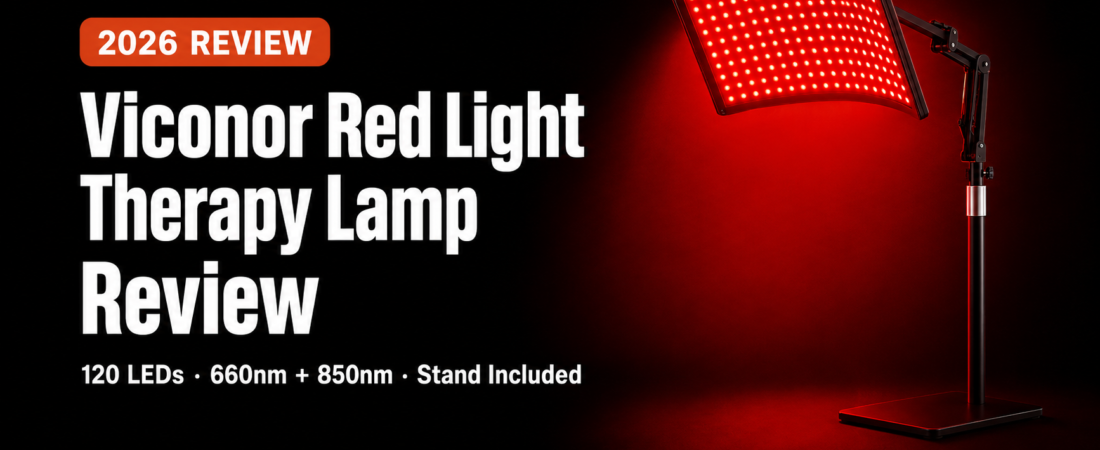
The Viconor is one of the more visible entry-level lamp-with-stand options on Amazon, featuring 120 LEDs emitting 660nm red light and 850nm infrared light for deep tissue penetration, with a curved adjustable design that allows for targeted full-body or facial treatments. It has held a 4.5-star rating across its reviews and recorded 50+ purchases in the past month — modest volume, but consistent enough to warrant a serious look.
This review breaks down what the device actually delivers, where it performs well, and where the honest limitations are.
Table of Contents
At a Glance: Viconor Lamp Specs
Viconor Red Light Therapy Lamp — Full Specs
Confirmed specs from Amazon listing and manufacturer data.
ASIN
B0C699MQZT
LED count
120 LED positions (3-chip design: 1×660nm + 2×850nm per chip)
Wavelengths
660nm Red (visible) · 850nm NIR (invisible)
Panel design
Curved surface · concentrates light toward treatment area
Stand
Adjustable height · wheels for room-to-room mobility
Controls
Remote timer included
Eye protection
Protective glasses included
Mounting options
Stand (included) · can also be hung independently
Session time
10 minutes (recommended per session)
Best for
Face, neck, back, shoulders, legs · pain relief · skin care
The Viconor is a lamp-style red light therapy device — not a panel you mount on the wall, not a wearable mask, but a freestanding unit on an adjustable stand with wheels that you position in front of you during sessions. The form factor sits between a compact desktop panel and a full-size floor panel, which defines both its advantages and its limitations.
Each LED contains 1 visible 660nm red light and 2 invisible 850nm infrared lights, giving 120 total LED positions with a 3-in-1 chip design — meaning each physical chip emits at both therapeutic wavelengths simultaneously. Total LED count across the three-chip configuration is therefore effectively 360 individual emitters (120 positions × 3 chips), though marketed as 120 LEDs in the conventional sense.
The curved panel surface is the device’s primary design differentiator. The curved design concentrates light for maximum efficacy, suitable for full-body and facial treatments. Rather than a flat panel that emits light at a single angle, the curved surface focuses light from multiple angles toward the treatment area — an approach that reduces the dead zones that flat panels can create when the treatment area is not perfectly perpendicular to the panel surface.
The stand includes wheels for room-to-room mobility, adjustable height, and the ability to tilt and angle the lamp head toward the specific body area being treated. The stand also includes protective glasses and a remote timer.
The Technology: Wavelengths and What They Do
660nm Red Light
The 660nm wavelength sits at the upper end of the primary red light therapeutic range. It is absorbed efficiently by cytochrome c oxidase in the mitochondria of dermal fibroblasts — the cells that produce collagen and elastin — at a penetration depth of approximately 8–10mm into the skin. This is the wavelength with the strongest evidence base for skin anti-aging applications: collagen stimulation, fine line reduction, and improvement in skin texture and tone.
For panel-style devices used at a treatment distance of 6–12 inches, the 660nm wavelength is also the primary driver of surface-level skin benefits during body treatment sessions — reaching the dermis of the back, chest, legs, and arms with each session.
850nm Near-Infrared
The 850nm infrared light penetrates 30–50mm below the skin surface, reaching muscles, joints, fascia, and connective tissue. This wavelength is not visible to the naked eye but is physically present and biologically active. At this depth, the same cytochrome c oxidase mechanism operates in muscle cells, joint tissue, and connective structures — supporting ATP production, reducing inflammatory cytokine expression, and facilitating tissue repair processes.
The combination of 660nm and 850nm in each LED chip means every position on the curved panel delivers both surface-level skin benefits and deeper tissue effects simultaneously. This dual-wavelength configuration penetrates and causes thermal effects to increase tissue temperature, promote blood circulation, enhance metabolism, and improve cell vitality.
Design and Build: What You Actually Get
The Curved Panel
The curved panel is 120 LEDs arranged on a concave surface — think of it as a gentle bowl shape rather than a flat rectangle. This concentrates the light source and, according to the manufacturer, doubles the effective coverage. Whether that specific claim holds up to independent measurement is not verified, but the physics are sound: a curved emitter illuminates a target zone from multiple angles simultaneously, reducing the falloff that occurs at the edges of flat panels.
The panel is small relative to many competitors — appropriate for targeted face, neck, and localised body treatment, but not for covering the full torso in a single session.
The Adjustable Stand with Wheels
The stand is the device’s most practical feature for home use. Height adjustment lets you position the panel at face level when seated, chest level when standing, or aimed at lower body areas when lying on a mat. The wheels allow seamless room-to-room movement — from the bedroom to the living room without disassembly.
The honest caveat on the stand: some users report that the stand can be unstable and prone to tipping, particularly at maximum height extension. This is a known issue in the category — freestanding lamp-style devices with small footprints are inherently less stable than wall-mounted panels. Users with children or pets in the home should be aware of this and position the device against a wall or in a stable position during sessions.
Build Quality and Controls
The device operates via a remote timer, eliminating the need to reach the panel during sessions. Protective glasses are included — an important safety feature for 850nm NIR, which is invisible and therefore easy to accidentally expose the eyes to.
Build quality is consistent with the price point. The panel and stand are functional without being premium — the combination of wheels, adjustable height, and curved panel at $89 leaves little budget for high-end materials.
Performance: What Users Are Experiencing
Users consistently report smoother skin and less soreness after consistent 10-minute sessions. The specific outcomes mentioned most frequently in reviews:
Skin improvements at 3–6 weeks of consistent use — primarily improved texture, reduced redness, and more even tone. These are the expected outcomes of 660nm red light therapy at adequate irradiance for skin-depth applications.
Pain and soreness relief for the back, shoulders, and neck — the most common body areas where users apply the lamp during standing or seated sessions. The 850nm component at therapeutic distance reaches muscle and connective tissue in these areas.
Ease of setup and daily use — multiple reviewers note that the stand and wheels make it practical to integrate into a daily routine without dedicating floor space permanently to the device.
Honest Limitations
The device may not be bright enough for some users’ expectations, and the build quality of the stand and components has mixed reviews.
The key limitation to address clearly: at $89, the Viconor is not publishing irradiance data at treatment distance. Without a published mW/cm² figure at 6 or 12 inches, it is not possible to objectively compare its dose delivery to more expensive panels. The curved design and dual-wavelength chips are genuine engineering choices, but the power output at a given distance is unknown.
This does not mean the device is ineffective — the 660nm and 850nm wavelengths are real, and user-reported outcomes suggest meaningful results at the consistent 10-minute session protocol. It means the device sits in the “likely therapeutic but unverified” category rather than the “independently confirmed therapeutic dose” category of brands like Mito Red.
Protective goggles are not included in all listings — verify before ordering. The B0C699MQZT listing (Ivory Black) specifies goggles are included, but this should be confirmed at purchase.
Who Is the Viconor Best For?
Strong fit:
First-time red light therapy buyers who want a lamp-with-stand format at low cost of entry
Users who want flexibility to treat both face and body without repositioning a wall-mounted panel
Anyone with limited wall space or who rents and cannot mount panels
Users who want a device they can move between rooms easily
Genuine 660nm + 850nm dual-wavelength in each LED chip
Curved panel design concentrates light toward the treatment area
Adjustable stand with wheels — genuinely practical for home use
Compact enough to store when not in use
Remote timer included — no reaching mid-session
Protective glasses included
$89 price point with stand included is competitive
4.5⭐ rating consistent with delivered value
⚠️ Honest limitations:
No published irradiance data at treatment distance
Stand stability concerns at maximum height
120 LEDs is modest — suitable for targeted sessions, not full-body coverage
No third-party certification
Relatively new product with a small review base (8 reviews on B0C699MQZT at time of writing)
Our Verdict: 4.1 / 5
The Viconor red light therapy lamp delivers what its price point promises: a functional, dual-wavelength 660nm/850nm device in a portable stand format that makes daily home use practical without requiring wall mounting or permanent floor space. The curved panel design and wheel-equipped stand are genuine usability advantages over cheaper flat desktop devices.
The limitations are also real: no verified irradiance data, modest LED count, and a stand that requires careful positioning for stability. For users willing to accept those trade-offs in exchange for the lowest-cost-of-entry lamp-with-stand experience, the Viconor is a reasonable starting point.
Watch this overview to see the curved panel design, stand setup, and real-world use before buying.
Frequently asked questions
Common questions about the Viconor red light therapy lamp before buying.
For skin benefits, a distance of 6–12 inches from the panel is generally recommended — close enough to receive adequate irradiance but not so close that the heat becomes uncomfortable. For deeper tissue applications (muscle recovery, joint pain), staying closer to 6 inches delivers more energy per session. The curved design of the Viconor panel allows you to sit slightly off-center and still receive good coverage, which is a practical advantage over flat panels that require more precise perpendicular alignment. Always start a few inches further away in your first sessions to gauge your skin’s response before moving closer.
Usage & protocol
The manufacturer recommends 10-minute sessions, which aligns with the clinical protocols used in most photobiomodulation research for entry-level devices. At 10 minutes per session, 4–5 times per week is a practical frequency for skin and body applications. Do not assume longer sessions produce proportionally better results — red light therapy follows a biphasic dose response, meaning excessive session length at close distance can theoretically inhibit rather than enhance the cellular response. The 10-minute protocol is well within the safe and effective range for most applications at this device’s power level.
Usage & protocol
Yes — the adjustable stand is specifically designed to enable this. Position the lamp at face level for a facial session, then lower the stand to aim at the neck, chest, back, or legs for body treatment. The wheels make repositioning between body areas quick without lifting the device. The panel size means you will need to reposition for different areas rather than treating the full body simultaneously — which is expected at this size and price point. Most users run a dedicated 10-minute session per target area rather than trying to cover everything in one go.
Usage & protocol
At lower to mid height settings the stand is generally stable. The reported stability issues occur primarily at maximum height extension — at full extension the centre of gravity is higher and the footprint feels relatively narrow. Practical recommendations from experienced users: position the stand against a wall at maximum height as a secondary support, keep pets and children away from the device during sessions, and avoid maximum height for the first few uses until you are comfortable with the device’s stability in your specific space. The wheels, while convenient for moving the lamp between rooms, should be locked or positioned against a wall when the lamp is in use.
Safety & stability
Both use 660nm + 850nm dual wavelengths with a stand included at a similar price point. The key differences: the Viconor uses a curved panel design with 120 LED positions and wheels for mobility; the Hooga HG300 uses a flat panel with 60 LEDs and a more established track record with thousands of reviews. The Hooga has more user data behind it, while the Viconor offers the mobility advantage and a higher LED count. Neither publishes independent irradiance data. For users who move between rooms frequently, the Viconor’s wheels are a practical advantage. For users who want a fixed position with more buyer confidence data, the Hooga is the safer choice.
Buying decision
For muscle soreness and pain relief, some users report feeling improvement after just a few consistent sessions — the anti-inflammatory effect of 850nm NIR can be relatively rapid when applied to the target tissue. For skin improvements — texture, tone, fine lines — the timeline follows the collagen remodelling cycle: early radiance improvements at 2–4 weeks, meaningful structural changes at 8–12 weeks of consistent use (4–5 sessions per week, 10 minutes per session). Expecting visible skin anti-aging results in under a month is inconsistent with how photobiomodulation works at the biological level — patience and consistency are the primary drivers of outcome.
Results timeline
Ready to try the Viconor lamp?Check current price and availability on Amazon
⚠️ Affiliate Disclosure: This page contains affiliate links. We may earn a commission at no additional cost to you. Red light therapy devices are not intended to diagnose, prevent, or treat any medical condition. Individual results may vary.