My 10-Minute Morning Skincare Routine with Red Light Therapy (GRWM 2026)
Spread the love
My red light therapy morning routine didn’t start as a “routine” at all — it started as me trying to fit one more thing into a morning that already felt too short. I’d read enough about photobiomodulation to be curious, skeptical about most of the marketing, and genuinely tired of skincare steps that promised a lot and delivered vague results I couldn’t actually see. What changed my mind wasn’t a single dramatic result. It was that ten minutes, done consistently, became the one step in my morning that I never wanted to skip. Here’s exactly what that routine looks like, in the order I do it, and why each step is there.
Table of Contents
Why Mornings, Specifically
I get asked this a lot: doesn’t red light therapy work just as well at night? Mechanically, yes — the skin-level effects of red and near-infrared light don’t change depending on the clock. But timing still shapes how a habit survives contact with real life, and mornings won out for me for a practical reason, not a scientific one. My evenings are unpredictable. Dinner runs late, plans change, and “I’ll do it before bed” quietly becomes “I’ll do it tomorrow.” Mornings, before anyone else in my house is awake, are the one window I actually control.
There’s also a mood argument for morning sessions specifically. Some research on morning near-infrared and red light exposure has linked it to improved alertness and mood, particularly in lower-light months, separate from any skin benefit at all. I noticed that too — the ten minutes became less about the mask and more about a quiet buffer before the day started moving.
The Core Mechanism: What the Light Is Actually Doing
Red and near-infrared light in the 620–850nm range is absorbed by mitochondria in skin cells, which increases ATP production and triggers a cascade of downstream effects — more efficient cellular repair, better circulation to the treated area, and increased signaling for collagen synthesis. Reviews of the photobiomodulation literature describe this as a biphasic dose-response: too little light does very little, an appropriate dose is stimulating, and excessive light can actually blunt the benefit. That’s the reason devices are dosed in short daily sessions rather than long ones — more isn’t automatically better.
Blue light (around 460–465nm) works through a different mechanism, targeting the bacteria associated with breakouts, while amber/yellow light in the 570–590nm range is generally used to calm visible redness and support the skin barrier. A device that offers more than one wavelength isn’t a gimmick if the wavelengths are genuinely different — it just means it’s addressing more than one skin concern.
One honest caveat worth stating plainly: skin-level outcomes from photobiomodulation follow slower timelines than the marketing suggests. Collagen remodeling and barrier repair happen over weeks, governed by cumulative dose and consistency — not by any single session, morning or otherwise. If you’re expecting an overnight transformation, red light therapy is the wrong category of product. If you’re looking for a slow, evidence-backed improvement that rewards showing up daily, it’s a reasonable bet.
The Routine, Step by Step
This is the actual sequence, and the reasoning behind each part of it.
Step 1: Cleanse (30 seconds). I splash with a gentle, fragrance-free cleanser — nothing exfoliating this early. Light penetrates skin more effectively when it isn’t sitting under a layer of overnight oil, sweat, or leftover product, so a clean face isn’t optional here. Pat dry rather than rubbing.
Step 2: A lightweight hydrating serum (1 minute). I apply a thin layer of a hyaluronic acid or peptide serum before the mask, not after. This is a personal preference more than a hard rule — some routines apply serum after light therapy so nothing sits between the LEDs and the skin. I’ve found a thin, fully-absorbed layer doesn’t meaningfully block light, and it means my skin isn’t dry going into a 10-minute session. If you use a serum with retinol or active exfoliants, save that for a different part of your day — those ingredients and direct light exposure aren’t a combination most dermatology sources recommend pairing.
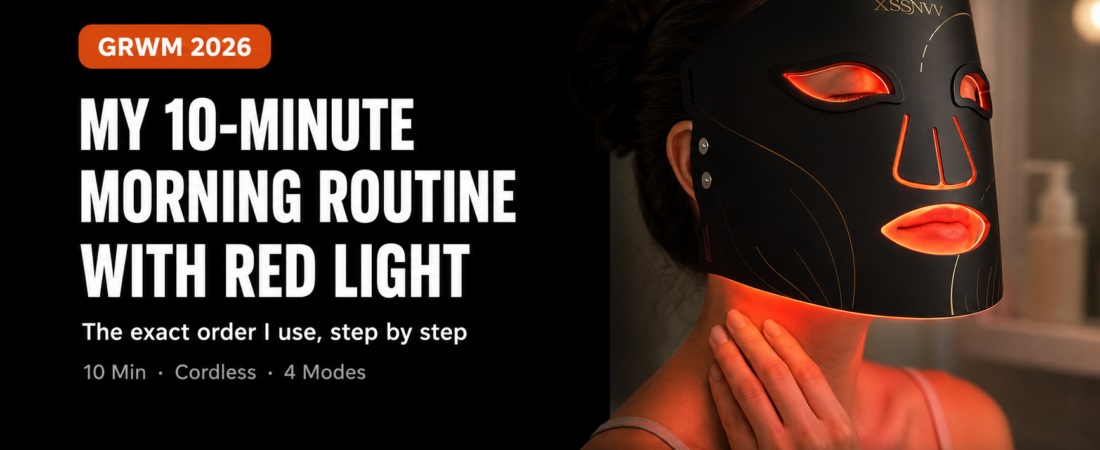
Step 3: The LED mask, 10 minutes. This is the actual “red light therapy morning routine” step everything else is built around. I use the XSSNVV Wireless Red Light Therapy Face Mask, mostly because it’s cordless — no cable tethering me to an outlet while I’m making coffee or half-listening to the news. It runs a built-in 10-minute timer and shuts off on its own, which matters more than it sounds like: I don’t want to be the person checking a phone timer with a mask strapped to my face. It has four settings — Anti-Wrinkle (620nm red + 850nm NIR), Clarifying (460nm blue), Calming (580nm amber), and an All-in-One blend — and I rotate depending on what my skin is doing that week. Most mornings I default to All-in-One. Around a breakout, I’ll switch to Clarifying for a few days.
Step 4: Wait a beat, then moisturizer (30 seconds). I let my skin come back to room temperature for a minute or two after the mask comes off — it’s warm, and pressing a heavy moisturizer straight onto flushed skin doesn’t feel great. Then a normal moisturizer, nothing fancy.
Step 5: SPF, no exceptions (30 seconds). This is the step people skip and shouldn’t. Red and near-infrared light don’t increase UV sensitivity the way some actives do, but that’s irrelevant — SPF is the single most effective anti-aging step in any morning routine, red light or not, and skipping it undercuts everything else you just did.
Total time, cleanse to SPF: about ten minutes on a normal morning, closer to twelve if I’m being slow about it.
Who This Routine Actually Fits
This isn’t the routine for everyone, and it’s worth being honest about that. It fits people with an actual consistent morning window — if your mornings are the chaotic ones and evenings are calmer, move the light therapy step there instead; the skin-level benefit doesn’t disappear. It fits people prioritizing daily consistency over occasional long sessions, since the evidence favors frequent short exposure over infrequent long ones. It’s a poor fit if you’re using retinoids, benzoyl peroxide, or other photosensitizing actives in the same morning window — space those out from any direct light exposure, and check with a dermatologist if you’re unsure. And it’s not a substitute for sunscreen, prescription treatments, or a dermatologist’s care if you’re managing a diagnosed skin condition — it’s a maintenance habit, not a treatment plan.
What the Research Actually Shows About Timing
I want to be direct about the evidence here rather than oversell it. The photobiomodulation literature is genuinely encouraging on mechanism — increased ATP production, downstream collagen signaling, and anti-inflammatory effects are well documented in cell and animal studies, and some human trials on wound healing and skin texture support real, if modest, effects. Where the evidence is thinner is on morning-versus-evening timing specifically for skin outcomes. Most researchers in this space describe timing as mattering far less than session frequency and cumulative dose — meaning the “morning routine” framing in this article is really a consistency framing wearing a morning costume. Put simply: the best time to do red light therapy is the time you’ll actually keep doing.
The Mask I Use
The XSSNVV LED Face Mask isn’t the most powerful device on the market, and it doesn’t try to be. Its 272 LEDs and 27mW/cm² output sit in a reasonable at-home range, not a clinical-strength one, and I don’t think it’s trying to replace an in-office treatment. What earned it a permanent spot in a routine I’ve kept for months is unglamorous: it’s cordless, it’s light enough (145g) that I forget it’s on my face by minute four, and the built-in timer means the habit requires zero decision-making at 6:45 a.m. That’s the actual bar for a device that has to survive a real morning, not a review unit tested once under ideal conditions.
Building Your Own Version, by Skin Goal
Not everyone’s morning skin goal is the same, so here’s how I’d adjust the routine depending on what you’re working with.
Build Your Morning Routine by Skin Goal
Same 5 steps, same 10 minutes — just a different mask setting and serum focus.
The short version: the order of steps stays identical across every goal — cleanse, light layer, mask, moisturizer, SPF. What changes is which of the mask’s four modes you default to, and how often you rotate in Clarifying versus Anti-Wrinkle.
A Realistic Timeline
Nothing here changed my skin in a week, and I’d be skeptical of anyone who tells you otherwise. Texture and tone shifts became noticeable to me somewhere around the four-to-six week mark of near-daily use, which lines up with what the research on collagen remodeling would predict — this is a slow-build category, not a same-day one. The habit itself was the easier win. Once the mask became part of getting ready rather than an extra task, I stopped having to talk myself into it.
FAQ
Frequently asked questions
Common questions about building a red light therapy morning routine.
Not meaningfully, at the skin level. The collagen-supporting and anti-inflammatory effects of red and near-infrared light are largely timing-agnostic. Morning sessions may offer a secondary alertness or mood benefit for some people, but for skin results specifically, consistency matters far more than the hour you choose.
Science
Both approaches are used. A thin, fully-absorbed hydrating serum before the mask shouldn’t meaningfully block light penetration. If you’d rather be cautious, apply serum immediately after instead. Avoid retinol or exfoliating acids in the same window as direct light exposure.
Usage
Yes. Once your moisturizer has absorbed, SPF and makeup can be applied as normal. Red and near-infrared light don’t increase UV sensitivity, but daily SPF remains essential regardless of your light therapy routine.
Usage
Most people notice texture or tone changes somewhere between four and six weeks of near-daily use, consistent with the slower timelines of collagen remodeling documented in photobiomodulation research. Individual results vary, and consistency matters more than any single session.
Results
For most people, daily 10-minute sessions fall within the ranges studied in photobiomodulation research and are generally considered safe for home use. Those who are pregnant, have a history of skin cancer, or are on photosensitizing medication should check with a healthcare provider first.
Safety
A cordless mask lets you move around while it runs — making coffee, getting dressed, checking a bag — instead of standing still near an outlet. For a routine that has to survive a real weekday morning, that mobility is often the difference between a habit that sticks and one that quietly stops.
Buying Decision
See the mask used in this routineXSSNVV Wireless LED Face Mask, 4 modes, 10-min timer
A red light therapy morning routine isn’t a dramatic overhaul — it’s ten minutes stitched into a sequence you’re probably already doing in some form. Cleanse, treat, light, moisturize, protect. The part that actually matters isn’t the device you choose or the exact minute you use it; it’s whether the routine survives a Tuesday morning when you’re running eight minutes behind. Build it around a window you’ll actually protect, and let the results show up on their own slower timeline.
Red light therapy devices are not intended to diagnose, prevent, or treat any medical condition. Individual results may vary. Consult a healthcare provider before starting any new health regimen.
⚠️ Affiliate Disclosure: This article contains affiliate links. If you purchase through our links, we may earn a commission at no extra cost to you. We only recommend products we have thoroughly researched.