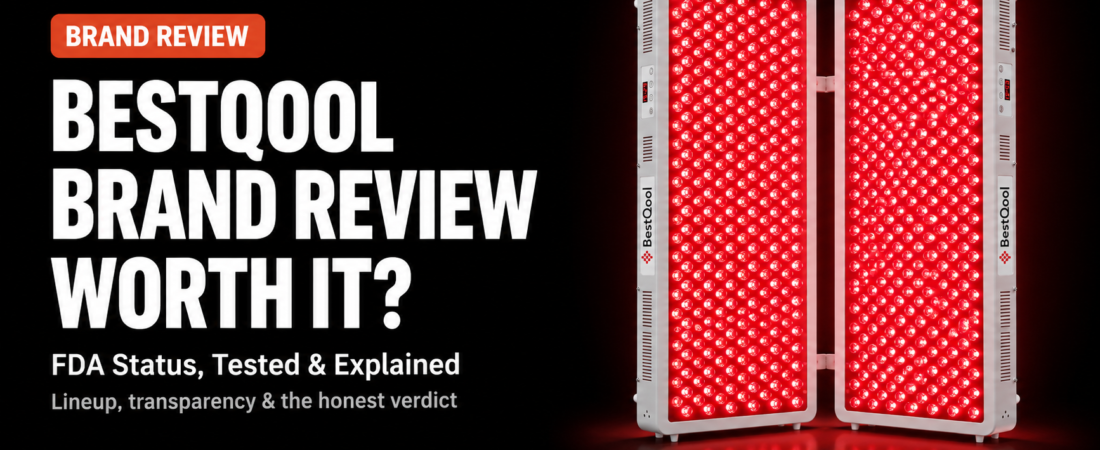
This BestQool review covers a brand whose most interesting characteristic isn’t a product spec — it’s how the company handles a genuinely confusing regulatory topic that trips up nearly every brand in this category: the difference between FDA registration and FDA clearance. Rather than letting that ambiguity sit unaddressed, or worse, letting marketing copy imply more than the regulatory reality supports, BestQool published a detailed blog post explicitly clarifying its own FDA status after a Reddit community raised questions about how those terms appeared on its product pages. That level of public self-correction is rare in this industry, and it’s a useful lens for the rest of this review: a company founded by people with genuine R&D experience in the category, building a tiered product line, that’s also willing to publicly walk back its own marketing language when it gets ahead of the facts.
Table of Contents
Company Overview
BestQool was founded in 2019 by a team the company describes as having more than ten years of combined R&D experience in red light therapy prior to the company’s launch — a specific, checkable claim distinguishing it from brands that entered this category with no prior technical background. BestQool operates as a US and Canada warehouse-based company, positioning its distribution closer to end customers than brands relying solely on overseas fulfillment. The company’s stated mission, per its own “About Us” materials, centers on serving people dealing with fatigue, chronic illness, and emotional exhaustion — a somewhat more clinically-framed positioning than the general wellness or beauty language used by several brands covered earlier in this series. BestQool states its first product launched after “over a year of development” refining red light therapy principles, suggesting a genuine product-development runway rather than a rushed market entry.
Origin Story & Technology Background
BestQool’s founding narrative — a team with pre-existing R&D experience in red light therapy specifically, rather than founders pivoting from an unrelated industry — sets it apart from several brands profiled earlier in this series (Nanoleaf from smart lighting, Wavytalk from hair tools, Aurphany with no disclosed background at all). This matters because it suggests the company’s technical decisions (wavelength selection, irradiance targets, panel architecture) were made by people with direct prior exposure to the category’s engineering challenges, rather than being outsourced entirely to a generic contract manufacturer. BestQool’s own materials describe its devices as manufactured in FDA-registered, RoHS-, ETL-, and CE-approved facilities, and the company shares third-party testing data from LightLab, a US-based independent testing institution — a genuine, named external verification source, distinguishing this from purely brand-internal irradiance claims common at this price tier.
Product Lineup
BestQool organizes its lineup into three clearly differentiated series, each with an explicit, brand-stated use case rather than overlapping, confusingly similar products.
BQ Series is positioned as the entry point for beginners or targeted treatment — smaller, more affordable panels aimed at first-time buyers or people treating specific areas like the face or a single joint, rather than full-body coverage.
Pro Series is BestQool’s maximum-coverage line, including the Pro300 covered in our best red light therapy panels roundup — 300 dual-chip LEDs across four wavelengths (630nm, 660nm, 850nm, 940nm), a published 106mW/cm² irradiance figure at 3 inches, and a splicing design that allows multiple Pro Series panels to connect together for even wider coverage. The company specifically markets this line’s more durable shell and sophisticated internal components as a step up from the BQ Series in build quality, not just size.
Redot Series covers BestQool’s wearable, hands-free category, including the Redot S covered in our best budget devices roundup — advanced 3-chip technology in a portable belt format, positioned for buyers who want to integrate red light therapy into daily activity rather than a dedicated stationary session.
One notable caution worth flagging directly: an earlier BestQool 105W panel model (a different ASIN than the products currently covered on this site) was discontinued mid-production according to prior research — a reminder to always verify a specific listing’s current, active status before purchase rather than assuming every historical BestQool product remains available, a caution that applies broadly across this fast-moving product category, not uniquely to BestQool.
What Makes This Brand Different
BestQool’s clearest differentiator is the combination of its founders’ stated prior category experience with a genuinely transparent, self-correcting approach to regulatory claims. The company’s blog post on FDA terminology is worth quoting the substance of directly: BestQool states plainly that some of its devices “may be FDA Cleared through the 510(k) pathway, but that status applies exclusively to the specific device,” that its relevant manufacturing establishment “is registered with the FDA,” and that these registration records “should not be falsely presented as FDA Clearance or FDA Approval.” Publishing this kind of explicit correction, prompted by community feedback rather than a regulatory enforcement action, is a genuinely uncommon transparency signal in a category where “FDA” language is frequently used loosely to imply more regulatory backing than a product actually has.
The Science / Technology Approach
BestQool consistently uses 660nm red and 850nm near-infrared as its core wavelength pairing, with the Pro Series adding 630nm and 940nm for broader depth coverage — the same wavelength logic covered throughout this site’s reviews, with 660nm working primarily at the skin surface for beauty and skin health, and 850nm penetrating deeper for muscle, joint, and deep tissue effects, per the company’s own stated explanation. BestQool devices are Class II medical devices, 510(k) exempt under 21 CFR § 890.5500 — a specific, citable regulatory classification rather than vague “medical-grade” language. It’s important to be precise here, echoing the company’s own clarification: FDA registration and 510(k) exemption are not the same as FDA clearance, and BestQool’s own public statements confirm the company continues pursuing additional FDA clearances rather than already holding them across its full range.
Clinical Evidence & Expert Endorsements
BestQool doesn’t claim peer-reviewed clinical studies of its own, but it does share third-party testing data from LightLab, a named US-based independent testing institution, providing a real external verification point for its irradiance claims beyond brand-internal assertion alone. This puts BestQool’s evidence tier above brands relying purely on self-reported specs, though below Omnilux’s peer-reviewed academic study volume or Wavytalk’s Intertek-commissioned clinical trial covered earlier in this series. We did not locate named celebrity, dermatologist, or physician endorsements for BestQool specifically, consistent with a company whose marketing emphasizes engineering credentials and regulatory transparency over spokesperson-driven promotion.
Pricing & Value Positioning
BestQool’s three-tier structure mirrors Hooga’s approach in spirit — a clear entry point (BQ Series), a maximum-coverage premium tier (Pro Series, with the Pro300 priced around $719-$749), and a wearable category (Redot Series, with the Redot S priced around $84-$130) — giving buyers a genuine step-up path within one brand. BestQool runs regular promotional periods, including Black Friday discounts historically up to 18%, and its products are explicitly FSA/HSA eligible, a real cost consideration for buyers with either account type, matching the eligibility we noted for the Redot S in our budget roundup.
Reputation & Customer Feedback
BestQool maintains an active Trustpilot presence, where its own review-response materials emphasize high power output, customer service responsiveness, FDA-registered manufacturing, and the LightLab testing data discussed above — a genuinely more structured, multi-point reputation-management approach than smaller brands in this series display. The company’s willingness to publicly address and correct FDA terminology confusion, rather than ignore community pushback, is itself a positive reputation signal worth weighing alongside standard review-score data. As with most mid-tier brands in this category, we didn’t locate extensive independent editorial coverage beyond product review sites and the brand’s own materials, placing BestQool’s reputation evidence closer to Hooga’s pattern (real but not extensively covered by outside press) than to Omnilux’s depth of independent, checkable clinical citation.
Comparison vs Competing Brands
BestQool vs Other Value-Tier Brands
Founding, FDA status, and tier structure compared.
| Brand | Founded | FDA Status | Independent Testing | FSA/HSA | Flagship Price |
|---|---|---|---|---|---|
| BestQoolMOST TRANSPARENT Founders w/ prior R&D experience | 2019 | Registered, Class II exempt | LightLab (named) | Yes | Check price → |
| Hooga Health Value-focused, broad catalog | 2017 | Not disclosed | Self-described “irradiance-tested” | Via TrueMed | Check price → |
| Mito Red Light 3rd-party lab verified | N/A | FDA Class II registered | Independent lab (joules/session) | Yes | Check price → |
Against the field, BestQool’s standout advantage is regulatory transparency specifically — its public FDA terminology clarification is a genuinely uncommon move that most competitors, including several covered elsewhere in this series, haven’t matched. Hooga counters with a broader overall catalog and longer independent reviewer coverage; Mito Red Light counters with stronger independent lab verification specifically tied to irradiance claims rather than general manufacturing registration. BestQool’s tiered BQ/Pro/Redot structure closely parallels Hooga’s HG/PRO/ULTRA approach, making the two brands a natural head-to-head comparison for buyers weighing value-tier panel brands against each other.
Common Misconceptions About This Brand
The most common misconception — one BestQool itself has publicly worked to correct — is conflating “FDA registered” with “FDA cleared.” Registration means the manufacturing establishment is listed with the FDA; clearance means a specific device has gone through the 510(k) review process for specific indications. BestQool’s own products are largely 510(k) exempt Class II devices with FDA-registered manufacturing, which is a real and meaningful regulatory status, but it’s a different (and lower) bar than clearance, and buyers should understand that distinction precisely rather than assuming the strongest possible reading of “FDA” language on any product page. A second misconception is assuming the Pro Series’ splicing/modular design means you need to buy multiple panels to get meaningful coverage — a single Pro300 already offers substantial coverage on its own; the splicing option is for buyers who specifically want to expand beyond that baseline.
Who Should Buy From This Brand
BestQool is a strong fit for buyers who specifically value regulatory transparency and want a brand that’s demonstrated willingness to correct its own marketing claims publicly, buyers who want FSA/HSA eligibility across a tiered product range, and buyers interested in a modular, expandable panel setup via the Pro Series’ splicing design. It also suits buyers who want independent (if not peer-reviewed) testing data behind irradiance claims via the LightLab partnership. It’s a weaker fit for buyers who require actual FDA clearance (not registration) for a specific product, where they should verify clearance status per-device directly with BestQool before purchase, and for buyers prioritizing the single most independently lab-verified panel in the category, where Mito Red Light’s more specifically irradiance-focused independent verification remains the stronger case.
Our Verdict
4.3/5. BestQool earns a strong score primarily on the strength of factors that don’t show up in a typical spec sheet: founders with genuine prior category R&D experience, third-party LightLab testing data, and — most distinctively — a public willingness to correct its own FDA terminology when community feedback identified confusion. Combined with a clearly tiered, FSA/HSA-eligible product range and a modular Pro Series design most competitors don’t offer, BestQool holds up well against Hooga as the closest direct comparison in this value-tier panel category. The main caution, one the company itself would likely endorse communicating clearly: read FDA-related claims on any specific BestQool product carefully, and don’t assume registration equals clearance.
FAQ
Frequently asked questions
Common questions about BestQool and its FDA status.
BestQool’s manufacturing establishment is FDA registered, and its devices are largely Class II, 510(k)-exempt medical devices — a real regulatory status, but distinct from full FDA clearance. BestQool has publicly clarified this distinction itself and states it continues pursuing additional clearances.
SafetyBestQool was founded in 2019 by a team stating more than ten years of combined R&D experience in red light therapy prior to launching the company, giving it a genuine technical background relative to brands entering the category with no prior red light therapy experience.
Buying DecisionBQ Series is the entry point for beginners and targeted treatment. Pro Series offers maximum coverage, higher irradiance, and a modular splicing design for full-body use. Redot Series covers wearable, hands-free devices for on-the-go use.
UsageLightLab is a named, US-based independent testing institution BestQool shares data from to support its irradiance claims. Having a named third-party testing source is a stronger evidence signal than the purely brand-internal claims common among many competitors at this price tier.
ScienceYes, BestQool products are explicitly marketed as FSA/HSA eligible, a genuine cost consideration worth checking against your specific plan before purchase.
UsageThe company states it responded to a discussion in a Reddit red light therapy community where users questioned how FDA-related terms appeared on certain product pages, and updated its public materials to clarify the distinction between registration, listing, 510(k) clearance, and exemption more precisely.
Buying DecisionYes — the Pro Series features a splicing design specifically built to connect multiple panels with a stand, letting you expand treatment area coverage beyond what a single panel provides.
UsageBoth use a similar three-tier product structure and value-focused positioning. BestQool differentiates on named third-party testing (LightLab) and explicit FDA-registered manufacturing status; Hooga differentiates on a longer track record, broader wellness catalog, and coverage from multiple independent credentialed reviewers.
Buying DecisionAn earlier 105W panel model was discontinued mid-production based on prior research. Always verify a specific listing shows as currently active and in-stock before purchasing any older BestQool ASIN you find through a general search.
SafetyFinal Thoughts
BestQool’s case rests less on flashy specs and more on a pattern of transparency that’s genuinely uncommon in this category — real founder R&D credentials, named third-party testing, and a public correction of its own FDA language rather than letting ambiguity work in the brand’s marketing favor. That kind of self-correction is a meaningful trust signal, arguably more valuable long-term than any single spec claim. For the full technical breakdown of BestQool’s individual products, see our panels roundup and budget devices roundup, each featuring a different BestQool product.
Red light therapy devices are not intended to diagnose, prevent, or treat any medical condition. Individual results may vary. Consult a healthcare provider before starting any new health regimen.