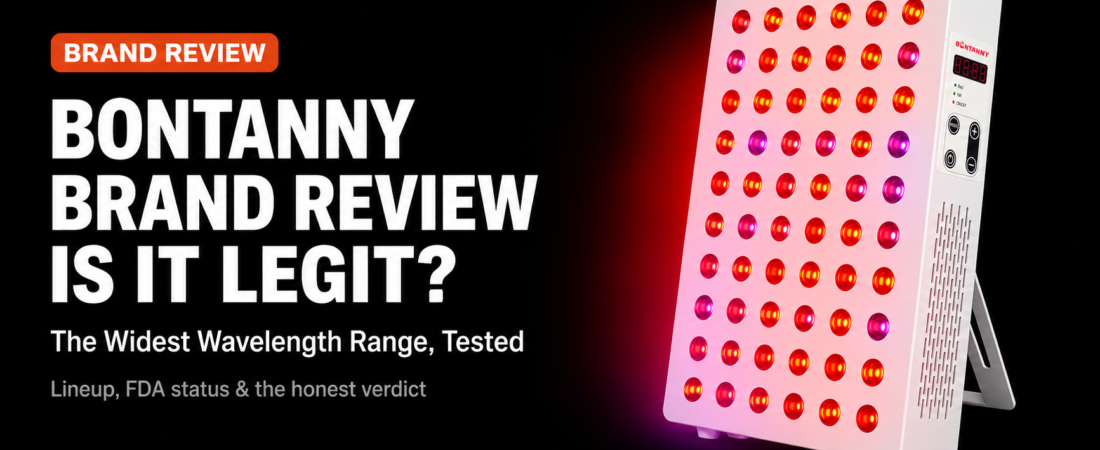
This BONTANNY review covers a brand whose defining characteristic isn’t a single flagship product or a tightly organized tier system — it’s sheer catalog breadth. Where Hooga organizes its lineup into three clean tiers (HG/PRO/ULTRA) and BestQool does the same (BQ/Pro/Redot), BONTANNY sells a genuinely sprawling range of panels spanning 2 to 7 wavelengths, 60 to 300+ LEDs, and portable to full-body sizes, often with overlapping specs and less obvious differentiation between models than its more organized competitors. This review covers what’s actually behind that breadth — a real, FDA-registered Chinese manufacturer with a specific, checkable registration number — and whether the lack of a clean tier structure is a genuine drawback or simply a different, less polished approach to offering choice.
Table of Contents
Company Overview
BONTANNY’s products are manufactured by Shenzhen Bonliter Optoelectronic Co., Ltd., a China-based electronics manufacturer, and the brand operates its own site (bontanny.com) alongside a separate European storefront (bontanny.eu) and Amazon listings, plus distribution through at least one US wholesale reseller (Saksby). This multi-channel, multi-region presence is broader than most brands profiled at this price tier in this series, though it comes without the kind of clear founding narrative or named leadership that brands like Hooga or Mito Red Light provide — BONTANNY’s own “About Us” content is notably thin, largely restating marketing language (“a leading provider of red light therapy solutions”) rather than offering a specific founding date, founder name, or company history. The brand’s stated philosophy — “enhancing wellness through simplicity” — centers on three named proprietary features across its product line: a “Dynamic Electric Stand,” a “Precision Red Light Spectrum,” and “Multi-Intensity Therapy Modes,” suggesting at least some deliberate branding effort around specific technical claims, even without a fuller company backstory to anchor them.
Origin Story & Technology Background
Unlike several brands profiled earlier in this series with documented founder stories (Mito Red Light’s Scott Chaverri, Hooga’s frustration-driven origin), BONTANNY’s public technology narrative is thinner and more product-focused than company-focused. What is verifiable is the brand’s FDA registration: BONTANNY explicitly states its devices carry FDA Registered Class II status under registration number 3021033331 — a specific, checkable number rather than vague “FDA approved” language, which is a genuine positive transparency signal even in the absence of a broader company history. The brand’s marketing makes a notably bold, specific value claim worth quoting directly: devices priced “at a thousand dollar price” are positioned to “enjoy the quality of two or three thousand dollars” — an explicit comparison against premium competitors that, unlike vaguer “professional grade” language, at least invites direct scrutiny against specific price points.
Product Lineup
BONTANNY’s catalog is genuinely the largest, most varied in this brand review series by raw SKU count, though with less clear tiering than competitors like Hooga or BestQool.
BO-300 Series is the brand’s most-reviewed product on this site, available in a 2-wavelength black version (660nm/850nm, 60 dual-chip LEDs) and an upgraded 5-wavelength white version (630nm, 660nm, 810nm, 830nm, 850nm), both covered in our best red light therapy panels roundup and best budget devices roundup — a genuinely feature-dense budget option with remote control and a built-in timer.
Bontanny Pro Max steps up considerably, offering seven wavelengths (480nm blue, plus 630nm, 660nm, 810nm, 830nm, 850nm, and 1060nm — the deepest-penetrating wavelength found across any brand covered in this entire series) with an included mounting bracket, positioned as the brand’s premium tier.
1500W Large Professional 7-Band Panel and the related BO1500/BO2400 full-body panels extend the brand into genuine full-body coverage territory, with the largest version housing 300 dual-chip clinical-grade LEDs across the same broad 7-wavelength spectrum, built with solid metal construction the brand specifically markets as staying cooler and outlasting plastic-bodied competitors.
Bontanny Moving Pro Series and additional portable devices round out the catalog with smaller, targeted-use options at 450nm, 480nm, and 590nm wavelength combinations, plus a BL-2400 professional device sold through wholesale channels.
This breadth — spanning at least 6-7 genuinely distinct product families with overlapping but not identical wavelength combinations — gives buyers substantial choice, but also means comparing BONTANNY products against each other requires more careful spec-reading than the cleaner tier structures Hooga or BestQool offer.
What Makes This Brand Different
BONTANNY’s clearest differentiator is raw wavelength range at accessible prices — the Pro Max’s inclusion of 1060nm alongside 480nm blue light gives it one of the broadest spectral ranges of any panel covered across this entire site, at a price point well below premium competitors like PlatinumLED or Mito Red Light’s top tiers. The brand’s second differentiator is a genuinely aggressive value positioning, explicitly marketing its devices as delivering “two or three thousand dollar” quality at a fraction of that price — a bold claim that, unlike Hooga’s more measured value-brand positioning, invites direct comparison against specific premium price points rather than just general affordability language.
The Science / Technology Approach
BONTANNY’s wavelength selection is genuinely the broadest in this series when the full catalog is considered — from 450nm/480nm blue (targeting acne-causing bacteria and, per some research, circadian and mood applications) through the well-established 630nm/660nm red and 810nm/830nm/850nm near-infrared core, up to 1060nm, a wavelength range with thinner specific consumer-device research than the well-established 660nm/850nm pairing but generally associated in the broader photobiomodulation literature with the deepest tissue penetration available in this wavelength class. The brand’s own educational content correctly attributes different therapeutic associations to different wavelengths (630nm for wrinkles and wound healing, 660nm for pain and inflammation, per their product copy), suggesting a genuine effort to educate rather than simply list numbers, even though — as with most brands at this price tier — these associations aren’t backed by BONTANNY-specific clinical trials.
Clinical Evidence & Expert Endorsements
BONTANNY does not claim independent clinical studies or third-party lab verification of irradiance output, placing its evidence tier alongside most budget-focused brands in this series (similar to XSSNVV or Aurphany) rather than brands like Wavytalk (Intertek study) or Mito Red Light (independent lab-verified output). The one concrete, checkable claim is the FDA Class II registration number discussed above — real, but registration status alone (as BestQool’s own public clarification, covered earlier in this series, makes clear) is a different and lower bar than clinical efficacy evidence or device-specific FDA clearance. We did not locate named expert or dermatologist endorsements for BONTANNY specifically.
Pricing & Value Positioning
BONTANNY’s pricing spans genuinely widely across its sprawling catalog — the BO-300 sits around $89-$130, positioning it as a strong budget-to-mid pick, while the larger BO1500/BO2400 full-body panels and Pro Max command meaningfully higher prices reflecting their expanded LED count and wavelength range, though still generally undercutting premium competitors like PlatinumLED or Mito Red Light’s top tiers at comparable specs. The brand’s wholesale distribution through Saksby adds “no sales tax outside California” and “free lifetime customer support” as specific stated value propositions, a slightly different sales channel than the direct-to-Amazon or direct-to-brand-site model most competitors in this series rely on exclusively.
Reputation & Customer Feedback
BONTANNY’s reputation is concentrated primarily on Amazon and its own site rather than distributed across independent editorial coverage — we did not locate significant independent press or credentialed-reviewer coverage comparable to what we found for Hooga or Mito Red Light. The brand does actively market itself toward specific use-case communities (yoga and fitness practitioners, combat sports athletes via its European site’s “built for champions” messaging), suggesting deliberate niche-marketing efforts beyond generic wellness positioning, even without extensive third-party validation of those specific claims. The 1-year limited warranty offered through wholesale channels is standard for this price tier, shorter than Hooga’s 3-year or Mito Red Light’s 2-year-plus-guarantee commitments covered earlier in this series.
Comparison vs Competing Brands
BONTANNY vs Other Budget-Tier Brands
Wavelength range, organization, and evidence compared.
← Scroll to see all →
Brand
Max Wavelength Range
Tier Structure
FDA Status
Independent Testing
Entry Price
BONTANNYWIDEST RANGEUp to 7 wavelengths incl. 1060nm
Against the field, BONTANNY’s clearest advantage is raw wavelength breadth at accessible prices — no other budget-tier brand in this series offers a 7-wavelength panel including 1060nm at BONTANNY’s price points. Where it loses ground to Hooga and BestQool specifically is organizational clarity — both competitors offer a cleaner, easier-to-navigate tier structure, and both provide either independent testing data (BestQool’s LightLab) or a longer, more independently-covered track record (Hooga) than BONTANNY currently has.
Common Misconceptions About This Brand
The most common misconception is assuming BONTANNY’s large SKU count and wide wavelength range automatically signals more advanced engineering than tightly-tiered competitors — a large catalog with overlapping products can just as easily reflect a less disciplined product strategy as it can reflect genuine innovation, and buyers should evaluate the specific model they’re considering on its own published specs rather than assuming general brand sophistication from catalog size alone. A second misconception is treating the “two or three thousand dollar quality” claim as a verified, independent comparison — it’s a brand-stated marketing claim without independent third-party verification behind it, similar in kind (though more explicit in framing) to the unverified superlative claims common across this price tier.
Who Should Buy From This Brand
BONTANNY is a strong fit for buyers who specifically want the widest available wavelength range at a budget-to-mid price, particularly the deeper 1060nm option most competitors don’t offer at any price tier BONTANNY competes in, and buyers comfortable navigating a less organized catalog to find the specific spec combination they want. It’s a weaker fit for buyers who want a clean, easy-to-understand tier structure for stepping up within one brand, where Hooga or BestQool are more straightforward, and for buyers who specifically prioritize independent testing verification or a longer, more independently-documented reputation, where several other brands in this series currently offer stronger evidence.
Our Verdict
3.8/5. BONTANNY earns a reasonable, if not exceptional, score for offering genuine wavelength breadth — including the deepest-penetrating 1060nm option found anywhere in this brand series — at consistently accessible prices, backed by a real, checkable FDA Class II registration. What holds it back relative to Hooga or BestQool, its closest budget-tier comparisons, is a less organized product catalog, a thinner independent reputation footprint, and marketing claims (like the “$2,000-3,000 quality” comparison) that lean more aggressive than verified. For buyers specifically drawn to its broad wavelength range at accessible prices, it’s a reasonable choice; for buyers who want the cleanest possible brand ecosystem to navigate, Hooga remains the stronger overall pick in this specific price tier.
FAQ
Frequently asked questions
Common questions about BONTANNY and its product lineup.
Yes — BONTANNY states its devices carry FDA Registered Class II status under registration number 3021033331. As with other registered-but-not-necessarily-cleared brands, registration is a real but different (lower) regulatory bar than full FDA clearance.
Safety
The brand offers a genuinely broad, somewhat overlapping catalog spanning 2 to 7 wavelengths and multiple sizes, without the cleaner tier structure competitors like Hooga or BestQool use. Read specs carefully to find the specific model that matches your needs rather than assuming a clear “good/better/best” hierarchy.
Usage
1060nm sits at the deep end of the near-infrared range, generally associated in the broader photobiomodulation literature with the deepest tissue penetration available in this wavelength class. Consumer-device-specific research at this exact wavelength is thinner than for the well-established 660nm/850nm pairing.
Science
It’s a brand-stated marketing claim without independent third-party verification behind it. Treat it as a positioning statement rather than a confirmed, apples-to-apples technical comparison against specific premium products.
Buying Decision
The black version uses two wavelengths (660nm/850nm), while the upgraded white version adds three more (630nm, 810nm, 830nm) for a total of five, offering broader treatment range at a correspondingly higher price.
Usage
Yes — the BO1500 and BO2400 models offer genuine full-body coverage with up to 300 dual-chip LEDs across the brand’s broad wavelength range, built with solid metal construction the brand markets as more durable than plastic-bodied competitors.
Usage
BONTANNY products are manufactured by Shenzhen Bonliter Optoelectronic Co., Ltd., a China-based electronics manufacturer, consistent with the manufacturing origin of many brands covered across this site.
Usage
BONTANNY offers a wider wavelength range, including 1060nm not found in either competitor. Hooga and BestQool both offer a cleaner tier structure and stronger independent evidence — Hooga through broader independent reviewer coverage, BestQool through named third-party LightLab testing.
Buying Decision
See BONTANNY’s BO-300 panel5 wavelengths, remote control, budget-friendly
BONTANNY’s case rests on genuine wavelength breadth and real FDA registration rather than a polished brand narrative or independent testing program — a real, if less refined, value proposition in this category. For buyers specifically drawn to its extended wavelength range, our best red light therapy panels roundup and best budget devices roundup both cover the BO-300 in direct comparison against organized-tier competitors like Hooga and BestQool.
Red light therapy devices are not intended to diagnose, prevent, or treat any medical condition. Individual results may vary. Consult a healthcare provider before starting any new health regimen.