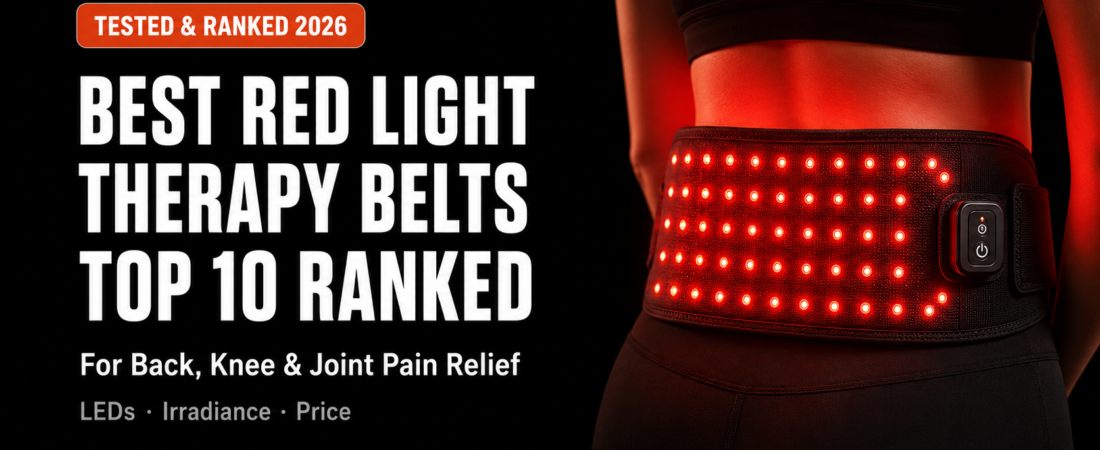
Best Red Light Therapy Belts & Wraps for Pain Relief 2026: Top 10 Ranked
Spread the love
Finding the best red light therapy belts means navigating a category built almost entirely around one core promise: hands-free, wrap-and-go treatment you can wear while doing something else. That’s the whole point of a belt over a panel — you can sit at a desk, watch TV, or move around the house while red and near-infrared light works on your lower back, waist, or a stiff joint. For this ranking, we evaluated belts across price and feature tiers, weighting published irradiance and LED density heavily, while also accounting for genuinely useful extras — vibration massage, heat, pulse modes — that separate the more capable belts from simple LED wraps.
Every belt here has an active, verifiable Amazon listing and uses at least the two most research-backed wavelengths (660nm red, 850nm near-infrared), several with additional wavelengths layered on top. We weighted published irradiance and total LED/chip count heavily, since belts operate in direct or near-direct skin contact — a different use case than panels, where distance matters more. We also gave real credit to brands offering FSA/HSA eligibility, since that’s a genuine cost consideration many buyers overlook, and to established brands with longer independent track records (iRestore, Hooga, LifePro) alongside newer entrants making a specific technical case for themselves (MEGELIN’s exceptionally high LED density, for instance).
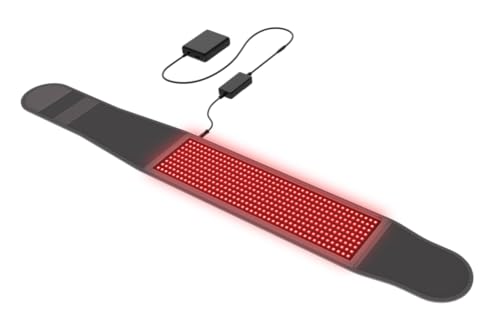
MEGELIN’s TheraLux earns the top spot on raw technical spec strength: 450 triple-chip LED modules housing 1,350 total light-emitting cores — the highest LED density on this list by a wide margin — paired with a published 100 mW/cm² irradiance figure and six distinct wavelengths for multi-depth tissue penetration. At 51.2″x7.1″, it’s sized for genuine multi-purpose use across the back, waist, and larger body areas, and its price sits comfortably in the mid-tier despite outspecifying belts costing considerably more. The honest caveat: as with panels, more wavelengths beyond the core 660nm/850nm pairing adds modest additional depth-penetration variety rather than a proportional increase in benefit, and MEGELIN is a newer brand without the longer independent track record of iRestore or Hooga.
Best for: Buyers who want the strongest raw technical specs (LED density, published irradiance, wavelength count) in the category.
Pros:
Highest LED density on this list (1,350 total light cores)
Published 100 mW/cm² irradiance — a real, disclosed number
Six wavelengths for varied tissue-depth coverage
Genuinely large coverage area (51.2″x7.1″)
Cons:
Newer brand with a shorter independent track record
Not FDA-registered or FSA/HSA eligible
Marginal benefit of wavelengths beyond the core two is less established in research
iRestore built its reputation in hair-growth devices before expanding into skincare masks and now body recovery, and the Flex Belt carries that longer company history into a genuinely well-specced product: 315 medical-grade LEDs combining 660nm red, 850nm near-infrared, and 590nm amber wavelengths, FDA registration, and backing from a company with 600,000+ customers across its device lineup. The cordless design runs on a 6000mAh battery for multiple sessions per charge, and the amber wavelength addition — less common in belt-format devices — specifically targets redness and tone alongside the pain-relief mechanism of the other two wavelengths. Compared to MEGELIN above, iRestore trades peak LED density for a longer, more independently verified brand track record and FDA registration.
Best for: Buyers who prioritize an established brand with FDA registration and a long independent track record over maximum raw LED count.
Pros:
FDA-registered, backed by a company with 600,000+ customers
Triple-wavelength design including less-common amber (590nm)
Cordless with a large 6000mAh battery for multiple sessions
12-month warranty, extendable to 3 years
Cons:
Not waterproof — requires careful cleaning around the light panel
Fewer total LEDs (315) than MEGELIN or LTW
Premium pricing relative to simpler belts on this list
Hooga’s belt carries the same brand transparency that made its HG300 panel a top pick in our panels roundup: a published 70 mW/cm² irradiance figure, 405 dual-chip LEDs (810 total diodes), and — its standout feature — a 15,000mAh rechargeable battery delivering up to 150 minutes of continuous use per charge, the longest battery life on this list by a significant margin. Three modes (Red, NIR, or combined), adjustable brightness (20–100%), and a 10Hz pulse option round out a genuinely well-built belt backed by Hooga’s 1-year warranty and 60-day return window.
Best for: Buyers who want the longest battery life between charges and a trusted brand with published irradiance transparency.
Pros:
Published irradiance (70 mW/cm²) — a real, disclosed number
Exceptional battery life (150 minutes continuous per charge)
Adjustable brightness and 10Hz pulse mode
Backed by Hooga’s established brand reputation and warranty
Cons:
No vibration or heat feature, unlike Medisana or LTW
Mid-to-premium price relative to simpler belts
Fixed 1:1 wavelength ratio offers less customization than multi-wavelength options
Medisana takes a genuinely different approach than most belts on this list by combining three distinct comfort mechanisms in one device: 186 LED beads delivering 660nm/850nm light, plus three vibration intensity levels and heat — a combination that addresses both the slower photobiomodulation effect and the immediate comfort of heat and massage in a single session. The 5000mAh battery supports cordless use, and three light modes let you adjust the session to your preference. This is the belt to reach for if you want more than light alone — the heat and vibration provide real, if separate, comfort mechanisms that work alongside (not instead of) the light therapy itself.
Best for: Buyers who want heat and vibration massage combined with red light therapy in a single cordless device.
Pros:
Combines light, heat, and vibration in one device
Cordless with a 5000mAh battery
Three vibration levels and three light modes
Genuinely mid-range pricing for a 3-in-1 device
Cons:
Lower LED count (186) than dedicated light-focused belts on this list
Heat and vibration are separate mechanisms from photobiomodulation — don’t confuse comfort for light-therapy dose
LifePro’s AllevaRed stands out for an unusually wide pulsed-light range — up to 1000 Hz, far beyond the 10Hz pulse most competitors on this list offer — alongside 105 triple-LED chip sets delivering 660nm and 850nm wavelengths. It supports wall, USB, or external battery power, includes a 32.5″ extension belt for larger-area fit, and is backed by LifePro’s lifetime warranty, a meaningfully stronger guarantee than the 1-to-3-year warranties typical elsewhere on this list. The remote control display lets you adjust power, brightness, and pulse mode while tracking remaining session time — a small but genuinely useful usability touch.
Best for: Buyers who want to experiment with a wider range of pulsed-light frequencies, or who simply want the reassurance of a lifetime warranty.
Pros:
Unusually wide pulse range (up to 1000 Hz)
Lifetime warranty — the strongest guarantee on this list
Extension belt included for larger-area fit
Remote control with session-time display
Cons:
The specific benefit of very high pulse frequencies (500-1000Hz) is less established in research than lower, more commonly studied frequencies
LTW’s Flagship pairs a high 430-LED count with vibration massage, giving it one of the strongest LED-plus-feature combinations on this list at a genuinely accessible price. The 49.2″x9.1″ wrap covers larger areas comfortably, and the vibration function adds a comfort mechanism most pure-LED belts skip. As with several newer belt brands on this list, LTW doesn’t publish an irradiance figure, so the higher LED count is a reasonable but unverified proxy for output rather than a directly comparable number against belts that do disclose theirs.
Best for: Buyers who want a high LED count and vibration massage without paying premium prices.
Pros:
High LED count (430) at a genuinely accessible price
Vibration massage included
Large coverage area (49.2″x9.1″)
Multiple intensity and vibration level combinations
BestQool’s Redot S is the most accessible FSA/HSA-eligible belt on this list, combining a published 72 mW/cm² irradiance figure with triple-chip 660nm/850nm LEDs at a genuinely low price. At 21.5″x5.0″ and 21W, it’s sized for targeted areas (waist, knee, elbow) rather than full lower-back coverage, which is the tradeoff for its compact, budget-friendly form factor. BestQool’s broader Redot line scales up to medium and large sizes with proportionally more LEDs if you need wider coverage later.
Best for: Budget-conscious buyers who want FSA/HSA eligibility and a real published irradiance figure without paying mid-tier prices.
Pros:
FSA/HSA eligible
Published irradiance (72 mW/cm²) at a low price
Skin-friendly materials suitable for direct-contact use during activity
Scales up to medium/large sizes in the same product line
Cons:
Smaller coverage area (21.5″x5.0″) than most competitors on this list
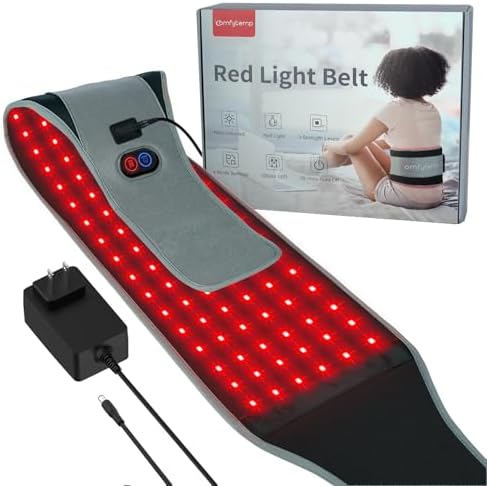
Comfytemp’s cordless massage belt combines 660nm/850nm light with vibration massage in a wearable, battery-powered design, positioned specifically for lower back and waist use. It’s FSA/HSA eligible and priced below most vibration-equipped competitors, making it a reasonable mid-tier pick for buyers who want the massage feature without paying LTW or Medisana’s slightly higher prices. As a company, Comfytemp (manufactured by Shenzhen Yicai Health Technology Co.) has built a growing catalog across belts, pads, and panels, giving it more of a track record than some single-product newcomers on this list.
Best for: Buyers who want cordless vibration massage combined with light therapy at a genuinely mid-tier price.
Pros:
FSA/HSA eligible
Cordless with vibration massage included
Reasonable mid-tier price relative to feature set
Part of a growing, multi-product brand catalog
Cons:
No published irradiance figure
Smaller battery capacity than Hooga’s belt
Fewer LEDs than the higher-LED-count picks on this list
For buyers who don’t need cordless portability, Comfytemp’s corded 126-LED belt undercuts nearly every other option on this list on price while still offering FSA/HSA eligibility, four modes including a 10Hz pulse setting, and a 22″x8″ coverage area at 50″x8″ overall — genuinely functional dimensions for waist, back, or belly use. The 5.9ft cable supports sitting or lying on a couch during sessions, and the tradeoff for the low price is straightforward: no battery, no vibration, and a smaller LED count than the cordless picks above it.
Best for: Budget-conscious buyers who don’t need cordless portability and want the lowest genuinely functional price on this list.
We covered bonodave’s pad in a full standalone review, and it earns its place here as the most affordable entry point on this list — 105 beads with 3 chips each (315 total light points, 1×660nm + 2×850nm per bead) in an elastic-strap wrap design adaptable to back, knee, shoulder, hands, and feet. At roughly $40, it’s less than half the price of the next-cheapest belt on this list, with the tradeoffs covered in depth in our full review: it’s corded only despite marketing suggesting travel use, and its secondary heat effect is milder than some buyers expect.
Best for: Buyers testing whether red light and mild heat therapy works for them before investing in a more capable belt.
Pros:
Lowest price on this list by a wide margin
315 total light points across a flexible, multi-area wrap design
Sound 660nm/850nm wavelength combination
Extended warranty options available
Cons:
Corded only, despite “travel” marketing elsewhere in the brand’s catalog
LED density and published irradiance. As with panels, a disclosed mW/cm² figure (Hooga, BestQool, MEGELIN) is more trustworthy than an undisclosed LED count alone, since higher LED counts don’t automatically translate to proportionally higher output without knowing the driver and chip specifications behind them.
Cordless vs. corded. Cordless belts (Hooga, iRestore, Comfytemp’s massage belt) offer genuine mobility during a session — walking around, doing chores — while corded belts (Comfytemp’s 126-LED, bonodave) are cheaper but tie you to an outlet. Decide based on whether you’ll actually use the mobility or mostly sit still during sessions anyway.
Added features: heat, vibration, pulse range. These are genuinely separate mechanisms from the light therapy itself. Heat provides immediate circulation-related comfort independent of photobiomodulation; vibration adds a massage-adjacent benefit; wider pulse ranges (LifePro’s 1000Hz) are less-studied than the standard 10Hz pulse most belts use. None of these make the underlying light therapy “stronger” — they’re complementary comfort mechanisms worth choosing based on personal preference, not treating as upgrades to the core mechanism.
FSA/HSA eligibility. BestQool, Comfytemp, and iRestore (FDA-registered) offer this on this list — a genuine dollar savings worth checking against your specific plan before assuming a non-eligible belt is actually cheaper after tax considerations.
Coverage area and body-part fit. A compact belt (BestQool Redot S, bonodave) suits smaller targeted areas — a knee, an elbow — while a longer wrap (Hooga, MEGELIN, LTW, at 49-52 inches) suits full lower-back or waist coverage more comfortably.
The Most Common Objection: “Do Belts Deliver Enough Light to Actually Work?”
This is a fair question, since belts are generally lower-powered per square inch than dedicated panels, and it’s worth answering honestly. The mechanism is identical to panels — mitochondrial ATP stimulation via 660nm/850nm light — and belts compensate for lower per-LED output with direct or near-direct skin contact, which panels typically don’t offer at the same proximity. Direct contact meaningfully increases the effective dose delivered compared to a panel used several inches away, which is part of why belts remain a legitimate delivery format despite lower raw wattage than large panels. The honest caveat is that belts are generally better suited to smaller, more localized concerns (a knee, lower back) than the kind of large-area, higher-intensity sessions a full-body panel is built for — it’s a format tradeoff, not a fundamentally weaker technology.
Full Specs Comparison
Full Specs: All 10 Belts Compared
Wavelengths, features, and FSA/HSA eligibility side by side.
← Scroll to see all →
Belt
Wavelengths
Extra Features
FSA/HSA
Size
MEGELIN TheraLux
6 wavelengths
None
No
51.2″x7.1″
iRestore Flex Belt
590/660/850nm
None
No (FDA reg.)
Wrap-around, flexible
Hooga Wrap Belt
660/850nm
10Hz pulse
Via TrueMed
52″x7″
Medisana 3-in-1
660/850nm
Heat + vibration
No
Wrap-around
LifePro AllevaRed
660/850nm
Up to 1000Hz pulse
No
49.5″x7.7″ + extension
LTW Flagship
660/850nm
Vibration
No
49.2″x9.1″
BestQool Redot S
660/850nm
None
Yes
21.5″x5.0″
Comfytemp Massage Belt
660/850nm
Vibration
Yes
Wearable wrap
Comfytemp 126-LED
660/850nm
10Hz pulse
Yes
50″x8″
bonodave Pad
660/850nm
Mild heat
No
Elastic strap wrap
A few non-obvious takeaways: the belt with the highest LED density (MEGELIN) isn’t the most expensive on this list — strong specs and accessible pricing aren’t mutually exclusive here. Only three belts (BestQool, Comfytemp, iRestore) offer FSA/HSA eligibility, despite most listings using “wellness” and “therapy” language freely. And battery life varies enormously (Hooga’s 150 minutes vs. others offering far less), a spec worth checking closely if you plan multiple sessions between charges.
How This Fits Into a Broader Recovery Routine
A red light therapy belt is typically one part of a broader pain-management or recovery routine rather than a standalone solution. Many users pair belt sessions with stretching, foam rolling, or a broader panel session for larger-area maintenance — our best red light therapy panels roundup covers that adjacent category in the same depth if you’re building out a fuller at-home setup. For general wavelength background applicable across belts, panels, and masks alike, our wavelengths explainer covers the underlying mechanism in more detail.
FAQ
Frequently asked questions
Common questions about choosing between the best red light therapy belts.
The bonodave pad is our recommendation for testing whether the category works for you at minimal cost. If you’re ready to commit to a more capable belt from the start, BestQool’s Redot S offers FSA/HSA eligibility and published irradiance at a still-accessible price.
Buying Decision
Yes, though the mechanism differs from panels. Belts compensate for generally lower per-LED output with direct or near-direct skin contact, which meaningfully increases effective dose compared to a panel used several inches away. Belts are best suited to smaller, more localized areas rather than large-area, high-intensity sessions.
Science
These are separate comfort mechanisms from the light therapy itself, not upgrades to it. Heat and vibration provide their own independent benefits (circulation, muscle relaxation) alongside the light — choose based on personal preference for the session experience, not because you think they make the light therapy “stronger.”
Usage
BestQool’s Redot S and both Comfytemp belts on this list are explicitly FSA/HSA eligible. iRestore’s Flex Belt is FDA-registered, which typically supports FSA/HSA eligibility through reimbursement, though you should confirm with your specific plan administrator before purchase.
Buying Decision
Immediate warmth and circulation-related comfort can be felt within the first session, especially with heat-equipped belts. The deeper anti-inflammatory photobiomodulation effect follows a slower, cumulative timeline — research on muscle soreness suggests noticeable relief within two to three weeks of consistent use.
Results
It depends on whether you’ll actually use the mobility. If you mostly sit or lie still during sessions anyway, a corded belt like Comfytemp’s 126-LED model delivers the same light therapy at a lower price. If you want to move around the house during treatment, cordless models like Hooga’s or iRestore’s justify their higher price.
Buying Decision
Not necessarily on its own — a disclosed irradiance figure (like Hooga’s or MEGELIN’s) is a more reliable output indicator than LED count alone, since LED count without a known driver and chip specification is a less direct comparison across brands.
Science
Most brands recommend daily sessions of 15-30 minutes, which fall within ranges studied in photobiomodulation research and are generally considered safe. Those who are pregnant, have a pacemaker or other implanted device, or manage a diagnosed medical condition should check with a healthcare provider before starting.
Safety
For lower back specifically, a longer wrap with genuine coverage (Hooga’s 52″, MEGELIN’s 51.2″, or LTW’s 49.2″) fits the lumbar region more comfortably than the shorter, more targeted BestQool Redot S or bonodave pad, which suit smaller joints better.
Buying Decision
See our top overall pickMEGELIN TheraLux Belt — highest LED density, published irradiance
Across all ten, MEGELIN’s TheraLux Belt takes our top spot for its combination of exceptional LED density, published irradiance, and accessible price — a genuinely strong technical package for a newer brand. If an established, FDA-registered brand matters more to you, iRestore’s Flex LED Belt is the more thoroughly vetted choice. If battery life is your priority, Hooga’s belt delivers 150 minutes of continuous use unmatched elsewhere on this list. And if you’re simply testing whether the category works for you at minimal cost, the bonodave pad remains the most accessible entry point, with the honest caveats covered in our full review.
Red light therapy devices are not intended to diagnose, prevent, or treat any medical condition. Individual results may vary. Consult a healthcare provider before starting any new health regimen.
⚠️ Affiliate Disclosure: This article contains affiliate links. If you purchase through our links, we may earn a commission at no extra cost to you. We only recommend products we have thoroughly researched.