This Hooga red light therapy review covers a brand whose entire business model is built around a single, relatable grievance: one of its founders bought a small targeted red light device from a well-known premium brand and was genuinely shocked at the price. That frustration became Hooga Health’s founding mission — deliver effective red light therapy without celebrity endorsements, unnecessary features, or the pricing that comes with either. Hooga has appeared repeatedly across this site’s roundups (its HG300 panel, PRO300 panel, wrap belt, and Dot device are all covered in our panels and belts rankings), and this review steps back to evaluate the company itself: its founding story, its full lineup, its independent review coverage, and one honest limitation worth knowing before you buy.
Table of Contents
Company Overview
Hooga Health was founded in 2017 and is headquartered in New Berlin, Wisconsin, operating as a genuinely US-based wellness company with additional warehouse operations in China to support its international shipping. The company’s name is the English spelling of the Danish word “hygge” — the concept of coziness and comfort — and Hooga’s earliest products before its red light therapy pivot were lifestyle-comfort items: weighted blankets and non-blue-light-emitting reading lights aimed at better sleep. That origin as a broader comfort-and-wellness brand, rather than a company built from day one around photobiomodulation specifically, is a useful piece of context for understanding Hooga’s positioning today: it’s a value-focused wellness company that found red light therapy as a natural extension of its “helping you feel better at home” mission, not a specialized medical device manufacturer.
Origin Story & Technology Background
The company’s own account of its founding is specific and checkable in spirit if not in exact names: one of Hooga’s founders purchased a small, targeted red light therapy device from an established premium brand and was struck by how much it cost relative to what seemed like a straightforward LED product. That experience became the company’s explicit mission statement — deliver effective, affordable red light therapy to “the average person dealing with everyday issues who doesn’t want to pay an arm and a leg.” Hooga has been transparent about the tradeoffs this mission implies: the company states plainly that it doesn’t spend money on celebrity or athlete endorsements, and it avoids adding features to devices purely to justify a higher price tag. This positioning has held consistently as the company expanded — from an initial panel lineup into wearables (belts, wraps), targeted spot-treatment devices (the Dot), and more recently PEMF (pulsed electromagnetic field) therapy and color light therapy products, following a similar “affordable version of an adjacent wellness category” pattern.
Product Lineup
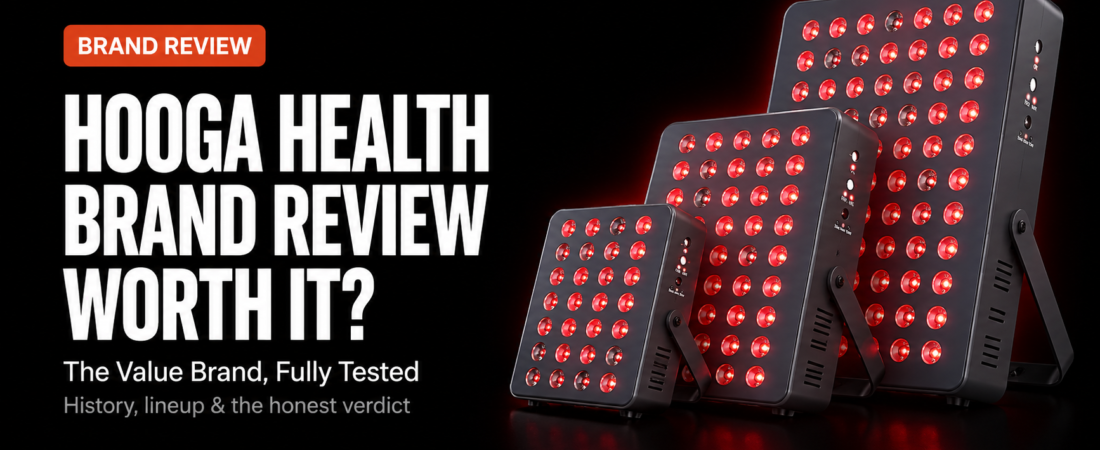
Hooga’s red light therapy lineup is now genuinely extensive, organized into three clear panel tiers plus a range of wearable and targeted devices.
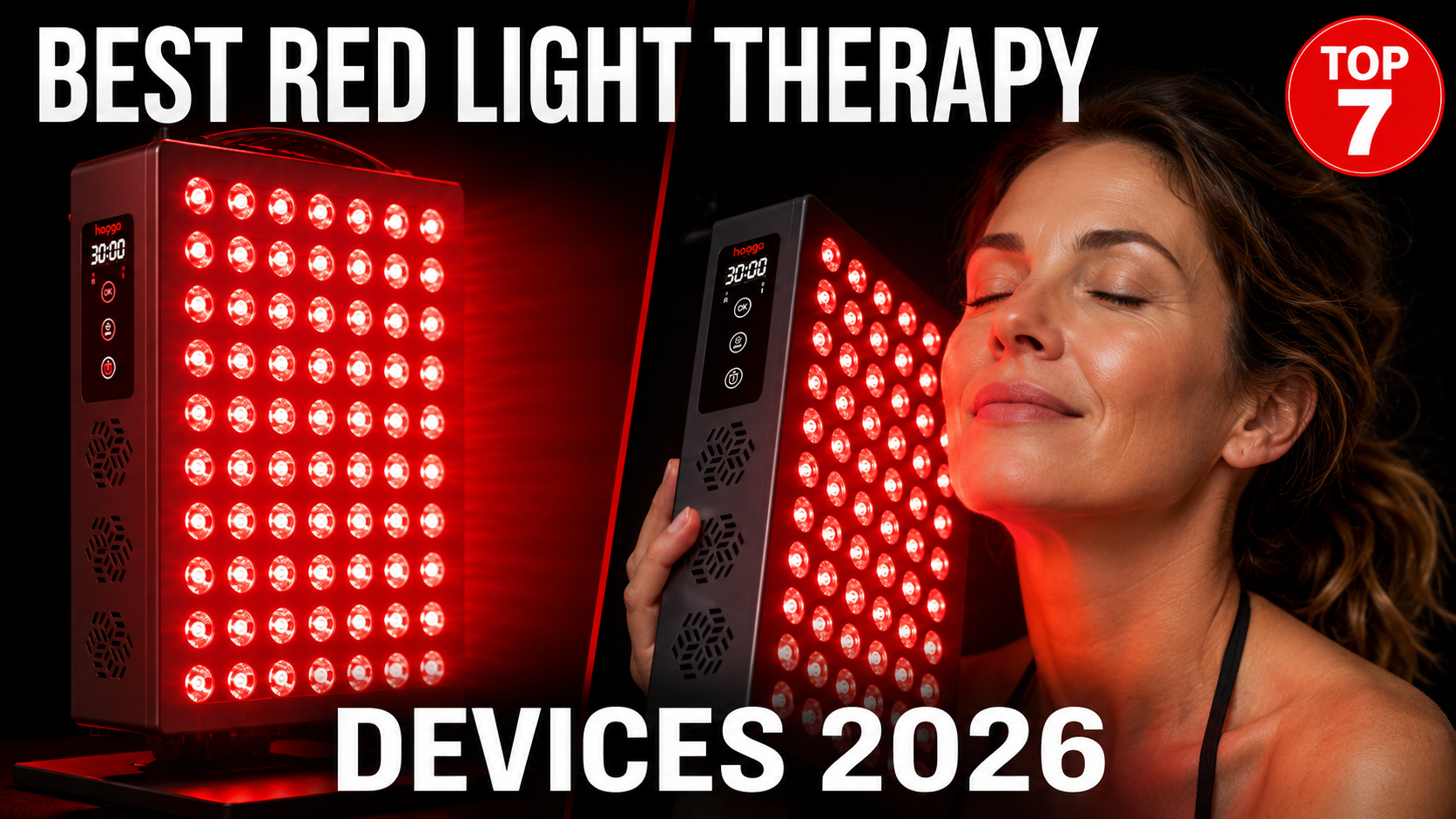
HG Series Panels, including the HG300 covered in our best red light therapy panels roundup, represent Hooga’s entry-level panel tier — single-chip LEDs at 660nm and 850nm, a complete starter kit (stand, protective eyewear, cord), and published irradiance figures, all backed by the company’s standard 3-year warranty.
PRO Series Panels, including the PRO300 also covered in our panels roundup, step up to dual-chip LEDs at the same wavelength pairing, delivering meaningfully higher irradiance at a similar footprint — a genuine, honestly-marketed upgrade path rather than a renamed product at a higher price.
ULTRA Series and Larger Panels, including the PRO4500 and ULTRA4500, scale up to genuine full-body treatment sizes, extending Hooga’s tiered approach to buyers who need to treat large areas in a single session rather than moving a smaller panel between body parts.
Hooga Red Light Therapy Wrap Belt, covered in our best red light therapy belts roundup, brings the same published-irradiance transparency to a wearable format, with an exceptionally long 150-minute battery life that led the category in our ranking.
Hooga Dot, the smallest device in the lineup, is a stick-on, USB-C rechargeable micro-device for targeted spot treatment, also covered in our budget devices roundup.
Beyond red light therapy specifically, Hooga has expanded into PEMF therapy devices, color light therapy products, and blue-light-blocking eyewear and reading lights — a pattern of adjacent-category expansion consistent with the brand’s broader “affordable wellness” positioning rather than a narrow, single-technology focus.
What Makes This Brand Different
Hooga’s clearest differentiator, reinforced across every product tier, is published irradiance transparency combined with genuinely affordable pricing — a combination that’s harder to find than either factor alone in this category. Where many budget brands skip publishing any power output figure and many premium brands charge heavily for the privilege of disclosing one, Hooga discloses irradiance across its panel and belt lineup while remaining priced well below premium competitors like Joovv and PlatinumLED, both of which Hooga is explicitly compared against in independent reviews. The brand’s second differentiator is honesty about its own tier structure: rather than obscuring the difference between its HG and PRO lines, Hooga’s own marketing plainly states the PRO line uses higher-output dual-chip LEDs specifically for buyers who want more power — a level of straightforward internal product differentiation this review has found genuinely uncommon across the budget-to-mid tier of this category.
The Science / Technology Approach
Hooga’s core technology across its panel lineup uses 660nm red and 850nm near-infrared light — the two most heavily research-backed wavelengths referenced throughout this site — delivered via standard LED (not laser) arrays. The company states its hardware has been “independently irradiance-tested,” a claim that, if verified with real third-party lab documentation, would place Hooga in a similar evidence tier to Mito Red Light, the top pick in our panels roundup specifically for its independent verification. It’s worth being direct about one honest limitation here: Hooga devices are not FDA cleared, a gap noted explicitly in independent third-party reviews of the brand. This doesn’t mean the underlying wavelength science is unsound — 660nm and 850nm are well-supported by the broader photobiomodulation literature regardless of any individual brand’s regulatory status — but it does mean Hooga’s evidence case rests on published specs and independent irradiance testing rather than the additional regulatory layer that FDA-cleared competitors like Omnilux or CurrentBody can claim.
Clinical Evidence & Expert Endorsements
Hooga’s evidence case is built primarily around device-level published specifications and independent testing claims rather than clinical trials — a meaningfully different approach than Omnilux’s 40+ peer-reviewed studies or Wavytalk’s Intertek-commissioned study. Where Hooga has earned genuine third-party credibility is through independent editorial review: Cybernews’ health-tech research team conducted a dedicated review of the brand, explicitly comparing it against premium competitors Joovv and PlatinumLED and assessing whether Hooga delivers “medical-grade” claims at a lower price point. Separately, Alex Fergus — an ISSN Sports Nutrition Specialist and fitness professional who has reviewed red light therapy devices for close to a decade — published a detailed independent breakdown of Hooga’s pricing, quality, testing standards, and real-world performance, drawing on both his own testing and a broader community of users. Neither of these represents peer-reviewed clinical evidence, but both represent genuine, named, independent editorial scrutiny of the brand specifically — a stronger signal than most brands in this category receive, even without formal clinical trials backing individual devices.
Pricing & Value Positioning
Hooga’s entire brand identity is built around value pricing relative to the broader category, and this holds up under scrutiny: independent reviewers consistently note that Hooga panels cost significantly less than similarly-sized panels from premium competitors while offering comparable published specs. The HG300 (~$159), PRO300 (~$259-$299), and the belt and Dot products covered elsewhere on this site all sit at or below the median price for their respective device categories, without the corresponding spec sheet looking noticeably weaker than pricier alternatives. This is Hooga’s central, and most defensible, value proposition: you are not obviously trading meaningful hardware capability for the lower price the way you sometimes are with the very cheapest, least-transparent brands in this category.
Reputation & Customer Feedback
Hooga has accumulated a genuinely positive independent reputation across multiple review sources beyond this site. Customer testimonials on the brand’s own site describe a “flawless” purchasing experience and repeat customers who’ve told friends, family, and even patients (in the case of one reviewer identifying as a healthcare provider) about the brand. Independent, non-affiliate reviewers echo this pattern — Alex Fergus’s detailed review, drawing on both personal testing and community feedback gathered over years of covering this category, offers a credible outside validation point beyond the brand’s own marketing. The most consistent critique found across independent sources is the lack of FDA clearance, alongside the observation that Hooga’s newest, most premium product series (“a little costly,” in one reviewer’s words) is moving somewhat further from the brand’s original hyper-affordable positioning as the lineup has grown.
Against the field, Hooga’s clearest advantage is the combination of published irradiance and genuinely lower pricing than premium alternatives like Joovv and PlatinumLED — a value case independent reviewers have specifically validated by making that exact comparison. Where it loses ground to Mito Red Light, our top overall panel pick, is FDA registration and fully independent third-party lab verification rather than the brand’s own irradiance testing claims; where it loses ground to Omnilux is any form of peer-reviewed clinical evidence, a category Hooga doesn’t compete in at all.
Common Misconceptions About This Brand
The most common misconception is assuming “not FDA cleared” means Hooga’s devices are somehow lower quality or less effective than FDA-cleared competitors — regulatory clearance status and underlying wavelength science are related but distinct questions, and Hooga’s 660nm/850nm wavelength selection is identical to the pairing used by many FDA-cleared devices covered elsewhere in this series. A second misconception is assuming Hooga’s low pricing across the board means every product in the lineup is equally basic — the PRO and ULTRA tiers represent genuine engineering upgrades over the entry HG line, not just relabeled versions of the same hardware at a higher price, a distinction the brand’s own marketing is unusually transparent about compared to competitors in this category.
Who Should Buy From This Brand
Hooga is a strong fit for buyers who specifically want published irradiance transparency without paying premium-brand prices, buyers comparing directly against Joovv or PlatinumLED and looking for a genuinely validated lower-cost alternative, and buyers who want a tiered upgrade path (HG to PRO to ULTRA) within one trusted, US-based company as their needs grow. It also suits buyers interested in adjacent wellness categories (PEMF, color therapy, blue-light-blocking products) who want to consolidate purchases with one brand. It’s a weaker fit for buyers who specifically require FDA clearance as a purchase condition, or for buyers prioritizing peer-reviewed clinical evidence over published specs and independent editorial review, where Omnilux remains the stronger case in this brand series.
Our Verdict
4.4/5. Hooga has built a genuinely credible value proposition in this category, backed by a relatable founding story, transparent tiered product engineering, and real independent editorial validation from reviewers who’ve directly compared it against premium competitors. Its main limitation — no FDA clearance — is a real gap relative to brands like Omnilux or CurrentBody, but it hasn’t stopped independent reviewers from recommending the brand specifically for buyers prioritizing value without a corresponding drop in published specs. Across the panels, belts, and targeted devices covered elsewhere on this site, Hooga has consistently ranked among our top picks in its price tier, and this brand-level review confirms that ranking reflects a company with real substance behind its affordability claims.
FAQ
Frequently asked questions
Common questions about Hooga Health and its product lineup.
Yes — Hooga Health was founded in 2017 and is headquartered in New Berlin, Wisconsin, with warehouses in both the US and China to support its now-broad product catalog spanning red light therapy, PEMF, and general wellness products.
Buying Decision
HG uses single-chip LEDs at an accessible entry price. PRO steps up to dual-chip LEDs for higher irradiance at a similar footprint. ULTRA represents the brand’s top tier, including large full-body panels like the ULTRA4500. All three maintain the same core 660nm/850nm wavelength pairing.
Usage
Hooga’s products do not appear to carry FDA clearance across the range, placing the brand alongside most mid-tier competitors rather than the smaller group of FDA-cleared brands like Omnilux or Solawave. The brand does publish specific irradiance figures for several products.
Safety
It’s a deliberate business decision tied to the brand’s founding mission — Hooga states it avoids celebrity and athlete endorsements specifically to keep costs, and therefore prices, lower for customers, rather than passing that marketing expense on through higher device prices.
Buying Decision
The HG300 is the brand’s recommended entry point for first-time buyers, covered in our panels roundup as our top true-budget pick. If you want higher irradiance from the outset, the PRO series is the next step up within the same trusted ecosystem.
Usage
Yes — beyond panels, belts, and micro-devices, Hooga’s broader catalog includes facial masks, blue-light-blocking glasses and reading lights, mounting systems, weighted blankets, grounding/earthing products, and a growing PEMF and color therapy line.
Usage
Hooga states its panels have been irradiance-tested by an outside party rather than only internally. We’d recommend checking the specific testing lab or methodology disclosed on individual product pages before treating this as equivalent to a formal third-party lab certificate, though it’s a stronger transparency claim than most competitors at Hooga’s price point make.
Science
Mito Red Light holds an edge on independently, third-party lab-verified irradiance specifically, which earned it our top overall pick in the panels roundup. Hooga counters with a broader product range across three tiers plus wearables, a longer overall track record, and coverage from multiple independent credentialed reviewers.
Buying Decision
Hooga backs its panel line with a consistent 3-year warranty across the HG, PRO, and ULTRA series — one of the longer warranty periods in this category, applied brand-wide rather than only to a single flagship product.
Usage
See Hooga’s entry-level panelHG300 — complete starter kit, 3-year warranty
Hooga’s story — a founder frustrated by premium pricing, building a company explicitly to fix that — is a genuinely relatable origin in a category often dominated by clinical-sounding brand narratives, and the company has backed that origin story with real, published transparency across a lineup that’s grown considerably since 2017. It’s not the most clinically documented brand in this series, but it may be the most consistently good value, a claim independent reviewers beyond this site have reached the same conclusion on. For the specific devices covered in more depth, see our best red light therapy panels and best red light therapy belts roundups, and for the wavelength science referenced throughout this review, our wavelengths explainer covers the fundamentals.
Red light therapy devices are not intended to diagnose, prevent, or treat any medical condition. Individual results may vary. Consult a healthcare provider before starting any new health regimen.