Red Light Therapy for Hair Growth: What the Science Actually Shows
Spread the love
Hair loss is one of the few areas where red light therapy has not just promising preliminary data but a formal regulatory recognition. Multiple devices are FDA-cleared specifically for androgenetic alopecia. The evidence base includes randomised controlled trials, systematic reviews, and meta-analyses. A 2025 consensus review — covered by NPR in April 2026 — confirmed pattern hair loss at the highest evidence level available for photobiomodulation applications.
That said, FDA clearance and clinical evidence do not mean it works for everyone, or equally across all hair loss conditions. This guide explains what the research supports, what it does not, who is most likely to benefit, and what to realistically expect from a device used at home.
Table of Contents
A Brief History: How This Application Was Discovered
The application of red light therapy to hair growth has an unusually precise origin point. In 1967, Hungarian physician Endre Mester was attempting to test whether laser radiation could cause cancer in mice. Using a low-powered ruby laser, he found no cancer — but he did observe that the shaved mice exposed to the laser grew their hair back significantly faster than controls. The observation was so unexpected that Mester repeated it multiple times before publishing.
That accidental finding launched decades of photobiomodulation research, and hair regeneration remains one of the most robust and well-replicated clinical applications of the field. The mechanism Mester stumbled on is now well understood at the cellular level.
How Red Light Therapy Affects Hair Follicles
Hair follicles are among the most metabolically active structures in the body. Each follicle cycles through phases: anagen (active growth), catagen (regression), and telogen (resting). In androgenetic alopecia — the most common form of hair loss — follicles progressively miniaturise and spend longer periods in the telogen phase, producing finer, shorter hairs until they eventually stop producing hair altogether.
Red and near-infrared light at 630–680nm penetrates the scalp to the depth of the dermal papilla — the cellular structure at the base of each follicle that controls the growth cycle. Hair follicles typically sit 3–5mm below the scalp surface, which is within the penetration range of these wavelengths.
Once absorbed by cytochrome c oxidase in the mitochondria of follicle cells, the photons trigger increased ATP production, which gives follicle cells more energy to maintain anagen phase activity. Simultaneously, photobiomodulation stimulates nitric oxide release, improving scalp microcirculation and nutrient delivery to follicles. It also upregulates growth factors — including fibroblast growth factor — that support the follicle’s transition back into the growth phase.
The net effect, confirmed across multiple trials, is that follicles in the miniaturisation process can be partially reversed: hairs become thicker, grow longer, and the density of hairs in the growth phase increases measurably.
What the Research Shows
The evidence base for red light therapy in hair loss is among the strongest in photobiomodulation, partly because it is relatively easy to measure — hair density, strand thickness, and follicle counts can be precisely quantified over time.
Studies suggest that red light therapy can increase hair growth by 35% to 51% compared with placebo when used over 16 weeks. Wimpole Clinic
A 2017 systematic review and meta-analysis published in the Journal of the American Academy of Dermatology — one of the field’s most rigorous journals — included separate analyses for five non-surgical hair loss treatments and found that low-level laser therapy was superior to placebo in men with androgenetic alopecia, placing it alongside minoxidil and finasteride in the evidence hierarchy for this condition.
The 2025 consensus review synthesised across multiple RCTs confirms pattern hair loss — male and female androgenetic alopecia — responds measurably to red light therapy applied consistently over 16–26 weeks. Stanford Medicine’s February 2025 review lists hair growth as one of the primary dermatology applications for red light therapy. Vacuactivus
A 2026 prospective trial published in Dermatologic Therapy examining 12-month outcomes confirmed that low-level laser therapy enhances mitochondrial function, increases ATP production, stimulates nitric oxide release, and promotes the transition of hair follicles into the anagen phase — with results maintained at the 12-month follow-up.
A 2024 comparative study published in Photodermatology, Photoimmunology & Photomed found that both red and green LED therapies effectively enhanced hair growth, increasing density and thickness over 6 months, with red LED demonstrating superior improvements in specific measures. PubMed
The American Hair Loss Association, in an April 2026 review by dermatologist Aron Nusbaum MD, noted that the evidence supporting LLLT devices is robust, with double-blind, randomised controlled trials demonstrating significant improvements in hair counts in both men and women. American Hair Loss Association
What the evidence does not support
The research is strong for androgenetic alopecia — pattern baldness driven by DHT sensitivity. It is considerably weaker for other hair loss types. Alopecia areata — an autoimmune condition causing patchy loss — has some supporting studies but the evidence is less consistent. Chemotherapy-induced alopecia has emerging data. Scarring alopecias, where follicles are permanently destroyed, are not amenable to any light-based intervention.
The honest framing from the literature is: red light therapy is a clinically validated adjunct for androgenetic alopecia, not a universal hair loss treatment. If the underlying cause of the hair loss is not follicular miniaturisation from hormonal sensitivity, the mechanism that makes PBM effective is not necessarily relevant.
Which Wavelengths Are Most Effective
The optimal wavelengths for hair growth sit in a narrower range than for skin or pain applications.
630–680nm is the primary therapeutic range — this is where the strongest clinical evidence concentrates. It reaches the dermal papilla depth (3–5mm) with sufficient energy to activate cytochrome c oxidase in follicle cells. The majority of FDA-cleared LLLT hair devices operate at 650–670nm.
Near-infrared (810–850nm) penetrates deeper but is less efficiently absorbed by follicle structures at the dermal papilla depth. Some devices include NIR as a secondary wavelength. iRestore’s Elite model uses triple-wavelength technology at 625/655/680nm — all within the primary therapeutic window — rather than adding NIR.
What matters more than hitting exactly 660nm versus 650nm is adequate power delivery to the scalp surface and full coverage — ensuring light reaches follicles across the entire treatment area rather than only directly under individual diodes.
Laser vs LED: Does It Matter?
This distinction causes considerable confusion in the hair growth device market.
Low-level laser therapy (LLLT) uses coherent, collimated light — laser diodes that produce a narrow, focused beam. LED devices produce non-coherent, broader-spectrum light from individual diodes. Early research used laser devices; later studies confirmed that LEDs at the same wavelength and power density produce comparable outcomes.
The American Hair Loss Association notes that while LLLT and LED devices use different light sources, their mechanisms and efficacy differ significantly in some configurations — primarily around power delivery and scalp coverage, not the fundamental mechanism. The practical implication is that LED-based helmets can match laser device outcomes when they deliver adequate irradiance to the scalp. Devices with very low power density — regardless of whether they use lasers or LEDs — are less likely to achieve therapeutic effect. American Hair Loss Association
FDA clearance is the most reliable proxy for whether a specific device has met minimum efficacy thresholds for androgenetic alopecia.
Realistic Timeline and Who Benefits Most
The clinical trials that produce the outcomes above use protocols of 16–26 weeks. This is not a treatment where results appear in weeks — follicle biology operates on a longer timescale.
Months 1–3: Reduced shedding is often the first observable change. This reflects follicles stabilising in the anagen phase rather than entering telogen. New hair growth is occurring but not yet visible above the scalp.
Months 3–6: Visible improvements in density and strand thickness typically appear in this window. The 24-week mark used in many trials corresponds to roughly 6 months.
Months 6–12: Continued improvement in density, with the 12-month prospective trial confirming maintained and progressive results through the full year.
Who benefits most: The use of red light therapy has demonstrated significant improvement in appearance across a wide age range, particularly 30 to 60 years old for skin applications — a similar demographic profile applies to androgenetic alopecia. People with early-to-moderate AGA — where follicles are miniaturising but not yet permanently dormant — respond best. Advanced hair loss with prolonged follicle dormancy shows limited response regardless of device quality. ResearchGate
Consistency is the most important variable. Sessions missed over weeks reset some of the cumulative signalling that drives the follicle cycle shift. The devices that produce results in trials are used on schedule.
What to Look for in a Device
FDA clearance for androgenetic alopecia is the most meaningful specification. It confirms the device has met regulatory standards for safety and effectiveness in this specific application — not just general wellness claims.
Scalp coverage is the second most important factor. Devices that cover only the top of the scalp miss the hairline, temples, and lower crown — areas where androgenetic alopecia is commonly active. Full-dome helmets provide better coverage than laser combs or partial caps.
Wavelength should be in the 630–680nm range, either as laser diodes or LEDs. Power density at the scalp surface (mW/cm²) is more important than the number of diodes listed, though higher diode counts generally correlate with better coverage.
Session time in clinical devices ranges from 12–25 minutes per session, 3–7 times per week depending on the device. Shorter sessions are possible with higher-power devices.
Recommended Devices
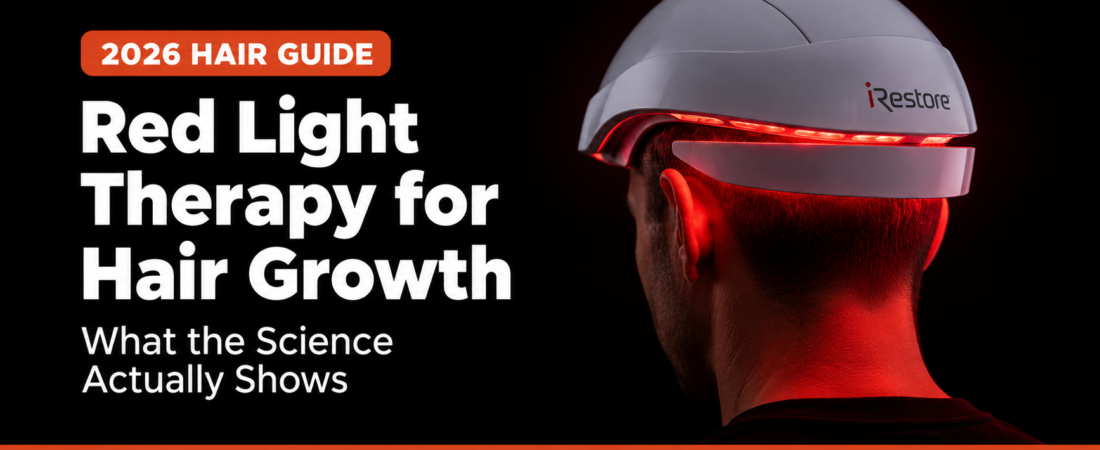
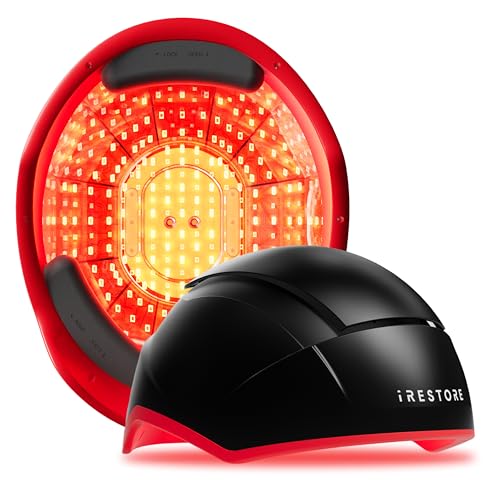
iRestore Elite — 500 lasers and LEDs, triple wavelength (625/655/680nm), 2500mW total power, FDA cleared, full dome coverage including hairline and temples, 12-minute daily sessions
Common questions about red light therapy for hair growth and hair loss.
For androgenetic alopecia — pattern baldness — the evidence is genuinely substantial. A 2017 meta-analysis in the Journal of the American Academy of Dermatology placed low-level laser therapy alongside minoxidil and finasteride in the evidence hierarchy for this condition. Multiple double-blind RCTs have confirmed 35–51% increases in hair growth versus placebo over 16 weeks. The 2025 consensus review confirmed pattern hair loss at the highest evidence level for photobiomodulation applications. Several devices are FDA-cleared for this specific indication — a regulatory hurdle that requires demonstrated safety and effectiveness, not just safety alone. For other types of hair loss, the evidence is thinner and less consistent.
Clinical evidence
The first observable change for most users is reduced shedding within the first 1–3 months — this reflects follicles stabilising in the anagen (growth) phase rather than entering telogen (resting). Visible new growth and measurable density improvements typically appear between months 3–6. The clinical trials that confirm the strongest results use 16–26 week protocols. A 12-month prospective trial confirmed continued and maintained improvement through the full year. Expecting visible regrowth in under 3 months is inconsistent with follicle biology — the hair growth cycle simply does not operate on that timescale.
Results timeline
No — and this distinction is important. The evidence is strongest for androgenetic alopecia (pattern hair loss in men and women), where DHT causes follicle miniaturisation. The mechanism of red light therapy directly addresses follicle miniaturisation by improving cellular energy and growth factor signalling. For alopecia areata (autoimmune patchy loss), the evidence is more limited and inconsistent. For chemotherapy-induced alopecia, there is emerging data but fewer robust trials. For scarring alopecias — where follicles have been permanently destroyed by inflammation or injury — no light-based therapy can restore follicles that no longer exist. If the cause of your hair loss is not androgenetic, consult a dermatologist or trichologist before investing in a device.
Clinical evidence
Yes — and combination approaches are common in clinical practice. Minoxidil works by prolonging the anagen phase and improving blood supply to follicles; finasteride reduces DHT levels; red light therapy improves follicle cellular energy and growth factor production. These are different mechanisms acting on different parts of the same problem, which is why combination therapy often produces additive results. Several studies have specifically examined red light therapy as an adjunct to pharmaceutical treatments and found superior outcomes versus either treatment alone. There are no known contraindications to combining them. iRestore itself notes that their devices may be used alongside minoxidil and supplements.
Usage & protocol
Yes — more so for hair growth devices than for most consumer red light products. FDA clearance for androgenetic alopecia (under the 510(k) pathway) requires the manufacturer to demonstrate safety and effectiveness for that specific indication with clinical data. It is a meaningful regulatory bar, not just a marketing claim. Many LED helmets on Amazon are not FDA-cleared for hair growth — they may carry general wellness claims or clearances for unrelated indications. When a device is specifically cleared for AGA, you have regulatory confirmation that it delivers therapeutic parameters to the scalp at clinically relevant doses. Devices without this clearance may still work, but you are relying on manufacturer claims rather than reviewed evidence.
Device selection
The safety profile of low-level laser and LED therapy for the scalp is well established across decades of clinical use. No trial has reported significant adverse effects from therapeutic-dose red light at 630–680nm applied to the scalp. It does not generate heat at consumer device power levels, does not damage DNA (being non-ionising), and does not interact with melanin in the way UV does. The main precaution is eye protection — laser diodes in particular can cause eye damage if directed at the eyes, which is why properly designed helmets shield the eyes from direct exposure. Standard red light wavelengths used in hair growth devices do not penetrate through the skull to brain tissue at consumer device power densities.
Safety
Ready to start a hair growth protocol?FDA-cleared devices with confirmed clinical evidence