
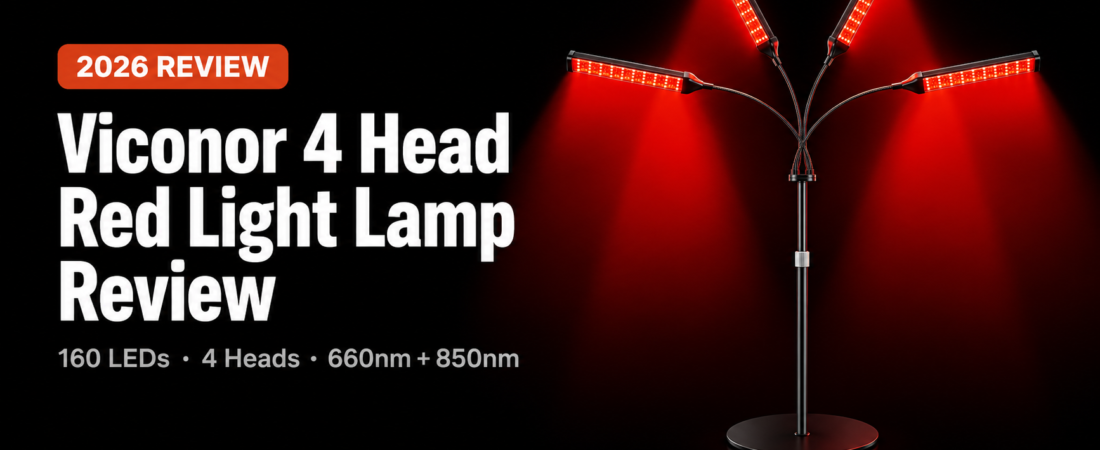
The Viconor 4 head red light therapy lamp review addresses a format that is genuinely uncommon at this price point: four independently adjustable lamp heads on a single stand, all delivering 660nm and 850nm light simultaneously, for under $60. With 160 LEDs across four heads, 5 modes, and 542 verified reviews at a 4.2-star average — with 100+ units purchased in the past month — this device has built a real user base.
The central question is whether four smaller heads covering multiple body areas delivers better practical value than a single larger panel, or whether the multi-head format trades depth for breadth in a way that undermines the therapeutic value. This review breaks down the technology, real-world usability, and who this device genuinely suits.
Table of Contents
At a Glance: Viconor 4 Head Lamp Specs
Viconor 4 Head Red Light Therapy Lamp — Full Specs
Confirmed specs from Amazon listing and manufacturer data.
| ASIN | B0CTCPXZX4 |
| LED count | 160 LED positions (3-chip: 1×660nm + 2×850nm per position) |
| Wavelengths | 660nm Red (visible) · 850nm NIR (invisible) |
| Heads | 4 independently adjustable heads on gooseneck arms |
| Modes | 5 modes · adjustable intensity levels |
| Controls | Wired handheld controller · timer included |
| Base | Weighted round base · adjustable height stand |
| Eye protection | Green protective goggles included |
| Best for | Multi-area body coverage · pain relief · muscle recovery · skin |
| vs single-head model | +40 LEDs · 4x coverage zones · $32 less expensive |
| Irradiance verified | Not published |
| Amazon rating | 4.2 ★ (542 reviews) · 100+ units/month |
| Price | Check current price → |
What Makes the 4-Head Design Different
The most obvious differentiator from standard lamp-style devices is the four-head configuration. Each arm extends from a central stand hub on a flexible gooseneck connection and can be independently angled — pointing outward, downward, or inward — to illuminate different body areas simultaneously.
In practice this means:
- Two heads aimed at the back while two aim at the torso simultaneously
- One head at the face, another at the neck, a third at the chest
- All four converging on the lower back for concentrated treatment of one large area
- Bilateral arm or leg treatment with heads aimed at both sides at once
This is the core value proposition of the 4-head format: coverage flexibility without requiring the user to reposition between body areas. For anyone with chronic pain in multiple locations, or athletes who want to treat multiple muscle groups in a single session, the multi-head format offers a meaningful practical advance over a single panel.
The Technology: Wavelengths and LED Configuration
Each of the 160 LED positions uses a 3-in-1 chip configuration: 1 visible 660nm red light and 2 invisible 850nm infrared lights per position. Total effective emitters across the four heads: 480 individual chips (160 positions × 3 chips).
660nm Red Light — Surface Treatment
At 8–10mm penetration depth, 660nm targets the dermis where fibroblasts produce collagen and elastin. For a lamp-style device used at 6–12 inches, this is the primary wavelength for skin texture, fine line reduction, and surface-level inflammation. Every one of the four heads delivers this wavelength simultaneously.
850nm Near-Infrared — Deep Tissue
At 30–50mm penetration, 850nm reaches muscle, joint capsules, and connective tissue. This is where the 4-head format earns its strongest use case: treating multiple areas of muscle soreness or joint pain simultaneously without repositioning. The NIR channel is present in every LED position across all four heads, making the device genuinely suited for body-wide recovery sessions.
5 Modes — Wired Controller
The wired handheld controller handles timer setting, mode selection, and intensity adjustment. Five modes allow for different wavelength combinations or intensity levels — ranging from lower-intensity maintenance sessions to higher-power recovery modes — without reaching up to the lamp head mid-session.
Design and Build
Four Independently Adjustable Gooseneck Arms
Each arm flexes independently, allowing precise targeting of different body zones before the session begins. The adjustment is manual and locks into position — stable for the duration of the session.
Weighted Round Base
The circular weighted base addresses the tipping concern noted in single-head lamp reviews. With four heads extending outward, the weight is more evenly distributed than with a single offset arm, and the round base adds downward mass that improves stability at height.
Wired Controller
The handheld wired controller is a practical necessity given the power demands of 160 LEDs across four heads. It allows full session control without reaching up to the lamp, which is useful when lying face-down or seated for back and shoulder treatment.
Green Goggles Included
Protective goggles are included — essential for sessions where heads are aimed near the face, since 850nm NIR is invisible and easy to accidentally expose the eyes to.
Performance: What Users Are Experiencing
Across 542 verified reviews, three outcome profiles dominate:
Chronic pain users — back, shoulder, and neck — report the most consistent results. Aiming multiple heads at a large pain area simultaneously delivers more total energy per session than a single head, which is particularly relevant for the 850nm channel where dose to deep tissue is the primary goal.
Athletes and active recovery users — the multi-head format suits post-training recovery sessions targeting multiple muscle groups simultaneously without separate sessions for each area.
Skin and anti-aging users who want face and neck treatment at the same time — one head at the face, another at the neck, creates a combined session that would require repositioning with a single-head device.
Comparison vs Competitors
Viconor 4 Head vs top red light therapy lamps 2026
How the 4-head model compares across coverage, specs, and value.
| Device | LEDs | Heads | Wavelengths | Verified | Rating | Price |
|---|---|---|---|---|---|---|
| Viconor 4 HeadTHIS REVIEW 160 LEDs · 5 modes · wired controller | 160 | 4 | 660 + 850nm | ✗ | 4.2 ★ | Check price → |
| Viconor Single HeadMOST PORTABLE 120 LEDs · curved panel · wheels | 120 | 1 | 660 + 850nm | ✗ | 4.5 ★ | Check price → |
| Hooga HG300 Flat panel · timer · stand | 60 | 1 | 660 + 850nm | ✗ | 4.5 ★ | Check price → |
| Mito Red MitoMIN 2.0VERIFIED Lab tested · FSA/HSA eligible | 60 | 1 | 660 + 850nm | ✓ Lab | 4.5 ★ | Check price → |
| Cholas 5 Head Lamp 5 heads · 5 brightness levels | — | 5 | 660 + 850nm | ✗ | 4.1 ★ | Check price → |
Pros and Cons
✅ What works:
- 160 LEDs across 4 independently adjustable heads
- 660nm + 850nm in every LED position across all heads
- 5 modes with wired controller — no reaching mid-session
- Weighted round base — more stable than single-head models
- Green goggles included
- $57 for 4-head format is strong value
- 542 reviews at 4.2⭐ — sustained across real volume
⚠️ Honest limitations:
- Wired only — no cordless operation
- No published irradiance data at treatment distance
- No third-party certification
- Mode configurations not fully documented by manufacturer
- Each head covers a smaller area than a dedicated panel
- No wheels — not designed for room-to-room mobility
Our Verdict: 4.2 / 5
The Viconor 4 Head lamp earns its position as one of the better-value multi-head red light therapy devices in the entry-level category. The four independently adjustable heads deliver a coverage flexibility that no single panel can match — treating back and shoulders simultaneously, or face and neck in the same session, is a genuine practical advantage that users notice quickly.
The limitations are real but proportionate to the price: no irradiance verification, wired only, smaller effective area per head than a dedicated panel. For the daily home user who wants comprehensive multi-area coverage at under $60, this is one of the most thoughtfully designed options in the lamp-with-stand category.
Frequently asked questions
Common questions about the Viconor 4 head red light therapy lamp before buying.
Each gooseneck arm adjusts independently — set the heads before starting the session rather than during. For back and shoulder treatment, aim two heads at the upper back and two at the lower back or shoulders simultaneously. For face and neck, point one head at the face from 6–8 inches and another at the neck and décolletage. For legs and recovery, spread heads across both thighs, both calves, or alternate between muscle groups. The weighted round base keeps the device stable at most angles — avoid extreme lateral extension at maximum height where the centre of gravity becomes less stable.
Usage & positioningFor skin benefits, a distance of 6–12 inches per head is the recommended range — close enough for adequate irradiance but not so close the heat becomes uncomfortable. For deeper tissue applications (muscle recovery, joint pain), 6 inches delivers more energy per session. Because each head is smaller than a full panel, staying closer to the 6-inch mark is more important here than with larger flat panels. Start at 8–10 inches for your first sessions to gauge skin response, then move closer as needed.
Usage & protocolIt depends entirely on how you plan to use it. The 4-head model wins if you have multiple treatment areas, want to cover more of the body per session, or need face + neck simultaneously. It also has more total LEDs (160 vs 120) and costs $32 less. The single-head model wins if you move the device between rooms frequently — its wheels and more compact form make it easier to reposition throughout the home. For a fixed daily routine in one location treating multiple body areas, the 4-head is the stronger choice. For mobility and simplicity, the single-head is better.
Buying decisionViconor does not publish a detailed breakdown of each mode’s wavelength combination or intensity setting. Based on user reports and the wired controller design, the 5 modes appear to offer different intensity levels (from low maintenance to high recovery output) and potentially different wavelength activation patterns (red only, NIR only, or combined). The controller also handles timer settings independently of mode selection. For most users, starting on a middle mode and adjusting based on comfort is the practical approach — the mode system is straightforward to navigate even without detailed documentation.
Usage & modesFor muscle soreness and pain relief, some improvement is often felt within a few consistent sessions — the anti-inflammatory effect of 850nm NIR on muscle tissue can be relatively rapid. For skin improvements — texture, tone, fine lines — the timeline follows the collagen remodelling cycle: early radiance at 2–4 weeks, meaningful structural changes at 8–12 weeks with consistent use (4–5 sessions per week, 10 minutes per target area). Consistency is the primary driver — irregular sessions do not allow the cumulative cellular signalling required for structural skin change to accumulate.
Results timelineThe 660nm red light is visible and the eyes naturally respond to it — but the 850nm NIR is invisible and the eyes do not instinctively protect themselves from it, which is why the green goggles included with the device are important for any session where heads are aimed near the face. Always wear the goggles during facial or neck sessions. For body applications where the heads are aimed at the back, legs, or torso with no head aimed at the face, goggles are less critical but remain a good habit. Never look directly into the LED heads at close range, especially during NIR-active modes.
Safety