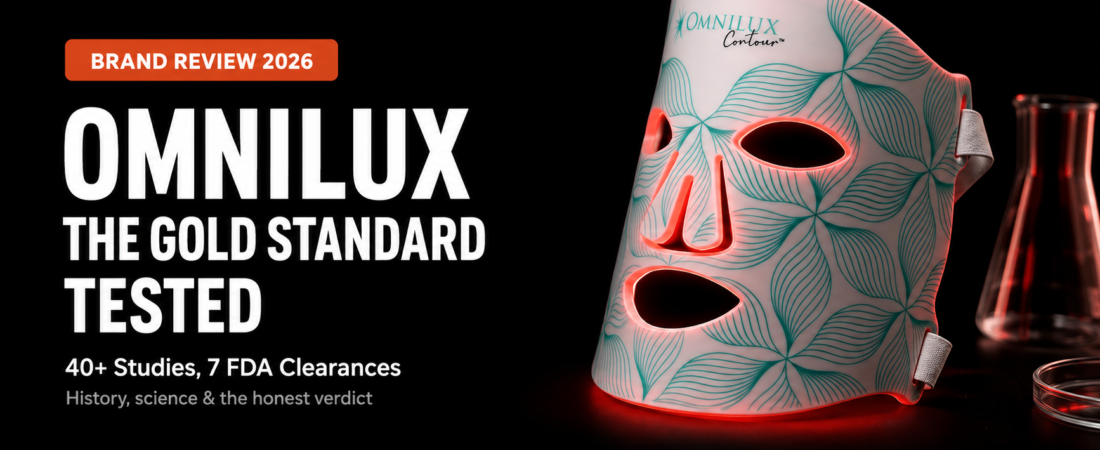
This Omnilux review covers a brand that stands apart from nearly every other name in this category on one specific dimension: independently published, peer-reviewed clinical evidence. Where most brands covered in this site’s brand series point to brand-internal testing programs or a single commissioned study, Omnilux points to more than 40 peer-reviewed clinical papers accumulated over two decades, 7 U.S. FDA clearances — more than any competitor in this space — and a presence in over 5,000 dermatology and med-spa offices worldwide. Omnilux is often described in industry coverage as the “gold standard” of LED phototherapy, and this review sets out to actually test that claim against the brand’s real history, current product lineup, pricing, and reputation, rather than repeating the marketing language uncritically.
Table of Contents
Company Overview
Omnilux originated in a genuinely unusual place for a beauty brand: the Paterson Institute for Cancer Research in the United Kingdom, where scientists were developing Photodynamic Therapy (PDT) as a treatment approach for non-melanoma skin cancers. That oncology research produced the first Omnilux Medical device in 2003, engineered as a flexible, portable LED system originally intended for clinical cancer treatment support rather than cosmetic use. This medical origin — not a beauty-industry starting point — is the foundational fact that shapes everything else about how Omnilux operates today, including its unusually heavy investment in published clinical research relative to competitors that entered this category from retail or consumer-electronics backgrounds.
The company’s corporate history includes a period as Photo Therapeutics Ltd, part of the Photomedex Inc. corporate family, before being acquired by GlobalMed Technologies, Inc., founded and led by Sanders Ergas. Today, Omnilux operates as a family-run business, with six siblings leading business strategy, operations, marketing, product development, and finance — a notably different ownership structure than the venture-backed or private-equity-owned brands common elsewhere in this category. The company is headquartered in Napa, California, and describes itself as a medical equipment manufacturer with 11-50 employees, a genuinely small team relative to the scale of its clinical and retail footprint. Omnilux also maintains a professional-facing international arm with additional leadership figures, including aesthetic medicine specialist Dr. Hany Abi Ghosn, reflecting the brand’s continued dual presence in both professional clinical settings and the direct-to-consumer market.
Origin Story & Technology Background
The technical foundation of Omnilux’s approach traces back to LED-based photobiomodulation research that gained significant momentum in the 1990s, an era when NASA-funded research into LED plant-growth lighting also demonstrated unexpected wound-healing and tissue-repair effects in astronauts and lab settings — research frequently cited across this entire product category as foundational, including in some of Omnilux’s own consumer-facing marketing. Omnilux’s more specific, verifiable origin is the Paterson Institute’s oncology-driven PDT research, which required precisely calibrated, medical-grade LED output to safely and effectively treat cancerous and pre-cancerous skin lesions — a substantially higher engineering bar than cosmetic-only applications typically demand. That medical-grade requirement, developed for a genuinely high-stakes clinical use case, is what later transferred into Omnilux’s cosmetic and at-home product lines.
The brand’s major product milestones illustrate a deliberate expansion pattern: Omnilux Medical (2003) established the clinical foundation; the professional in-office device line grew Omnilux’s presence into more than 5,000 dermatology and aesthetic clinics over the following years; the Contour collection launched in November 2020 as the brand’s first major at-home consumer product, using red and near-infrared light for anti-aging; Omnilux CLEAR followed in September 2021, described by the brand as the first flexible, home-use, FDA-cleared red-and-blue LED mask specifically proven for acne; and Omnilux Men launched in November 2022, calibrated with what the brand describes as the deepest-penetrating near-infrared wavelength on the market at the time, designed around men’s specific skin needs. The Mini collection, launched in late 2023, extended the brand into a lower-priced, spot-treatment category with devices under $100 — Omnilux’s first genuine move into budget-adjacent pricing.
Product Lineup
Omnilux’s current lineup is genuinely the most extensive and most clinically differentiated of any brand covered in this site’s brand review series, spanning full-face devices, targeted spot-treatment tools, and body-area-specific products.
Omnilux Contour Face is the brand’s flagship anti-aging device, combining red and near-infrared light to stimulate collagen production and address fine lines, wrinkles, redness, pigmentation, and overall skin texture. It’s FDA-cleared, designed to fit most face shapes and sizes, and priced in the $225–$295 range depending on retailer and current promotions — positioning it as a genuine premium competitor to CurrentBody’s Series 2 mask, covered in our Omnilux vs CurrentBody comparison already live on this site.
Omnilux CLEAR targets acne specifically, combining blue and red light in a flexible, portable format. The brand describes it as the first flexible home-use FDA-cleared device of its kind proven to significantly reduce or eliminate acne — a specific, checkable claim rather than vague “supports clear skin” marketing language common elsewhere in this category.
Omnilux Men is calibrated with a deeper-penetrating near-infrared wavelength specifically marketed toward men’s skin characteristics (generally thicker, oilier skin with different collagen density patterns than women’s skin on average), representing a genuinely differentiated product rather than a repackaged unisex device with different branding.
Omnilux Contour Neck & Decollete extends the Contour technology beyond the face, addressing an area most competing masks — including several covered elsewhere in this series — don’t reach at all, priced around $169.99–$275.
Omnilux Contour Glove is a genuinely unusual product in this category: a medical-grade LED device shaped for hand treatment, addressing an anti-aging concern (hands showing age faster than faces for many people) that essentially no competitor brand in this space addresses directly, priced around $149.99.
Omnilux Mini Collection (Mini Eye Brightener and Mini Skin Corrector/Blemish Eraser) rounds out the lineup as the brand’s first sub-$100 products, designed for targeted spot treatment rather than full-face sessions — a genuine strategic move to make Omnilux’s technology accessible at a price point closer to budget competitors like XSSNVV or Wavytalk, without diluting the brand’s premium positioning on its flagship devices.
This breadth — six genuinely distinct product lines addressing different areas, concerns, and price points — exceeds even INIA’s multi-tier catalog covered earlier in this series, and reflects two decades of accumulated R&D rather than a rapid multi-product buildout by a newer entrant.
What Makes This Brand Different
Omnilux’s core differentiator is unambiguous and independently verifiable in a way most brand claims in this category aren’t: 7 U.S. FDA clearances, more than any other brand covered across this entire site, and more than 40 published, peer-reviewed clinical studies accumulated over roughly two decades of continuous research. This is a meaningfully different evidence tier than CurrentBody’s internal Veritace® testing program, Wavytalk’s single Intertek-commissioned study, or INIA’s brand-published irradiance figures — Omnilux’s studies have gone through independent academic peer review, the highest evidence standard referenced anywhere in this brand series so far. The brand’s clinical presence in over 5,000 dermatology and aesthetic offices worldwide is a second, related differentiator: this isn’t a brand whose only real-world validation comes from Amazon reviews or brand-commissioned consumer testing — it’s a technology platform that practicing dermatologists have chosen to use professionally, at scale, over an extended period. Compared against CurrentBody specifically (the most natural comparison, given similar premium positioning and product categories), Omnilux’s clinical evidence volume and FDA clearance count both exceed what CurrentBody has publicly documented, even though CurrentBody’s own testing program (Veritace®) addresses a different question (manufacturing consistency) than Omnilux’s studies (clinical efficacy).
The Science / Technology Approach
Omnilux’s wavelength selection across its lineup covers red and near-infrared light for the Contour line (anti-aging, collagen stimulation), blue and red for CLEAR (acne, via bacterial elimination and inflammation reduction), and a deeper-penetrating near-infrared calibration specific to Omnilux Men. This is consistent with the core photobiomodulation mechanism referenced throughout this site: red and near-infrared wavelengths absorbed by mitochondrial cytochrome c oxidase, increasing ATP production and triggering fibroblast collagen synthesis, while blue light targets P. acnes bacteria through a photodynamic mechanism distinct from the collagen-focused pathway. What separates Omnilux technically from most competitors is the depth of its supporting research: the 40+ published studies span not just general “does red light work” questions but specific applications — post-microneedling healing support (the brand states Contour treatments can be used following microneedling to speed healing), acne-specific efficacy for CLEAR, and skin-type-specific safety data, including an explicit, publicly stated caution that people with darker skin tones (Fitzpatrick types IV, V, and VI) may experience transient pigmentation with blue light therapy specifically — a level of honest, skin-tone-specific safety disclosure notably more detailed than most competitors provide.
Clinical Evidence & Expert Endorsements
This is the section where Omnilux’s case is strongest relative to every other brand covered in this series. The company’s claim of “over 40 peer-reviewed clinical studies” is independently checkable in principle (published academic papers are findable through standard literature search, unlike a brand’s internal testing claims), and the brand’s professional-market presence — over 5,000 dermatology and aesthetic clinic placements — provides an additional, harder-to-fake reputation signal: practicing dermatologists choosing to invest in and use a specific device professionally is a meaningfully different endorsement than a paid social media partnership. On the expert-endorsement side, Omnilux’s international leadership includes Dr. Hany Abi Ghosn, a recognized figure in aesthetic medicine with credentials including the Best Medical Practice Award Europe 2018 from the European Medical Association and Oxford Royal Academy, presidency of the German Academy of Dermatology, and fellowship with the American Academy of Dermatology — genuine, checkable professional credentials rather than anonymous “as recommended by dermatologists” language. It’s worth being precise about evidence tiers here: Omnilux’s 40+ studies represent the peer-reviewed tier, the strongest standard referenced across this site’s brand reviews, ahead of Wavytalk’s single independent Intertek study, ahead of CurrentBody’s and INIA’s brand-internal testing programs, and ahead of the majority of budget-tier brands that publish no independent evidence at all.
Pricing & Value Positioning
Omnilux sits at the premium end of this category across nearly its entire lineup, with the Contour Face mask running $225–$295 depending on retailer and promotion — meaningfully above CurrentBody’s Series 2 ($469.99, though CurrentBody often runs deeper individual promotions) in typical street pricing, though direct comparison requires checking current pricing on both, since promotional cycles shift frequently for both brands. The Contour Neck & Decollete ($169.99–$275) and Contour Glove ($149.99) extend that premium positioning to body-specific devices most competitors don’t offer at any price. The genuine pricing shift is the Mini collection, priced under $100 specifically to create an entry point into the Omnilux brand and clinical-technology halo without the full Contour investment — a deliberate strategic move, similar in spirit to INIA’s tiered catalog but executed by a brand with substantially deeper clinical credentials backing even its cheapest products.
Reputation & Customer Feedback
Amazon listings for the Contour Face mask (sold under the “Environ Omnilux” listing, reflecting a specific retail distribution partnership) show a 4.3-star average across a modest 68 reviews on that specific listing — solid but with less review volume than some competitors, worth noting honestly rather than glossing over. Given Omnilux’s split distribution across its own site, professional/wholesale channels, Amazon, and third-party resellers on platforms like eBay (where used and new Omnilux devices circulate at prices ranging from roughly $225 to $275, similar to official retail pricing, suggesting less aggressive gray-market discounting than we found with CurrentBody), the brand’s aggregate reputation is genuinely distributed across more channels than most competitors in this series, making any single platform’s rating less representative of the brand’s overall standing. The brand’s most consistent independent praise, found across beauty press coverage, centers on its clinical credibility specifically — being “the brand most trusted and used by dermatologists worldwide” is a claim that shows up not just in Omnilux’s own marketing but in independent beauty journalism coverage as well, a genuinely stronger third-party echo than most brand claims in this category receive.
Comparison vs Competing Brands
Omnilux vs Other Premium Brands
Clinical evidence, FDA clearances, and pricing compared.
Against the field, Omnilux’s clearest and most defensible advantage over every other brand in this series — including CurrentBody, its closest premium competitor — is peer-reviewed clinical study volume and FDA clearance count. CurrentBody counters with its own internal Veritace® manufacturing-consistency program and a broader multi-channel retail footprint (Harrods, Selfridges) that Omnilux doesn’t match as visibly in mainstream retail. Solawave and TheraFace, both covered in our masks roundup, compete primarily on value and specific engineering claims (published irradiance, a single independent study) rather than Omnilux’s decades-long clinical research investment. iRestore’s differentiator remains its 600,000+ customer base and dermatologist-recommended positioning, a real but less specifically documented claim than Omnilux’s checkable study count.
Common Misconceptions About This Brand
The most common misconception is treating Omnilux as simply another premium consumer LED mask brand competing on the same terms as CurrentBody, Nanoleaf, or Solawave — its actual origin and ongoing business model (a medical device company with a genuine professional clinical channel that later expanded into consumer products) is a meaningfully different starting point than brands built directly for the at-home beauty market. A second misconception is assuming “40+ peer-reviewed studies” means every specific product in Omnilux’s current lineup has its own dedicated published trial — the studies span the broader Omnilux Medical technology platform and specific product lines like CLEAR, but buyers evaluating a specific device (say, the Contour Glove) should confirm which studies actually apply to that exact product rather than assuming the entire 40-study body of evidence covers every SKU equally. A third misconception, relevant given the brand’s oncology research origins, is assuming any connection to cancer research implies the consumer products themselves treat or prevent cancer — they don’t; the PDT research that founded the company addressed skin cancer treatment support in a clinical, medically supervised context entirely separate from the at-home cosmetic devices sold today.
Who Should Buy From This Brand
Omnilux is a strong fit for buyers who specifically prioritize independently published, peer-reviewed clinical evidence above all other purchase factors, buyers who want a device with genuine crossover credibility from professional dermatology settings rather than a consumer-only product, and buyers targeting acne specifically, where Omnilux CLEAR’s FDA-cleared, specifically-studied acne claim is among the strongest in this entire category. It also suits buyers interested in body-area-specific devices (neck, décolletage, hands) that most competitors don’t address, and budget-conscious buyers who still want Omnilux’s clinical pedigree via the Mini collection rather than the full Contour investment. It’s a weaker fit for buyers who want the absolute lowest price in the category regardless of brand history — Omnilux’s flagship devices remain priced well above XSSNVV, Wavytalk, or INIA’s entry tiers — and for buyers who specifically value a longer, more visible mainstream multi-retailer footprint, where CurrentBody’s Harrods and Selfridges presence currently exceeds Omnilux’s more clinically-focused distribution.
Our Verdict
4.6/5. Omnilux earns the highest score of any brand reviewed in this series so far, on the strength of genuinely differentiated, independently verifiable clinical evidence — 40+ peer-reviewed studies and 7 FDA clearances are not marketing language that dissolves under scrutiny the way many “clinically proven” claims in this category do. Combined with a professional dermatology presence spanning 5,000+ clinics and a genuinely broad, differentiated product lineup addressing face, neck, hands, and acne specifically, Omnilux has built a case for premium pricing that holds up better than most competitors covered in this series. The brand loses a fraction of a point for review volume that’s thinner than its clinical reputation might suggest on any single retail platform, and for pricing that remains a genuine barrier for budget-conscious buyers outside the Mini collection. For buyers weighing clinical credibility above all else, Omnilux is the strongest case in this entire brand series.
FAQ
Frequently asked questions
Common questions about Omnilux and its clinical history.
Yes — Omnilux originated at the UK’s Paterson Institute for Cancer Research, where scientists developed Photodynamic Therapy for non-melanoma skin cancers. That clinical, medical-grade engineering requirement is the foundation the brand’s later cosmetic and at-home devices were built on, though the consumer products themselves are not cancer treatments.
Science
On clinical evidence volume specifically, yes — Omnilux’s 40+ peer-reviewed studies and 7 FDA clearances exceed what CurrentBody has publicly documented. CurrentBody counters with its own internal manufacturing-consistency testing and a broader mainstream retail footprint. See our dedicated Omnilux vs CurrentBody comparison for the full breakdown.
Buying Decision
The 40+ study figure spans Omnilux’s broader technology platform and specific product lines like CLEAR. Confirm which specific studies apply to the exact device you’re considering (Contour Face vs. CLEAR vs. Contour Glove, for example) rather than assuming uniform coverage across every SKU.
Science
Yes — Omnilux CLEAR is FDA-cleared and specifically marketed as the first flexible, home-use device of its kind clinically proven to significantly reduce or eliminate acne, combining blue and red light for bacterial elimination and inflammation reduction.
Usage
Omnilux explicitly discloses that people with a predisposition to pigmentation or with Fitzpatrick skin types IV, V, and VI may experience transient pigmentation specifically with blue light therapy, typically resolving on its own with discontinued use. Consult a dermatologist if you have concerns before starting treatment.
Safety
Yes — the Omnilux Mini collection (Mini Eye Brightener and Mini Skin Corrector/Blemish Eraser) launched in late 2023, priced under $100, offering the brand’s clinical technology in a targeted, spot-treatment format at a meaningfully lower entry price than the full Contour line.
Buying Decision
Yes — Omnilux offers a Contour Neck & Decollete device and a Contour Glove for hands, both genuinely uncommon product categories most competitors in this space don’t address at all.
Usage
Omnilux states the Contour line’s red and near-infrared light can be used to speed healing after microneedling treatments. Always follow your provider’s specific post-treatment guidance and wait for any recommended skin recovery period first.
Usage
Professional clinical adoption depends heavily on documented, peer-reviewed evidence and regulatory clearance specific to the device — factors Omnilux has invested in more heavily and for longer than most competitors. A clinic’s liability and reputation depend on using devices with a verifiable evidence trail, which is a different calculus than an individual consumer’s at-home purchase decision.
Science
The first Omnilux Medical device launched in 2003, though the underlying company (as Photo Therapeutics Ltd) traces its LED treatment work back to 1998 — making Omnilux one of the longest-operating brands in this entire product category, well over two decades of continuous research and development.
Usage
Amazon (through verified official listings), the brand’s own site (omniluxled.com), and authorized professional/wholesale channels are the safest options for warranty validity. Secondary markets like eBay carry used and new units at prices comparable to retail, but warranty coverage typically doesn’t transfer with resale.
Safety
See Omnilux’s flagship maskContour Face — FDA cleared, 40+ studies behind the brand
Omnilux is the rare brand in this category where the “gold standard” language actually holds up under direct scrutiny — a medical-device origin story, decades of accumulated peer-reviewed research, more FDA clearances than any competitor, and a professional dermatology footprint that most consumer LED brands simply cannot claim. That pedigree comes at a real price premium, and buyers should weigh whether that specific evidence tier matters enough to their purchase decision to justify it over strong, lower-priced alternatives elsewhere in this series. For a direct, product-level comparison against its closest premium competitor, see our existing Omnilux vs CurrentBody comparison, and for the underlying wavelength science referenced throughout this review, our wavelengths explainer covers the fundamentals in more depth.
Red light therapy devices are not intended to diagnose, prevent, or treat any medical condition. Individual results may vary. Consult a healthcare provider before starting any new health regimen.