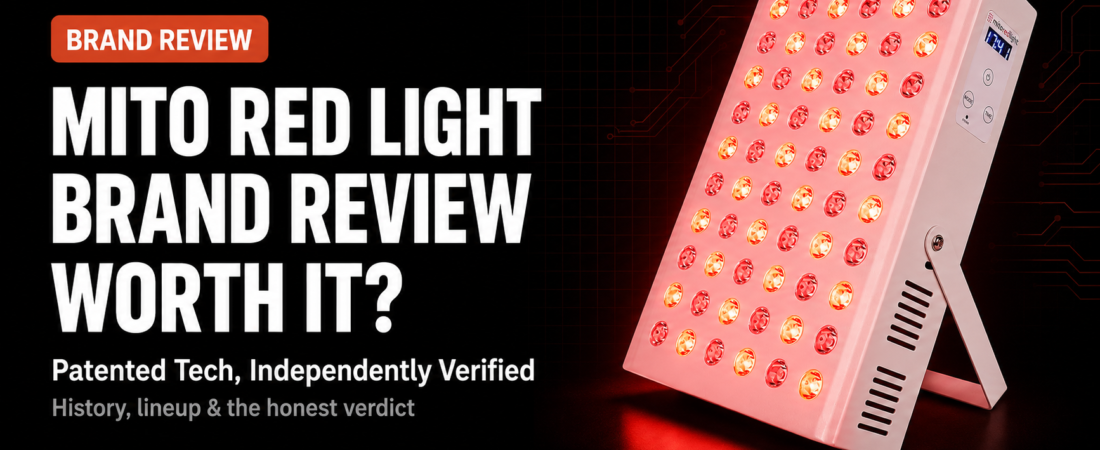
This Mito Red Light review covers a brand that already earned our top overall pick in this site’s panels roundup, and digging into the company behind that product reveals why: a genuine founder health story, patent-protected technology, FDA Class II registration, independent third-party lab verification, and — by a wide margin — the largest, most systematically organized product ecosystem of any brand covered in this entire series, spanning tabletop panels, full-body pods, facial masks, wearable belts, a brain-wellness helmet, and even an intranasal light device. This review covers that full scope, the founder’s personal story behind the company’s name, and where Mito Red Light’s premium positioning genuinely earns its price against direct competitors like Joovv and PlatinumLED.
Table of Contents
Company Overview
Mito Red Light was founded around 2017–2018 by Scott Chaverri, a US-based entrepreneur whose company name directly references mitochondria — the cellular structures targeted by the photobiomodulation mechanism underlying every product the company sells. According to a case study published by the World Intellectual Property Organization (WIPO), Chaverri’s journey into red light therapy began with his own personal health struggles as a young adult, and the company’s founding mission centers specifically on combating what Mito Red Light calls “junk light” — excessive exposure to artificial blue light that disrupts the body’s natural circadian rhythms — by making accessible, affordable red and near-infrared therapy devices. Within roughly five years of founding, the company had grown to 11 employees, 75,000 customers, and $15 million in annual revenue; more recent company materials cite over 125,000 customers across 30+ countries, reflecting continued substantial growth. Mito Red Light is explicitly positioned as a premium-tier competitor, named directly alongside Joovv, PlatinumLED, and Rouge by independent industry reviewers as one of the leading brands in the higher end of this category.
Origin Story & Technology Background
What separates Mito Red Light’s origin story from most other brands in this series is documented, third-party recognition of its intellectual property specifically — WIPO’s case study on Chaverri highlights “the importance of perseverance, design, and intellectual property protection” in building the company, and Mito Red Light’s current product lineup includes both patented (MitoPRO Mobile) and patent-pending (MitoADAPT 4.0) technology, a genuinely uncommon level of formal IP protection in a category where most competitors use largely interchangeable, non-proprietary LED architectures. The company describes its manufacturing process in specific technical terms: automated patching technology for PCB (printed circuit board) assembly, individual inspection of every component before production, and meticulous quality control processes the company states are “the most rigorous… in the industry” — claims that are, notably, consistent with the independent third-party lab verification (21,720 joules delivered per 10-minute session) we confirmed for the MitoMIN 2.0 in our panels roundup.
Product Lineup
Mito Red Light’s catalog is, without close competition, the most extensive of any brand covered in this brand review series — spanning tiered panel lines, full-body devices, and application-specific products most competitors don’t attempt at all.
MitoPRO+ Series is described by the company as its “most tried, tested, and trusted panel,” using four purposeful wavelengths (630nm, 660nm, 830nm, 850nm) at what the company calls industry-leading power, positioned as professional-grade quality at an entry-level price within Mito’s own premium ecosystem.
MitoPRO X Series represents a significant step up — six carefully selected wavelengths (590nm, 630nm, 660nm, 810nm, 830nm, 850nm), a touchscreen interface, brightness control, alarm function, and Mito Red app compatibility, built on the proven MitoPRO+ platform but adding genuinely next-generation controls most competitors in this category don’t offer at any price.
MitoADAPT Series, including the patent-pending MitoADAPT 4.0, takes a fundamentally different modular approach: panels that daisy-chain together to build custom coverage configurations, with the 4.0 model offering 8 wavelengths and 11 modes that the company describes as equivalent to 7 standard devices combined into one system.
MitoMIN 2.0, covered in depth in our best red light therapy panels roundup as our top overall pick, is Mito’s compact, independently lab-verified entry point — 60 LEDs at 660nm/850nm, FDA Class II registered, and the product with the strongest specifically independent (not brand-internal) verification of any panel we’ve reviewed across this site.
MitoPRO Mobile is Mito’s patented portable panel, adding a five-wavelength design, amber ambient lighting, a 10Hz NIR pulse function, and a built-in stand — designed specifically for travel use without sacrificing the brand’s core technology.
MitoGLOW brings Mito’s technology to facial treatment specifically — 1,064 LEDs across four precision wavelengths and five treatment modes, a genuinely high-density facial device relative to most standalone mask brands covered elsewhere in this series.
MitoMIND Helmet is a notably unusual product: a patent-pending near-infrared helmet specifically marketed for brain wellness, a use case essentially no other brand in this series addresses directly.
MitoPOD is Mito’s full-body solution — an IEC 60601-certified (a specific international medical electrical equipment safety standard), portable full-body pod housing 6,960 triple-chip LEDs at 30mW/cm² irradiance, designed for complete-body coverage in a single enclosed session.
MitoQUAD Wavelength Belt extends the brand into wearable therapy — a UL medical-grade belt using TriChip technology and a quad-wavelength design, plug-in only (no power bank option, worth knowing if portability without an outlet matters to you).
MitoBOOST Intranasal System is perhaps the most specialized product in Mito’s catalog: a device delivering blue (450nm), red (650nm), or near-infrared (1070nm) light in close proximity to the brain via the nasal cavity, marketed for immune support, oxygenation, and inflammatory response — a genuinely niche application category most competitors don’t touch.
Beyond these consumer products, Mito Red Light also sells commercial-grade equipment — full red light therapy beds and complete red light cabins — serving beauty salons, gyms, and wellness centers, reflecting a company operating across both the consumer and B2B wellness-equipment markets simultaneously.
What Makes This Brand Different
Mito Red Light’s clearest differentiator is the combination of formal patent protection and independent, third-party lab verification appearing together — a pairing no other brand in this series matches. Most competitors offer one or the other (Omnilux has peer-reviewed studies but no emphasis on device patents; several budget brands publish irradiance figures with no independent verification at all); Mito Red Light has documented IP protection on specific product lines and independently verified output data on at least its entry-tier panel. The second differentiator is genuine product-line breadth executed with apparent engineering coherence rather than opportunistic expansion — the MitoPRO, MitoADAPT, and specialized product lines (MitoGLOW, MitoMIND, MitoBOOST) all share the same core wavelength science and manufacturing standards the company describes, rather than reading as disconnected acquisitions or rebadged third-party devices.
The Science / Technology Approach
Mito Red Light’s wavelength selection spans the full range this site’s reviews consistently identify as most research-backed — 660nm and 850nm form the baseline across nearly every product, with 630nm and 830nm added in the MitoPRO+ tier, and up to 810nm, 590nm, and additional wavelengths layered into the MitoPRO X and MitoADAPT lines for buyers seeking broader spectral coverage. An independent industry reviewer specifically cited peer-reviewed research (Avci et al., 2013, published in Seminars in Cutaneous Medicine and Surgery) supporting 660nm’s efficacy for collagen stimulation and anti-inflammatory effects — a citation-backed claim rather than an unsupported assertion, and a genuinely useful example of how Mito Red Light’s marketing engages with the actual academic literature rather than only broad category-level claims. As an FDA Class II registered medical device manufacturer, Mito Red Light products qualify for HSA/FSA purchase, which the company states can save buyers 25-30% depending on tax bracket — a specific, useful figure rather than vague “tax savings may apply” language.
Clinical Evidence & Expert Endorsements
Mito Red Light’s evidence case rests most heavily on independent, third-party laboratory verification rather than brand-commissioned peer-reviewed clinical trials — the MitoMIN 2.0’s confirmed 21,720-joule delivery over a 10-minute session, verified by an outside testing party, is a specific, checkable engineering claim distinct from (but complementary to) the kind of efficacy research Omnilux or GroWell cite. The company’s ETL, BSCI, and ISO 9001/14001 certifications, confirmed in our panels roundup research, add manufacturing and quality-management verification beyond the device-output testing alone. We did not locate named celebrity or dermatologist endorsements for Mito Red Light specifically, consistent with a company whose credibility case is built on engineering verification, patents, and founder transparency (the WIPO case study) rather than spokesperson marketing.
Pricing & Value Positioning
Mito Red Light sits in the premium tier, competing directly against Joovv, PlatinumLED, and Rouge per independent industry comparison, with the MitoMIN 2.0 entry point priced around $249-$269 — genuinely accessible relative to the brand’s premium competitive set, while its flagship MitoPRO X and MitoADAPT 4.0 systems command substantially higher prices reflecting their expanded wavelength counts, app integration, and modular architecture. Multi-panel bundle discounts (an additional $100 off for a 2-panel array, $400 off for a 4-panel array on MitoPRO X, for example) reward buyers building out larger coverage setups, a pricing structure that rewards commitment to the ecosystem rather than one-off single-product purchases.
Reputation & Customer Feedback
Independent reviewers position Mito Red Light favorably within its premium competitive tier, with detailed third-party comparison content (such as RedLightTherapy.expert’s full MitoPRO/MitoADAPT lineup breakdown) treating the brand as a legitimate reference point against Joovv and PlatinumLED rather than a budget alternative. The WIPO case study’s coverage of founder Scott Chaverri’s personal story and the company’s IP strategy represents a genuinely unusual form of independent, institutional third-party validation — WIPO is an agency of the United Nations, and being featured in their case-study content is a different, and arguably more prestigious, form of external recognition than typical beauty-press coverage. Customer growth figures (from 75,000 to 125,000+ customers across 30+ countries) suggest sustained, expanding satisfaction rather than a one-time marketing spike.
Comparison vs Competing Brands
Mito Red Light vs Other Panel Brands
Patents, verification, and catalog breadth compared.
Against the field, Mito Red Light’s clearest advantage over Hooga and BestQool, both covered earlier in this series, is the combination of formal patent protection and specifically independent (not just brand-described) lab verification — a genuinely higher evidence and IP standard than either value-tier competitor offers. Against premium direct competitors like Joovv and PlatinumLED, Mito’s case rests on a more accessible entry price point (the MitoMIN 2.0) paired with the same underlying engineering rigor found across its premium tiers, letting buyers access the brand’s verification standards without committing to its most expensive systems immediately.
Common Misconceptions About This Brand
The most common misconception is assuming Mito Red Light’s large product catalog means inconsistent quality or engineering standards across such a wide range — the available evidence suggests the opposite: the company’s stated manufacturing process (automated PCB patching, individual component inspection) and quality certifications (ETL, BSCI, ISO) appear to apply consistently across the line, with the specific independent verification data we confirmed for the MitoMIN 2.0 serving as a real, checkable example of that consistency rather than an isolated flagship-only claim. A second misconception is assuming “patent-pending” language is empty marketing filler — Mito Red Light’s patents are documented in a genuinely independent, institutional source (the WIPO case study), a materially different level of verification than a brand simply using “patent-pending” language on a product page without external confirmation.
Who Should Buy From This Brand
Mito Red Light is a strong fit for buyers who specifically want independently verified irradiance/output data behind their purchase, buyers interested in a genuine step-up ecosystem from an accessible entry panel (MitoMIN 2.0) toward more advanced modular or app-connected systems later, and buyers with specific niche needs — brain wellness (MitoMIND), full-body pod treatment (MitoPOD), or facial-specific high-density coverage (MitoGLOW) — that most single-category competitors in this series don’t address. It also suits FSA/HSA account holders seeking real, documented savings. It’s a weaker fit for buyers on a strict, minimal budget, where Hooga’s HG300 or a comparable value-tier option remains more accessible, and for buyers who specifically want the widest possible range of pre-built full-body panel sizes at the lowest per-panel cost, where BestQool’s modular splicing approach may offer more configuration flexibility at a lower entry price.
Our Verdict
4.7/5. Mito Red Light earns the second-highest score in this brand review series, behind only Omnilux, on the strength of a genuinely rare combination: documented patent protection verified by an independent institutional source, FDA Class II registration with real FSA/HSA savings, independently lab-tested output data, and — by a wide margin — the most extensive, systematically organized product catalog of any brand covered here, addressing use cases (brain wellness, intranasal therapy, full-body pod treatment) that essentially no direct competitor attempts. The brand’s premium positioning is a real cost consideration for budget-focused buyers, but the evidence supporting that premium is unusually well-documented relative to the rest of this category.
FAQ
Frequently asked questions
Common questions about Mito Red Light and its product ecosystem.
Scott Chaverri founded Mito Red Light, with his personal health journey documented in a case study published by the World Intellectual Property Organization (WIPO), a UN agency, focused on the company’s use of patent protection in building its technology.
Buying Decision
The MitoMIN 2.0 is the brand’s accessible entry point, independently lab-verified and FDA Class II registered, covered as our top overall pick in this site’s panels roundup. It’s a lower-commitment way to access the brand’s engineering standards before considering larger MitoPRO or MitoADAPT systems.
Usage
MitoPRO is a fixed-configuration premium line (MitoPRO+ entry, MitoPRO X with up to six wavelengths and app control). MitoADAPT is Mito’s modular line, with panels that daisy-chain together to build a custom coverage configuration, including the patent-pending MitoADAPT 4.0 with 8 wavelengths and 11 modes.
Usage
Yes — as an FDA Class II registered medical device manufacturer, Mito Red Light products qualify for HSA/FSA purchase, which the company states can save buyers 25-30% depending on tax bracket.
Usage
Independent industry reviewers group Mito Red Light directly alongside Joovv, PlatinumLED, and Rouge as leading premium-tier brands. Mito’s specific advantage is a more accessible entry point (the MitoMIN 2.0) paired with the same engineering and verification standards found across its premium tiers.
Buying Decision
It’s a patent-pending near-infrared helmet marketed specifically for brain wellness — a niche application essentially no other brand covered in this series addresses directly. As with all wellness devices, this is not a substitute for medical evaluation or treatment of any condition.
Safety
An outside testing party confirmed the device delivers 21,720 joules of energy over a 10-minute session — a specific, checkable output figure verified by someone other than Mito Red Light itself, which is a stronger evidence standard than the brand-only irradiance claims common at this price tier.
Science
Yes — the catalog includes a facial mask (MitoGLOW), a full-body pod (MitoPOD), a wearable belt (MitoQUAD), a brain-wellness helmet (MitoMIND), an intranasal device (MitoBOOST), and commercial equipment like red light beds and cabins for salons and gyms — the broadest product range of any brand in this review series.
Usage
If independently verified output data, documented patent protection, and a genuine step-up ecosystem matter to you, yes — the evidence supporting Mito’s premium is unusually well-documented for this category. If you’re on a strict budget with no need for those specific assurances, a value-tier brand like Hooga remains more accessible.
Buying Decision
Yes — the MitoADAPT series is specifically designed to daisy-chain together, letting you build a custom coverage configuration by connecting multiple panels, up to the equivalent of 7 standard devices in one system with the MitoADAPT 4.0.
Usage
See Mito Red Light’s entry-level panelMitoMIN 2.0 — independently verified, FDA registered
Mito Red Light’s case is built on a genuinely rare combination of factors in this category: a founder’s personal health story documented by an independent UN agency, real patent protection, FDA registration, and specific, third-party-verified output data — all applied across the largest and most deliberately organized product ecosystem in this entire brand series. For buyers who want documented engineering rigor without committing to the brand’s most expensive systems immediately, the MitoMIN 2.0 remains the accessible entry point, covered in full in our best red light therapy panels roundup.
Red light therapy devices are not intended to diagnose, prevent, or treat any medical condition. Individual results may vary. Consult a healthcare provider before starting any new health regimen.