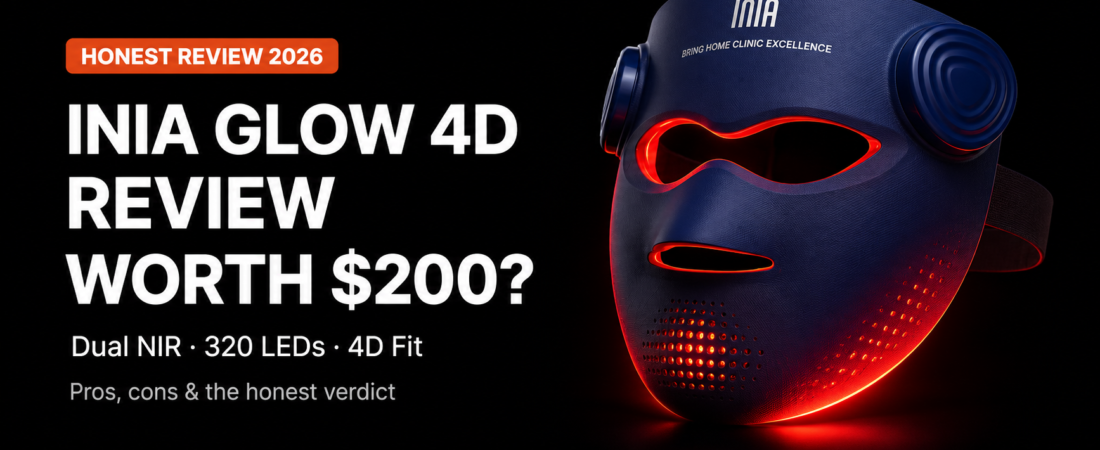
This INIA Glow 4D review looks at a mask that sits in an awkward, interesting middle ground: priced roughly double a basic LED mask like the XSSNVV, but well under premium options like CurrentBody’s Series 2, and positioned around one specific feature most competitors skip — a “4D” wraparound fit that extends light coverage down into the jawline and lower face rather than stopping at the cheeks. It’s currently ranked #3 in Amazon’s Wrinkle & Anti-Aging Devices category with a 4.5-star average across 260+ reviews, which puts it in genuine contention rather than novelty territory. This review breaks down the technology, the real-world usability, what results are realistic to expect, and where it genuinely loses to cheaper or pricier alternatives.
Table of Contents
What Makes This Product Different
Most LED masks on Amazon in this price range use a single near-infrared wavelength, typically 850nm. The Glow 4D’s headline feature is dual NIR — 850nm and 940nm together — paired with 320 LEDs distributed across four modes (Anti-Wrinkle, Clarifying, Glow, and Full Rejuvenation). The second differentiator is the fit itself: instead of a flat or lightly curved mask that mostly treats the forehead and cheeks, the Glow 4D wraps further down to include the jaw and chin, which is a meaningful design choice for anyone whose main concern is lower-face sagging rather than forehead lines. It also ships with removable magnetic under-eye cooling pads, a feature usually reserved for pricier devices. INIA sells this as a step up from its own entry-level Glow Wireless mask (272 LEDs, single 850nm NIR), and the pricing — typically $180–$200 on Amazon — reflects that positioning: not a budget mask, not a CurrentBody-tier splurge.
The Science Behind It
The core mechanism is standard photobiomodulation: red and near-infrared light is absorbed by mitochondria in skin cells, increasing ATP output and triggering fibroblasts to produce more collagen and elastin, while reducing inflammatory signaling. What’s specific to this device is the dual-NIR approach — 850nm is the wavelength most consistently supported in the photobiomodulation literature for collagen stimulation, while 940nm penetrates somewhat deeper and is marketed here for firmness and structural support beneath the dermis. It’s worth being direct about the evidence gap here: the broader 850nm research base is solid, but 940nm-specific clinical data for facial skin rejuvenation is thinner and largely comes from the brand’s own materials rather than independent trials, so treat the “goes deeper” claim as plausible mechanism rather than proven differentiator. One legitimate criticism raised in third-party testing is that INIA doesn’t publish model-specific irradiance (mW/cm²) for the Glow 4D the way it does for its simpler Glow Wireless model (105mW/cm²) — that’s a transparency gap worth knowing about going in, even though the underlying wavelength science is sound.
Design and Usability
At 1.9 lbs and roughly 9 x 7.5 x 4.5 inches in its resting shape, the mask is on the heavier side of the wearable category, though the flexible silicone construction distributes that weight better than a rigid shell would. The 4D wraparound design is the standout in daily use — it genuinely covers more of the lower face and jawline than flatter competitors, which matters if that’s your actual concern. The magnetic battery pack doubles as the mode-selector remote, which is a nice touch for one-handed control mid-session. The cooling pads are a legitimate comfort feature, especially for anyone using the mask on a warmer day or with sensitive under-eye skin. The most consistent usability complaint across buyer reviews is the absence of a built-in auto-shutoff timer — you’re responsible for tracking session length yourself, which is a step behind cheaper masks like the XSSNVV that include a 10-minute auto-timer as standard. Battery life is rated for roughly 120 minutes per full charge, meaning you’ll recharge every couple of weeks with typical use.
Results Timeline / What to Expect
INIA’s own guidance, and the results reported by third-party reviewers, suggest a fairly standard photobiomodulation timeline. Weeks 1–2 are foundation-building — no visible change yet, but this is when fibroblast activation is beginning. Weeks 2–4 are when brightness, smoothness, and general skin tone improvements typically start to show, consistent with what INIA’s own product listing states and in line with the broader photobiomodulation literature’s 4–8 week window for early visible change. Weeks 6–8 and beyond are where firmness and jawline-specific improvements — the feature this mask is actually built around — become more apparent, since structural collagen remodeling generally lags behind surface-level tone changes. As with any LED mask, individual results vary with skin type, baseline condition, and above all consistency of use; three sessions a week for two months will outperform a daily-for-a-week-then-forgotten approach every time.
Who Is This Product Best For
This is a strong fit if your primary concern is lower-face and jawline firmness rather than forehead or eye-area lines specifically — the 4D coverage is the actual reason to pick this over a flatter mask at a similar price. It also suits someone who already understands LED therapy requires weeks of consistency and isn’t shopping for a first LED mask purely on price. It’s a weaker fit for a first-time buyer whose main goal is the lowest possible entry cost — the XSSNVV covers that need at less than half the price with a simpler, well-documented single-NIR approach. It’s also not the right pick for someone who wants a hard auto-shutoff timer as a non-negotiable feature, or someone chasing the highest published irradiance number, since INIA doesn’t disclose that figure for this specific model.
Comparison vs Competitors
INIA Glow 4D vs the Competition
How it stacks up against other LED masks in and around its price range.
| Mask | Wavelengths | Coverage | Timer | Rating | Price |
|---|---|---|---|---|---|
| INIA Glow 4DJAWLINE FOCUS 320 LEDs, dual NIR | Red + Blue + Amber, 850/940nm NIR | Face + jaw/chin | Manual | 4.5 ★ | Check price → |
| XSSNVV 272 LEDs, single NIR | Red + Blue + Amber, 850nm NIR | Face only | 10-min auto | 4.4 ★ | Check price → |
| INIA Glow Wireless 272 LEDs, single NIR | 850nm NIR, 105mW/cm² (published) | Face only | Manual | 4.4 ★ | Check price → |
| CurrentBody Series 2 236 LEDs, triple wavelength | 633nm, 830nm, 1072nm | Face only, high irradiance | 10-min auto | 4.2 ★ | Check price → |
Against the field, the Glow 4D’s real edge is coverage area, not raw power or price. The XSSNVV wins on price and simplicity for someone who just wants a reliable entry point. The CurrentBody Series 2 wins decisively on published clinical backing and irradiance transparency for someone with the budget to spend nearly $470. The Glow 4D’s case is narrower and more specific: if jawline and lower-face coverage is your actual priority, it does something the cheaper option doesn’t, at a price well below the premium tier.
Pros and Cons
Pros:
- Genuine 4D coverage extending into jaw and chin, not just forehead and cheeks
- Dual NIR wavelengths (850nm + 940nm) — a legitimate differentiator on paper
- Removable magnetic cooling pads are a real comfort upgrade
- Cordless, with the battery pack doubling as an intuitive mode remote
- Strong buyer rating (4.5 stars) and solid market position (#3 in category)
Cons:
- No built-in auto-shutoff timer, unlike cheaper competitors
- INIA doesn’t publish model-specific irradiance (mW/cm²) for this device
- Heavier than flatter, simpler masks, which some users may find fatiguing over a full session
- 940nm-specific skin benefit claims rest more on brand materials than independent clinical trials
Our Verdict
4.2/5. The INIA Glow 4D earns its price primarily through one real, useful feature — genuine jawline and lower-face coverage most competitors in this range don’t offer — rather than through overall technical superiority. If that specific coverage area is your actual concern, it’s a reasonable, well-reviewed choice at a fair mid-tier price. If you just want a reliable entry point into red light therapy without a specific jawline concern, the XSSNVV remains the simpler, cheaper, better-documented starting point, and if budget isn’t a constraint at all, CurrentBody’s Series 2 offers stronger published clinical backing. The INIA Glow 4D is a legitimate middle option — not the mask for everyone, but a well-targeted one for the buyer it’s actually built for.
FAQ
Frequently asked questions
Common questions about the INIA Glow 4D LED mask.
It depends on your specific concern. If jawline and lower-face coverage matters to you, the 4D wraparound fit is a genuine feature cheaper masks don’t offer. If you just want a reliable general entry point into red light therapy, a simpler mask like the XSSNVV covers that at less than half the price.
Buying DecisionNo — this is one of the mask’s genuine drawbacks. Unlike some competitors that auto-shutoff after 10 minutes, you’re responsible for tracking your own session length. Using a phone timer alongside it is a simple workaround.
Usage850nm has the stronger independent research base for collagen stimulation. 940nm is marketed for deeper penetration and structural support, but the model-specific clinical evidence for that added benefit is thinner and comes primarily from brand materials rather than independent trials — treat it as a plausible mechanism, not a proven leap over single-NIR devices.
ScienceBrightness and tone improvements are typically reported within 2–4 weeks of consistent use. Firmness and jawline-specific results — the feature this mask is actually built around — tend to take longer, generally emerging around weeks 6–8 and beyond as collagen remodeling progresses.
ResultsMost sensitive-skin users tolerate LED masks like this well, and the removable cooling pads can help further reduce any warmth-related discomfort. As with any light therapy device, those who are pregnant, immunosuppressed, or on photosensitizing medication should check with a healthcare provider before starting.
SafetyThe standard Glow Wireless uses a single 850nm NIR wavelength across 272 LEDs and covers the face only, with a published 105mW/cm² irradiance. The Glow 4D adds a second 940nm NIR channel, more LEDs, jawline/chin coverage, and cooling pads — at roughly a $60–$80 premium depending on current pricing.
Buying DecisionFinal Thoughts
The INIA Glow 4D isn’t trying to be the cheapest or the most clinically documented mask on the market — it’s built around a specific, genuinely useful design choice: extending real coverage into the jawline where most competitor masks stop short. That’s a narrower pitch than most LED mask marketing makes, and it’s a more honest one. If lower-face firmness is actually what you’re trying to address, and you’re comfortable tracking your own session time without a built-in shutoff, this is worth the roughly $200. For general background on wavelengths and irradiance before you buy any mask, our wavelengths explainer and guide to choosing a red light therapy device cover what to check regardless of which mask you land on, and our masks vs panels vs wands comparison is worth a look if you’re still deciding on device format entirely.
Red light therapy devices are not intended to diagnose, prevent, or treat any medical condition. Individual results may vary. Consult a healthcare provider before starting any new health regimen.