⚠️ Affiliate Disclosure: This article contains affiliate links. If you purchase through our links, we may earn a commission at no extra cost to you. Read our full disclosure policy.
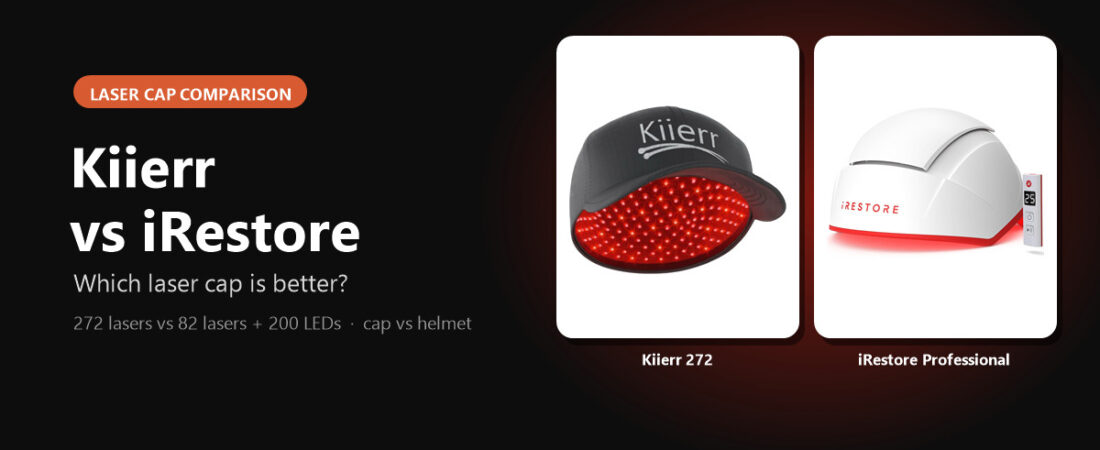
Kiierr vs iRestore is the most common head-to-head in at-home laser hair growth, and for good reason: both are FDA-cleared for hereditary hair loss in men and women, both use red light at 650nm, and both ask for sessions every other day. The difference is in how they deliver that light. The Kiierr 272 is a soft, cordless cap with 272 true laser diodes. The iRestore Professional is a rigid helmet that combines 82 lasers with 200 red LEDs.
We compared both devices on their FDA 510(k) summaries, Amazon listings, light source, coverage, session time, and comfort. We did not run hands-on tests; where a figure comes from the brand rather than the FDA documents, we say so.
★ Best for most people
Kiierr 272 Laser Cap
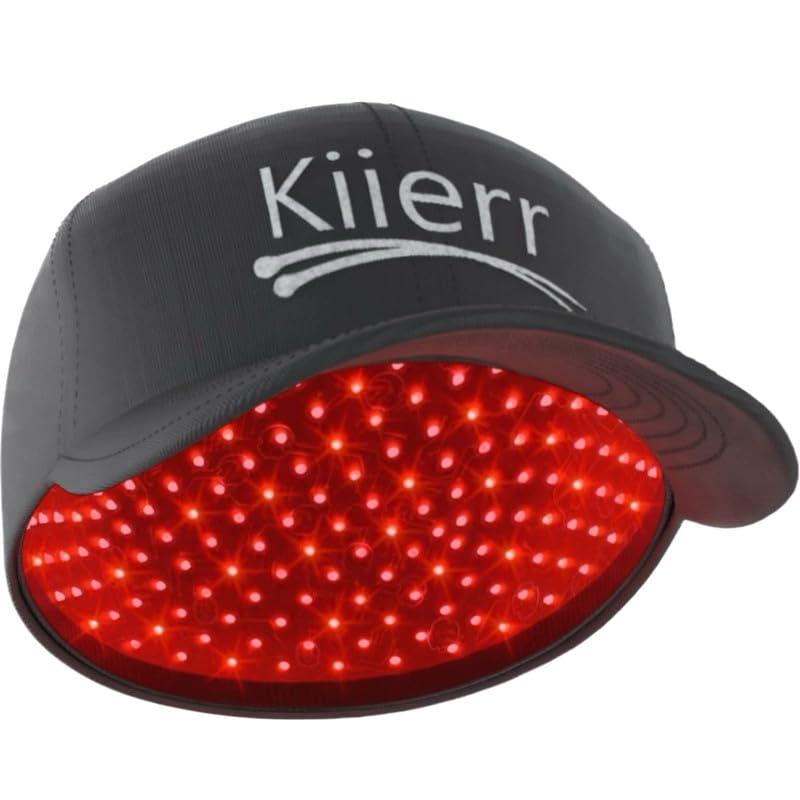
272 true laser diodes at 650nm, cordless and discreet enough to wear under a hat. FDA-cleared (K181878).
For most people, the Kiierr 272 is the better buy: all 272 light sources are true laser diodes, it fits discreetly under a regular hat, and it runs on a rechargeable battery. The iRestore Professional is the better choice if you prefer a hands-free helmet that covers the hairline, sides, and crown in one consistent shape, from one of the best-known brands in the category. The full picture is more nuanced, so here is the breakdown.
Kiierr 272 — What You Need to Know
The Kiierr 272 is a cap-style laser device with 272 laser diodes at 650nm (±5nm), each with an output of up to 5 mW, according to its FDA 510(k) summary (K181878). That works out to a maximum of roughly 1,360 mW of combined laser output. It is cleared to promote hair growth in men with Norwood-Hamilton classes IIa–V and women with Ludwig-Savin classes I–II, in Fitzpatrick skin types I–IV.
The cleared protocol is 30-minute sessions every other day, and the clearance summary describes a 16-week treatment period. The cap has a protective liner, a lithium-ion battery, and an embedded controller, so you can move around during sessions, and it is low-profile enough to wear under a baseball cap.
Its limitations: 30 minutes is a long session, and a soft cap can shift on the head more than a helmet. The Amazon listing covers Kiierr’s family of devices, so make sure you select the 272 model rather than the smaller 148.
iRestore Professional — What You Need to Know
The iRestore Professional is a helmet with 82 red laser diodes and 200 red super-luminescent diodes (LEDs) at 650nm, 282 light sources in total, with a combined optical output of about 1,410 mW, according to its FDA 510(k) summary (K183417). Sessions are 25 minutes every other day.
The helmet shape keeps the light sources at a consistent position over the hairline, sides, and crown, and it is completely hands-free. It plugs into the wall; a rechargeable battery pack is available bundled or separately for cordless use. iRestore is one of the most established names in the category, and our iRestore Professional review covers it in more depth.
Its limitations: only 82 of its 282 light sources are lasers, the helmet is bulky and cannot be worn discreetly, and it is corded unless you add the battery pack.
Winner: Kiierr. All 272 of its light sources are laser diodes, while the iRestore mixes 82 lasers with 200 LEDs. Most of the clinical research on hair growth caps involved lasers or laser-LED combinations, so both approaches are reasonable, but Kiierr offers more true lasers.
Total light output
Winner: roughly a tie. Kiierr’s diodes add up to a maximum of about 1,360 mW and the iRestore Professional lists about 1,410 mW. Neither number guarantees better results; consistent use matters more.
Coverage and fit
Winner: iRestore. A rigid helmet keeps every light source in the same place each session and covers the hairline, sides, and crown evenly. A soft cap is more discreet but can sit differently from session to session.
Session time and routine
Winner: iRestore, narrowly. 25 minutes every other day versus 30 minutes every other day. Both require months of consistent use.
Portability and comfort
Winner: Kiierr. It is cordless out of the box and low-profile enough to wear under a hat while you move around. The iRestore needs a wall outlet unless you buy the battery pack.
FDA clearance
Winner: tie. Both are FDA-cleared for androgenetic alopecia in men and women (Kiierr K181878; iRestore Professional K183417).
Full Specs Comparison
Full Specs: Kiierr 272 vs iRestore Professional
Every published spec, from the FDA 510(k) summaries and Amazon listings.
Sources: FDA 510(k) summaries K181878 and K183417 and Amazon listings, checked October 21. Kiierr total output is calculated from its diode count and per-diode maximum.
Who Should Buy Which
Choose the Kiierr 272 if:
You want true laser diodes only
You want to use the device discreetly, even under a regular hat
Cordless freedom during sessions matters to you
You are comfortable with 30-minute sessions
Choose the iRestore Professional if:
You prefer a hands-free helmet with consistent coverage
You want one of the most established brands in the category
You will mostly use it at home, sitting or lying down
You want slightly shorter sessions
Consider neither if:
You want the shortest routine: the Capillus Spectrum needs only 6 minutes a day
Your budget is tight: an LED cap is a cheaper way to start
Both devices are designed for hereditary pattern hair loss, and they work best on thinning hair rather than completely bald areas. Studies of laser and laser-LED hair devices typically measure changes after about 16 weeks, and most users should plan on four to six months of consistent use before judging results. Many people combine laser therapy with treatments such as minoxidil after talking to a doctor. Our guide to red light therapy for hair growth explains how it works, and our side effects guide covers safety.
Frequently asked questions
Kiierr vs iRestore: the questions buyers ask most.
For most people, the Kiierr 272: all 272 of its light sources are laser diodes, it is cordless and it fits discreetly under a hat. The iRestore Professional is better if you prefer a hands-free helmet with consistent full-scalp coverage.
Buying decision
Yes. The Kiierr 272 is cleared under 510(k) K181878 and the iRestore Professional under K183417, both for androgenetic alopecia (hereditary hair loss) in men and women.
Safety
Yes. The Kiierr 272 uses 272 laser diodes. The iRestore Professional uses 82 laser diodes plus 200 LEDs, for 282 light sources in total. Their total stated output is similar, roughly 1,360 mW for Kiierr and 1,410 mW for iRestore.
Science
Kiierr’s cleared protocol is 30 minutes every other day. The iRestore Professional uses 25-minute sessions every other day.
Usage
Plan on at least four to six months of consistent use. Studies and FDA clearances for laser hair devices typically measure results after about 16 weeks, and results vary from person to person.
Results
The Kiierr is cordless with a built-in battery and fits under a hat, so you can move around. The iRestore Professional plugs into the wall unless you add its optional battery pack, and the helmet is bulkier.
Usage
No. Laser caps are designed for thinning hair caused by hereditary pattern hair loss. They are unlikely to help areas with no visible hair, and sudden or patchy hair loss should be checked by a doctor.
Science
Our pick: Kiierr 272 Laser Cap272 lasers, cordless, FDA-cleared for men and women.
In the Kiierr vs iRestore matchup, the Kiierr 272 is our pick for most people: more true laser diodes, a cordless design, and a discreet cap you can wear anywhere. The iRestore Professional is the right choice if you want a hands-free helmet with consistent coverage from a long-established brand. Whichever you choose, the routine matters more than the device: every other day, for at least four to six months.
⚠️ Affiliate Disclosure: This article contains affiliate links. If you purchase through our links, we may earn a commission at no extra cost to you. Read our full disclosure policy.
Red light therapy devices are not intended to diagnose, prevent, or treat any medical condition. Individual results may vary. Consult a healthcare provider before starting any new health regimen.