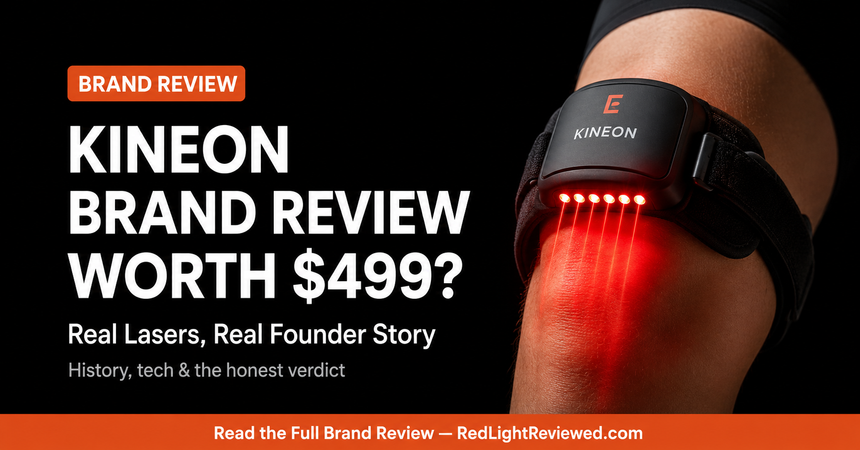
This Kineon review covers a brand with one of the most specific, well-documented founding stories in this entire series: a former professional rugby player’s own chronic MCL injury, a crowdfunding campaign that raised over $1 million and shipped 10,000+ units within nine months, and a device now reportedly used by athletes across the NBA, NFL, MLB, and MLS. Kineon’s Move+ Pro combines actual laser diodes with LEDs in a wearable, joint-targeted design — a genuinely different engineering approach than the flat-panel and mask formats covered across most of this brand review series. This review covers that origin, the specific laser-plus-LED technology, and an honest look at whether the roughly $499 price holds up against the evidence behind it.
Table of Contents
Company Overview
Kineon was founded in 2019 in Atlanta, Georgia, by CEO Forrest Smith and COO Tom Sanderson, later joined by CTO Dr. Chris Bohler — a named technical leader with a doctorate, a level of specific, checkable leadership credential this brand review series doesn’t often encounter. The company’s name comes from the Greek word “kineo,” meaning “to move,” reflecting its founding mission around joint mobility specifically. Kineon launched its first product on the crowdfunding platform Indiegogo in October 2021 after roughly two years of development, raising over $1 million and shipping more than 10,000 units within approximately nine months of launch — a genuine market-validation signal most brands in this series can’t point to. The company has since raised additional angel funding (reported around $480K per startup-tracking sources) and continues operating as an independent, founder-led company rather than a subsidiary of a larger manufacturer.


Origin Story & Technology Background
Forrest Smith’s personal path to founding Kineon is specific and independently corroborated across multiple outlets: a former professional rugby player, Smith suffered an MCL tear and, while researching alternatives to surgery, discovered red light therapy’s potential for pain and inflammation. His background also included 18 years working in China’s LED lighting industry — a genuinely relevant technical credential, giving him direct manufacturing and component-sourcing expertise most red-light-therapy founders in this series don’t have. The original product, initially called the “Knee+” before being renamed “Move+” as the design proved effective beyond just knees, reflects that specific, narrow starting point: rather than building a general-purpose panel, Kineon engineered a wearable device specifically to solve direct-contact joint therapy, a gap Smith and Sanderson identified in the existing at-home recovery market. The core technical differentiator — combining coherent laser diodes with LEDs rather than using LEDs alone — is grounded in real photobiomodulation research showing laser light’s superior tissue-penetration properties compared to scattered LED light, the same laser-vs-LED distinction covered in depth in our hair growth devices roundup.
Product Lineup
Kineon’s catalog centers on one evolving flagship product line rather than the broad multi-format catalogs seen at brands like Mito Red Light or Hooga.
Kineon Move+ Pro is the current flagship — each treatment module combines 10 near-infrared laser diodes (808nm) with 8 deep red LEDs (660nm), delivered through a wearable, hands-free strap system designed for direct joint or muscle contact rather than distance-based exposure. The device offers 5, 10, or 15-minute session lengths, a digital timer and battery display, and ships with 3 LED-plus-infrared modules, an adjustable strap, a travel case, and a charging dock. It’s FSA/HSA eligible and backed by a 30-day money-back guarantee.
Kineon Extender Strap is a genuinely useful accessory addressing a real limitation independent reviewers specifically flagged: the standard Move+ Pro strap fits knees, shoulders, and feet comfortably but is awkward for larger areas like the back or hips without additional circumference — the extender strap ($45–$79) solves that gap directly.
Original Kineon Move+ remains available as an earlier-generation model (manufactured by Shenzhen Kaiyan Medical Equipment Co., Ltd, first listed on Amazon in February 2023), since upgraded in the Pro version with more advanced medical-grade lasers for deeper penetration and a heavier-duty strap, per independent reviewer comparisons of the two generations.
What Makes This Brand Different
Kineon’s clearest, most independently verifiable differentiator is its genuine use of laser diodes rather than LEDs alone — a real engineering distinction with documented penetration advantages, not just marketing language, and one that places Kineon in a small group of brands across this entire site (alongside laser-based hair growth devices like Theradome and HairMax) actually using coherent light rather than scattered LED output. The wearable, direct-joint-contact design is a second genuine differentiator — most panels and masks covered in this series treat from a distance; Kineon’s strap system places the light source directly against the treatment area, which — combined with the laser technology — is a specific, deliberate engineering choice aimed at maximizing dose delivery to joints specifically.
The Science / Technology Approach
Kineon’s 660nm red LED and 808nm near-infrared laser combination sits within well-established photobiomodulation wavelength ranges, and the laser component specifically benefits from the coherent-light penetration advantage documented in comparative research between laser and LED devices. The company states its approach is “backed by over 6,000 published clinical papers” and “15,000+ hours of testing” — the clinical-papers figure reflects the broader photobiomodulation research base generally, similar to how most brands in this category cite general category research rather than device-specific trials, while the testing-hours figure is a brand-stated development claim rather than independently verified. Kineon’s devices are FDA registered, a genuine regulatory status, though — consistent with the precision applied to similar claims throughout this brand review series — registration is a different (lower) bar than full FDA clearance, and buyers should confirm the specific current regulatory status on the listing rather than assuming clearance.
Clinical Evidence & Expert Endorsements
Kineon’s evidence case combines genuine crowdfunding market validation (10,000+ units shipped rapidly), a substantial independent review count (1,487 reviews averaging 4.7 stars on the brand’s own site), and reported use by professional athletes across the NBA, NFL, MLB, and MLS — specific, if not individually itemized, athletic endorsement claims exceeding what most brands in this series can point to. Independent editorial coverage is genuinely extensive for a brand this size, spanning Entrepreneur, Mindbodygreen, AthleTech News, Cybernews, and Gadgets & Wearables — a broader, more mainstream media footprint than nearly every other brand covered in this series except Solawave and Omnilux. As with most brands at this tier, Kineon does not point to its own peer-reviewed, published clinical trial — its evidence rests on the general photobiomodulation research base, genuine crowdfunding and sales validation, and extensive independent editorial testing rather than a device-specific academic study.
Pricing & Value Positioning
Kineon’s Move+ Pro lists at $699 but is very frequently discounted to $499 or lower through ongoing promotions, positioning it as a premium, specialized device rather than a budget option. Independent reviewers have specifically compared this pricing against alternatives — one noted that Mito Red Light’s Mobile Flex offers considerably more raw LED power at roughly half the price ($250), though without Kineon’s laser component or joint-specific wearable design, framing the comparison as “different tools for different specific needs” rather than a straightforward value contest. FSA/HSA eligibility and a 30-day money-back guarantee both meaningfully soften the real financial commitment at this price point.
Reputation & Customer Feedback
Kineon’s reputation is unusually well-documented for a brand of its size and age — 1,487 reviews at 4.7 stars is a substantial review volume, and the extensive independent editorial coverage discussed above provides real, checkable third-party validation beyond the brand’s own customer testimonials. The most consistent independent critique, raised across multiple reviewer sources, is the standard strap’s limited circumference for larger body areas (addressed via the extender strap accessory) and the genuinely high price point relative to broader-coverage panel alternatives — honest, specific limitations rather than vague general complaints.
Comparison vs Competing Brands
Kineon vs Other Recovery-Focused Brands
Technology type, founding, and evidence compared.
| Brand | Founded | Light Source | Format | Reviews | Entry Price |
|---|---|---|---|---|---|
| KineonGENUINE LASER Crowdfunded, athlete-used | 2019 | Laser + LED (coherent) | Wearable, direct-joint | 1,487 (4.7★) | Check price → |
| Mito Red Light MitoMIN 2.0 Patented, independently verified | ~2017-2018 | LED only | Compact panel | Not disclosed | Check price → |
| NovaaLab Light Pad Zone-specific, patented | ~2019-2020 | LED only | Wearable, flexible pad | Not disclosed | Check price → |
Against the field, Kineon’s clearest advantage is genuine laser technology in a wearable, direct-joint-contact format — a combination no other brand in this series offers. Where it loses ground to Mito Red Light specifically is raw power-per-dollar for buyers who don’t need laser-specific penetration or joint-targeted wearable design; where it loses ground to NovaaLab is overall product-line breadth, since Kineon remains centered on essentially one evolving flagship product rather than a full zone-specific catalog.
Common Misconceptions About This Brand
The most common misconception is assuming Kineon’s crowdfunding origin means it’s a less-established or riskier brand than more traditionally-funded competitors — the opposite case is arguably stronger here: the Indiegogo campaign functioned as genuine, public market validation (10,000+ units shipped based on real customer demand, not investor speculation), and the company has since built a substantial independent review base and mainstream media footprint that exceeds most traditionally-funded competitors in this series. A second misconception is assuming “FDA registered” and the “6,000+ clinical papers” citation mean Kineon’s specific device has been through an independent clinical trial — both are real, legitimate claims, but they describe regulatory registration status and the broader research field respectively, not a device-specific published study.
Who Should Buy From This Brand
Kineon is a strong fit for buyers dealing with specific, localized joint pain (knees, shoulders, elbows) who want genuine laser-grade technology in a hands-free wearable format, buyers who value extensive independent editorial coverage and a large review base as trust signals, and buyers willing to pay a premium price for a device engineered specifically for direct-joint dosing rather than general-area coverage. It’s a weaker fit for buyers who want to treat larger or multiple body areas simultaneously, where a full-body panel offers more coverage per dollar, and for budget-conscious buyers who don’t specifically need laser technology’s penetration advantage over LED-only devices.
Our Verdict
4.4/5. Kineon earns a strong score on the combination of a genuinely well-documented founder story, real laser technology (not just marketing language), substantial independent review volume, and extensive mainstream media coverage rare for a brand of its size. Its premium price is a real consideration, and buyers whose needs are better served by broader-coverage panels should weigh that tradeoff directly, but for the specific use case Kineon was built to solve — targeted, joint-focused pain relief in a portable format — the evidence behind it is genuinely stronger than most comparably-priced competitors in this category.
FAQ
Frequently asked questions
Common questions about Kineon and the Move+ Pro.
Genuine laser diodes — each treatment module combines 10 near-infrared laser diodes (808nm) with 8 deep red LEDs (660nm). This is a real, checkable technical specification, not marketing language, and coherent laser light does have documented penetration advantages over scattered LED light.
ScienceForrest Smith (CEO) and Tom Sanderson (COO) founded Kineon in 2019, later joined by CTO Dr. Chris Bohler. Smith, a former professional rugby player, developed the concept after his own MCL knee injury and 18 years of experience in China’s LED lighting industry.
Buying DecisionKineon states its devices are FDA registered. As with other brands where this distinction matters, registration is a different, lower regulatory bar than full FDA clearance — confirm current status directly on the listing if this specifically matters to your decision.
SafetyThe standard strap fits knees, shoulders, and feet comfortably but is limited for larger areas like the back or hips. Kineon sells an Extender Strap accessory specifically to address this gap.
UsageYes, the Move+ Pro is marketed as FSA/HSA eligible, which can meaningfully offset its premium price for account holders.
UsageIt depends on your specific need. For genuinely localized joint pain, Kineon’s laser-plus-wearable design offers targeted dosing few panels replicate. For broader body coverage, a full-body panel typically offers more raw power per dollar, without the laser component or joint-specific wearable format.
Buying DecisionThe brand’s own guidance suggests some users notice reduced pain within minutes of a single session, though most independent reviewers recommend at least 30 days of consistent daily use for noticeable, lasting results.
ResultsFinal Thoughts
Kineon’s origin story — a rugby player’s own knee injury turned into a crowdfunded, laser-powered wearable now used by professional athletes across four major leagues — is one of the more compelling founder narratives in this entire brand review series, and it’s backed by real engineering substance (genuine laser technology) rather than just a good story. For buyers with a specific, localized joint pain concern, it’s one of the most evidence-supported specialized options covered on this site. For general background on laser-versus-LED technology referenced throughout this review, our hair growth devices roundup covers that distinction in additional depth.
Red light therapy devices are not intended to diagnose, prevent, or treat any medical condition. Individual results may vary. Consult a healthcare provider before starting any new health regimen.