Irradiance Explained: Why mW/cm² Is the Most Important Spec in Red Light Therapy
Spread the love
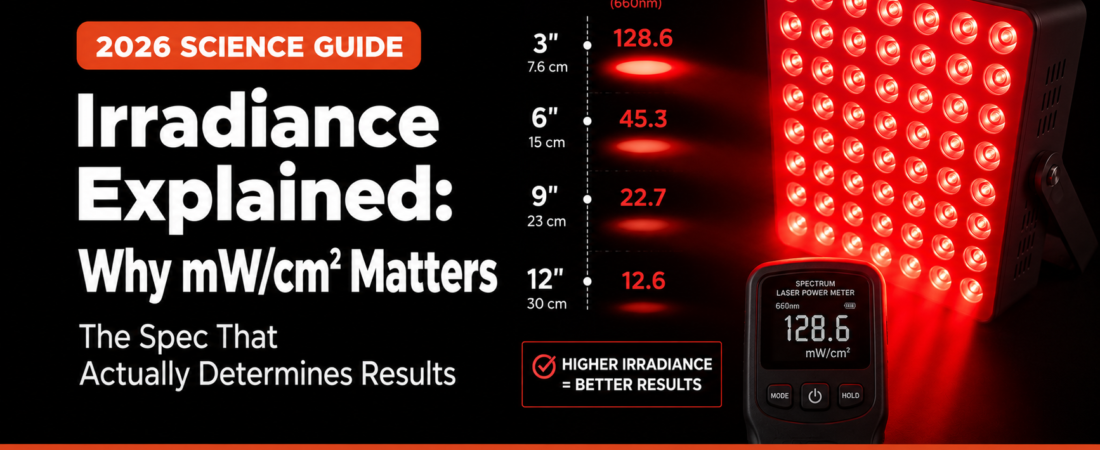
Of all the specifications listed on a red light therapy device — LED count, wattage, wavelength, number of colors — irradiance is the one that most directly determines whether the device will produce clinical results. It is also the one that receives the least honest treatment in marketing copy.
This guide explains what irradiance actually means, how it relates to the dose delivered to your tissue, why the biphasic dose response is the concept every buyer should understand, and what to look for — and be skeptical of — when evaluating a device.
Table of Contents
What Irradiance Is
Irradiance is the power density of light reaching a surface, measured in milliwatts per square centimetre (mW/cm²). It tells you how much light energy is arriving at the skin surface per unit area per unit time.
Think of it like water pressure from a shower head. The wavelength determines what type of water you are using; the irradiance determines how hard it hits. A low-irradiance device at the right wavelength is like running a therapeutic shower at barely a trickle. Enough time might eventually deliver some effect, but the physics are working against you.
In practical terms: irradiance corresponds to the amount of energy delivered to a specific part of the human body during a session. For instance, in a red light therapy device that radiates at 50 mW/cm², each square centimetre of skin that’s irradiated receives 50 milliwatts of energy per second.
Irradiance vs Fluence: Two Different Things
These terms are often used interchangeably in consumer content, which creates significant confusion. They measure different things.
Irradiance (mW/cm²) is instantaneous power density — how intense the light is at a given moment and distance. It is a rate, not a total.
Fluence or energy density (J/cm²) is the total energy delivered per unit area over the full session. It is calculated by multiplying irradiance by time:
(mW/cm² × seconds) ÷ 1000 = J/cm²
So a device delivering 50 mW/cm² for 600 seconds (10 minutes) delivers: (50 × 600) ÷ 1000 = 30 J/cm²
Both figures appear in clinical trial protocols, and both matter. But they interact: a high-irradiance device delivers therapeutic dose faster, requiring shorter sessions. A low-irradiance device requires longer sessions to reach the same total dose — or may never reach it if the session time is fixed.
This is why the 10-minute auto-shutoff common in consumer LED masks is worth scrutinising. At 5–10 mW/cm² (typical for budget masks), 10 minutes delivers only 3–6 J/cm² — at the lower end of the therapeutic window. At 15 mW/cm² for the same duration: 9 J/cm², which sits more comfortably in the range used in clinical studies.
The Therapeutic Window: How Much Is Enough?
The clinical research does not converge on a single irradiance figure — it converges on a range, with important variations by application.
The ideal irradiance for red light therapy typically ranges from 20 to 200 mW/cm². This range ensures the best therapeutic benefits with minimal risk of side effects.
Breaking it down by use case:
Skin and superficial tissue (collagen, wound healing, acne): Clinical studies typically use 5–50 mW/cm² at skin surface, with total doses of 3–10 J/cm² per session. LED masks at 10–20 mW/cm² for 10 minutes deliver 6–12 J/cm² — within the effective range for skin applications.
Muscle recovery and joint pain: Panels at 6 inches typically deliver 50–150 mW/cm². The higher irradiance is needed partly because these applications require energy to penetrate past the skin to reach deeper tissue, where much of it is scattered or absorbed before reaching the therapeutic target.
Hair follicle stimulation: Devices typically operate at lower power densities (5–50 mW/cm² at the scalp) because follicles sit only 3–5mm below the surface. Clinical hair growth studies use total doses of 1–4 J/cm² per session.
For superficial tissues such as your skin or ligaments that are really superficial on the human body, you’ll need a dose of 2–10 J/cm².
The Biphasic Dose Response: Why More Is Not Always Better
This is the single most important concept in photobiomodulation dosing, and the one most often ignored in consumer marketing.
Photobiomodulation follows a biphasic dose-response curve — also called the Arndt-Schulz law in biology. At subtherapeutic doses, there is little or no effect. As dose increases into the therapeutic window, effects increase proportionally. But beyond a certain threshold, the effect diminishes and can reverse — excessive light energy generates oxidative stress rather than reducing it, and inhibits the cellular activity it was meant to stimulate.
Many biological processes, including the response to light therapy, follow a biphasic dose-response curve, meaning that both too little and too much light energy can be ineffective or even harmful. Optimal dosing is essential to achieve the desired therapeutic effect without causing adverse side effects.
The practical implication for consumer devices: the highest-irradiance device is not necessarily the best device. A panel delivering 150 mW/cm² used at 2 inches for 20 minutes delivers a very high energy dose that may exceed the optimal range for skin applications. The same panel at 6–12 inches for 10 minutes delivers a more moderate dose that sits within the therapeutic window.
A 5–10 minute session at the right irradiance typically outperforms a 30-minute session at the same irradiance in some applications — evidence that session length cannot simply be extended indefinitely to compensate for lower power.
Why Manufacturer Irradiance Claims Are Unreliable
This is the most practically important section of this guide for anyone making a purchasing decision.
Consumer device irradiance figures are almost universally measured at the closest possible distance from the device — typically 0 or 1 inch — and represent the peak reading, not the average across the treatment area. Clinical research measures irradiance at the treatment distance (typically 6 inches for panels, skin contact for masks) and often reports average rather than peak values.
The difference is enormous. Light intensity follows the inverse square law: double the distance, quarter the irradiance. A device claiming 150 mW/cm² at 0 inches might deliver 15–25 mW/cm² at 6 inches. That is still potentially therapeutic, but the headline figure is misleading by an order of magnitude.
What to look for:
Third-party verified irradiance data — Mito Red Light publishes independent laboratory measurements of their devices at multiple distances. This is genuinely unusual in the consumer market and meaningfully differentiating. CurrentBody uses Veritace verification for their LED masks — the same principle applied to a different device format.
Irradiance at 6 inches specifically stated — any brand willing to publish this figure, rather than “at 0 inches” or “at device surface,” is providing more usable information.
Inverse square law confirmation — if a brand’s irradiance figures across multiple distances follow the inverse square law predictably, it suggests their measurements are real rather than inflated. One verified iRestore customer running their own measurement found power consumption of approximately 90W versus the stated 95W ± tolerance — figures that aligned with the inverse square law across distances. That kind of consistency is a meaningful signal.
What to be skeptical of:
Brands that list only total wattage (e.g., “105W panel”) without specifying irradiance at a treatment distance are not providing useful dosing information. Total wattage tells you the power consumption of the device, not how much light reaches your skin at a given distance.
How to Calculate Your Own Dose
The formula is straightforward:
(irradiance in mW/cm²) × (session time in seconds) ÷ 1000 = J/cm²
Examples:
Dose calculator — irradiance × time = joules
How different irradiance levels and session times translate into total energy dose (J/cm²). Therapeutic range for skin: 3–15 J/cm².
← Scroll to see all →
Device type
Irradiance at distance
Session time
Total dose
Range assessment
Budget LED mask
3–5 mW/cm² (contact)
10 min
1.8–3 J/cm²
Sub-therapeutic
Mid-range LED mask
10–15 mW/cm² (contact)
10 min
6–9 J/cm²
Therapeutic ✓
Premium LED mask
20–30 mW/cm² (contact)
10 min
12–18 J/cm²
Therapeutic ✓
Entry panel at 6″
30–60 mW/cm²
10 min
18–36 J/cm²
Deep tissue range
Mid panel at 6″
60–100 mW/cm²
10 min
36–60 J/cm²
Deep tissue range
High-power panel at 6″
100–150 mW/cm²
10 min
60–90 J/cm²
High dose / recovery
For skin applications, the research-supported range is roughly 3–15 J/cm² per session. For muscle and joint applications, higher doses (20–60 J/cm²) are used in clinical protocols because much of the energy is attenuated before reaching the target tissue.
What This Means for Device Selection
Understanding irradiance collapses a lot of the confusion in the consumer market.
A budget LED mask claiming 7 wavelengths and 200 LEDs but delivering 1–3 mW/cm² at skin contact is providing negligible therapeutic dose regardless of how many LEDs it has. An LED mask delivering a verified 15 mW/cm² with 272 LEDs at skin contact and a 10-minute session timer is delivering 9 J/cm² — within the therapeutic range for collagen stimulation.
A panel delivering 95 mW/cm² at 6 inches (independently verified) for a 10-minute session delivers 57 J/cm² — appropriate for deep tissue applications where much of the dose is attenuated before reaching the target.
The specifications that actually matter, in order of importance:
Irradiance at treatment distance (mW/cm²) — ideally third-party verified
Wavelength — 630–660nm for skin, 850nm for deeper tissue
Coverage area — adequate for the treatment zone
Session time and frequency — consistent with the clinical protocols
LED count, total wattage, and number of wavelengths are secondary indicators at best and marketing metrics at worst.
Recommended Devices with Transparent Irradiance Data
Common questions about irradiance, dosing, and power output in red light therapy.
For skin applications — collagen stimulation, acne, wound healing — an LED mask delivering 10–30 mW/cm² at skin contact for a 10-minute session delivers 6–18 J/cm², which sits within the therapeutic range confirmed in clinical studies. For panels used for body and joint applications at 6 inches, 50–150 mW/cm² is the typical range. The key caveat is that most manufacturers measure irradiance at 0–1 inches from the device, not at the treatment distance. A device claiming 100 mW/cm² at 0 inches may deliver 10–20 mW/cm² at 6 inches — still potentially therapeutic, but the headline number is essentially useless without knowing the measurement distance.
Dosing science
No — and this is the most important concept in photobiomodulation dosing. Red light therapy follows a biphasic dose-response curve: too little produces no effect, the optimal range produces the strongest effect, and too much can actively inhibit the cellular response. Using a very high-irradiance panel at very close range for extended sessions can push past the therapeutic window. For skin applications, this means that the highest-irradiance device is not necessarily the best — a moderate irradiance at the right distance and session duration is more reliably therapeutic than maximum power at minimum distance for maximum time.
Dosing science
The formula is: (mW/cm² × session seconds) ÷ 1000 = J/cm². For example, a mask delivering 15 mW/cm² for 600 seconds (10 minutes): (15 × 600) ÷ 1000 = 9 J/cm². The challenge is knowing your device’s actual irradiance at the treatment distance — not the manufacturer’s peak figure at 0 inches. If your device does not publish irradiance at treatment distance, you can only estimate based on the inverse square law: irradiance approximately quarters each time you double the distance from the light source.
Dosing math
Because there is no standardised measurement protocol that consumer brands are required to follow. Most brands measure at 0 or 1 inch from the device surface — the highest possible reading. Some measure at 6 inches. A few publish measurements across multiple distances. Light intensity follows the inverse square law, so these different measurement distances produce dramatically different numbers from the same device. A panel measuring 200 mW/cm² at 1 inch might measure 12–20 mW/cm² at 6 inches. Without knowing the measurement distance, irradiance figures across different brands are essentially incomparable.
Buying guidance
Wattage (W) tells you the device’s power consumption, not how much light reaches your skin. Total wattage includes power consumed by the device circuitry, heat dissipation, and other losses — not all of it converts to therapeutic light output. A 100W panel does not deliver 100W of red light to your body. Irradiance at treatment distance (mW/cm²) is the only specification that tells you how much light energy actually arrives at the skin surface. That said, higher-wattage devices generally correlate with higher irradiance at a given distance — the relationship exists, but it is not direct or linear.
Buying guidance
The most reliable signals: third-party verified irradiance data published at treatment distance (Mito Red and CurrentBody are the consumer brands that do this most transparently); FDA clearance for a specific clinical indication (which requires demonstrated effectiveness at therapeutic parameters); and buyer-verified measurements — experienced users who measure their devices with optical power meters and report consistent results. Absent these, a sustained high review rating from thousands of buyers over many months — not a spike of early reviews — is a reasonable secondary indicator that the device is delivering results, even without irradiance transparency.
Buying guidance
Looking for devices with verified irradiance data?The two most transparent options on the market