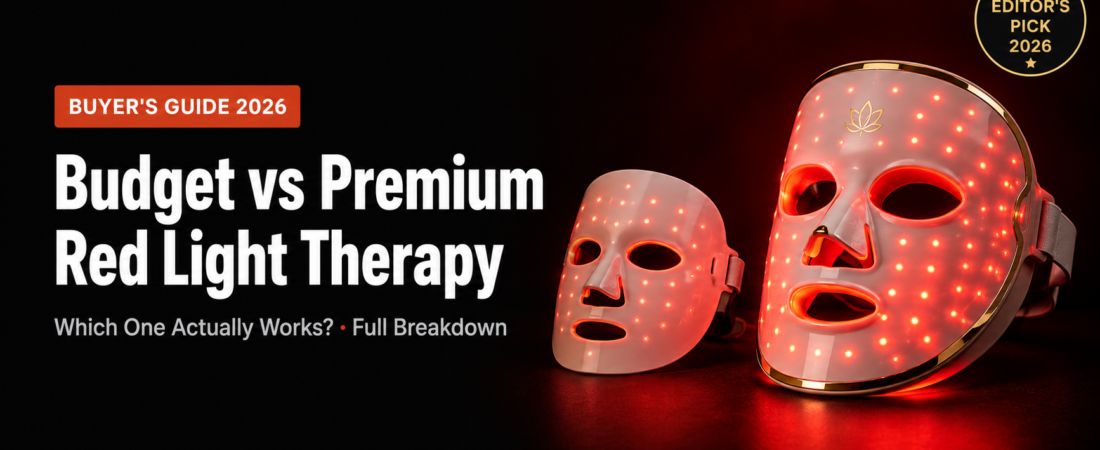
Budget vs Premium Red Light Therapy: Is It Worth Spending More?
Spread the love
You’ve decided red light therapy is worth trying. Now you’re staring at two devices side by side: one for $49 on Amazon, one for $399 from a brand your dermatologist mentioned. They both glow red. They both claim to reduce wrinkles, stimulate collagen, and improve skin tone. The photos look almost identical.
So what exactly are you paying for when you spend eight times more?
That’s the question this guide answers — honestly. Not with a blanket “buy premium” or “budget is fine” conclusion, but with the actual technical differences that determine whether a red light therapy device will produce real, visible results, or leave you with nothing but a glowing face and a lighter wallet.
Table of Contents
Why Red Light Therapy Device Prices Vary So Wildly
The wide price gap between budget and premium devices stems from several layers of cost that are not always obvious to first-time buyers. Manufacturing a basic LED array is relatively inexpensive, but adding verified wavelength precision, consistent irradiance output, safety certifications, robust electrical design, and reliable warranty support increases expenses significantly.
Add to that the cost of clinical research, independent third-party testing, regulatory compliance (FDA clearance), and customer support infrastructure — and you begin to understand why the same-looking product can cost $49 or $499.
The problem is that marketing language obscures these differences almost completely. Every device on Amazon claims “clinical-grade,” “medical-grade LEDs,” and “FDA registered.” Almost none of them explain what their irradiance output actually is at your skin, because that number — more than any other — exposes the gap between what a device costs and what it delivers.
The Three Specs That Actually Determine Results
Before comparing price tiers, you need to understand which specs actually drive results. Everything else is marketing.
1. Irradiance (mW/cm²) — The Most Important Number Nobody Talks About
Irradiance is the amount of light energy delivered per unit area at your skin surface, measured in milliwatts per square centimeter (mW/cm²). It is the single most important specification in red light therapy, and the one most frequently hidden or manipulated by budget brands.
The lower threshold for clinical irradiance is considered to be 40 mW/cm². Most clinical research studies that focused on skin rejuvenation used around 55 mW/cm². Studies with irradiances between 8–25 mW/cm² were a bit hit or miss in terms of finding the skin improvements they were looking for. The studies using irradiances around 35–50 mW/cm² had the strongest evidence of LED working as intended. Goals To Get Glowing
What does this mean practically? Many cheap masks don’t disclose irradiance because they’re under 10 mW/cm² — meaning they look the same but produce no real results.
If a mask does list irradiance, compare it against published therapeutic thresholds. Too low and you are just wearing a warm light.
There is also an upper limit to be aware of: photobiomodulation follows a biphasic dose response. Doubling the wattage often does not double the benefit and can extinguish it. The therapeutic sweet spot for facial skin is roughly 30–65 mW/cm² at the skin surface.
2. Wavelength Accuracy — What the Device Actually Emits
The therapeutic benefits of red light therapy depend on light being delivered at specific wavelengths: 630–660nm for red, 810–850nm for near-infrared. The research that supports red light therapy is built on these specific ranges.
Budget LEDs often drift by 20–30nm from their advertised wavelength, which matters because the research supporting red light therapy at 660nm doesn’t necessarily transfer to light peaking at 630nm or 690nm. Higher-end panels typically use LEDs from well-established manufacturers that bin tightly around specific target wavelengths.
A device claiming “660nm” may emit peak output anywhere from 640nm to 690nm. At the extremes, you’re no longer operating in the clinically validated range — and results will be correspondingly weaker or nonexistent.
3. LED Quality vs LED Count
More LEDs is not automatically better. 100 high-quality, tightly binned LEDs driven well will outperform 200 cheap LEDs running inefficiently every time.
Budget devices frequently advertise high LED counts using low-quality emitters that degrade quickly and deliver inconsistent output across the treatment surface. Premium devices use medical-grade or dual-chip LEDs with verified output consistency — fewer in count, but higher in quality and longevity.
What Cheap Devices Get Wrong (And How to Spot Them)
Not every affordable device is worthless — but the majority of sub-$75 red light therapy devices on Amazon fail on at least one of these dimensions:
They hide or omit irradiance data. If a device doesn’t publish its irradiance in mW/cm² at a specified distance, assume it’s below therapeutic threshold. Reputable brands publish this prominently. Budget brands bury it or omit it entirely.
They use the wrong wavelengths. Many cheap devices use mixed RGB LEDs that look red but emit light across a broad spectrum, diluting the therapeutic output at any specific wavelength. Many low-cost LED masks rely on mixed RGB lighting, which lacks wavelength precision and consistent irradiance.
They inflate wattage claims. Many budget device listings inflate wattage figures using “pull” or “theoretical” specs rather than real measured output. A device advertised as “300W” may draw only 60–80W at the wall.
They measure irradiance at the LED surface, not at treatment distance. Many manufacturers report irradiance at the LED surface (0 inches) rather than at treatment distance (6–12 inches). Irradiance drops dramatically with distance. A device claiming “200 mW/cm²” at 0 inches might deliver only 40 mW/cm² at 6 inches.
They have no FDA clearance. “FDA Registered” is a facility registration, not a device review. “FDA Cleared” requires actual clinical testing. Most sub-$75 devices have neither.
Their LEDs degrade faster. Cheap devices with poor heat dissipation experience LED degradation over time, meaning your device loses power and effectiveness faster.
What You’re Actually Paying for in Premium Devices
Premium pricing in legitimate devices buys you real, verifiable things:
Verified wavelength accuracy. Companies like Joovv, Mito Red Light, Platinum LED, and a handful of others have built reputations largely on being willing to publish real irradiance data and having those numbers independently verified. CurrentBody’s Veritace® system goes a step further — every individual LED bulb is tested and logged, and you receive the verification record with your device.
Adequate irradiance at therapeutic distances. Independent irradiance measurements consistently show premium panels delivering 2x to 4x more usable light energy than similarly priced Amazon options.
FDA clearance. Requires specific clinical testing to validate safety and efficacy claims. It’s not a guarantee of results, but it confirms the device has met a regulatory standard.
Published clinical research. Omnilux has 40+ peer-reviewed studies. CurrentBody has independent third-party clinical trials. Budget brands have marketing copy.
Build quality and longevity. Aluminum housing, active cooling, medical-grade silicone, and quality LED chips from reputable manufacturers (Epistar, Seoul Semiconductor) versus plastic housing with no thermal management.
Warranty and customer support. Premium brands typically offer 1–2 year warranties with genuine support. Many Amazon budget brands operate through rotating seller accounts with no meaningful warranty.
The Four Price Tiers — What Each Gets You
Tier 1: Under $75 — Approach With Extreme Caution
At this price point, the vast majority of devices deliver irradiance below the therapeutic threshold. Most $30–$50 masks deliver 10–15 mW/cm², which is below therapeutic threshold. Results: essentially placebo.
There are rare exceptions — devices that disclose real wavelength specs and irradiance data — but they require significant research to identify. As a general rule: if a device at this price doesn’t publish mW/cm² at a specified treatment distance, don’t buy it.
The honest verdict: Save until you can reach the next tier. Spending $49 on a device that delivers sub-therapeutic light is not a money-saving move — it’s a waste of $49.
Tier 2: $75–$200 — Where Budget Starts to Become Viable
This is where you begin to find devices that disclose real specs and deliver genuinely therapeutic irradiance. Masks above $75 from reputable brands typically deliver therapeutic doses; masks under $50 often don’t.
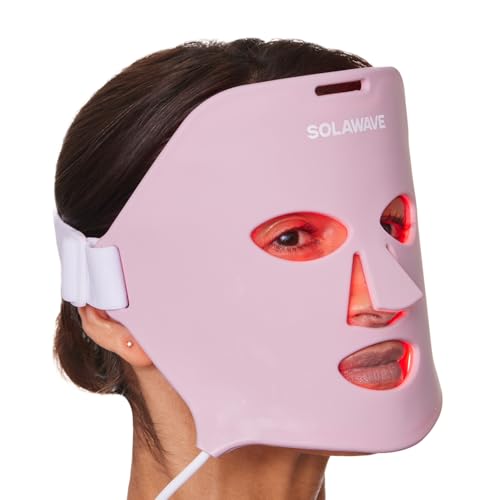
Devices in this range won’t match the clinical research backing or LED quality of premium brands, but with correct wavelengths and adequate irradiance (30+ mW/cm²), they can produce real results with consistent use. The Solawave Wrinkle Retreat Pro (~$199) sits at the top of this tier and is our best-value pick for facial anti-aging.
The honest verdict: Solid starting point if budget is a genuine constraint. Prioritize verified wavelengths and disclosed irradiance over LED count or brand claims.
Tier 3: $200–$400 — Best Value for Most People
This is where the best value lives in 2026. Clinical-grade specs, FDA clearance, and significant improvement in fine lines and firmness are achievable at this tier. Facecutie
Devices here typically offer 30–65 mW/cm² irradiance, verified wavelengths, FDA clearance, and meaningful warranty coverage. The gap between this tier and the premium tier above it is real but not dramatic for most users with general anti-aging goals.
The honest verdict: The sweet spot for serious users who want real results without paying premium brand premiums. Most people should buy here.
Tier 4: $400+ — Premium, With Justified Premiums
At this tier you’re paying for clinical research legacy (Omnilux’s 40+ studies), advanced wavelength technology (CurrentBody’s 1072nm deep NIR), per-LED quality verification (Veritace®), and the highest confidence that the device you receive actually performs as advertised.
For most users, the difference between a $349 mid-range mask and a $499 premium mask is 5–15% better results — which matters if you have severe concerns but is overkill for general anti-aging.
The honest verdict: Worth it if you have specific, serious skin concerns — visible aging, significant skin laxity, or you want the absolute highest confidence in your device’s performance. Not necessary for everyone.
Budget vs Premium: Full Comparison by Price Tier
What each price tier actually delivers — and our top verified pick at every level.
The four price tiers at a glance
⚠️ Avoid
Under $75
Sub-therapeutic
Most deliver 5–15 mW/cm². Below clinical threshold. Save your money.
✓ Viable
$75–$200
Budget entry point
Works if specs are verified. Solid for beginners and mild maintenance.
★ Sweet Spot
$200–$400
Best value 2026
Clinical-grade specs, FDA cleared, meaningful results for most users.
◆ Premium
$400–$500+
Maximum confidence
40+ studies, Veritace verification, advanced wavelengths. Best for serious concerns.
Spec comparison across price tiers
Spec
Under $75
$75–$200
$200–$400
$400–$500+
Irradiance (mW/cm²)
5–15 mW/cm²
20–40 mW/cm²
40–65 mW/cm²
30–65 mW/cm²
Wavelength accuracy
±20–30nm drift
±10–15nm
±5–10nm
±5nm verified
FDA Status
Usually none
Some cleared
✅ All cleared
✅ All cleared
Published irradiance
Rarely
Sometimes
Usually yes
Always
LED quality
Generic RGB
Consumer-grade
Consumer–Medical
Medical-grade
Clinical research
None
Minimal
Moderate
Extensive
Warranty
30–90 days
6–12 months
1 year
1–2 years
Expected results
Minimal / none
Moderate
Strong (8–12 wks)
Strongest
Session time needed
30–45+ min
20–30 min
10–15 min
10 min
Our verified top pick at every price point
Best Budget Pick
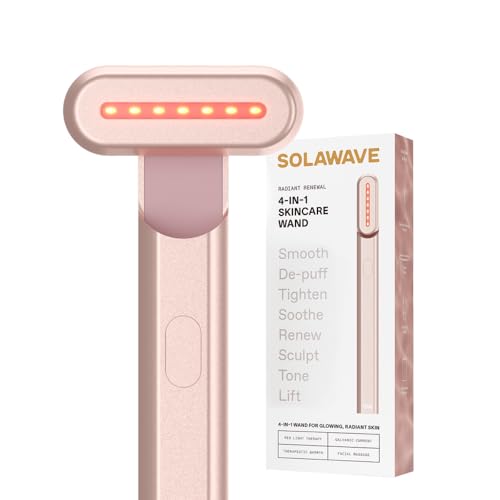
Solawave 4-in-1 Red Light Wand
~$169
✅ FDA Cleared📡 630nm red light⚡ + Galvanic + Warmth + Massage🏆 700K+ customers
You’re completely new to red light therapy and want to test before committing
Your primary goal is mild skin maintenance, not targeting visible aging
Budget is a genuine constraint — and you’re willing to do the research to verify specs
You’re under 30 with no specific skin concerns (collagen production is still robust; benefits will be subtle at any price)
You prioritize the device being a handheld wand for spot treatment only
Buy a Premium Device ($250–$500+) if:
You have visible fine lines, skin laxity, or specific aging concerns you want to address seriously
You’ve used a budget device and didn’t see results — and want to know if the technology works for you with a properly specced device
You want the confidence of FDA clearance and independent clinical research
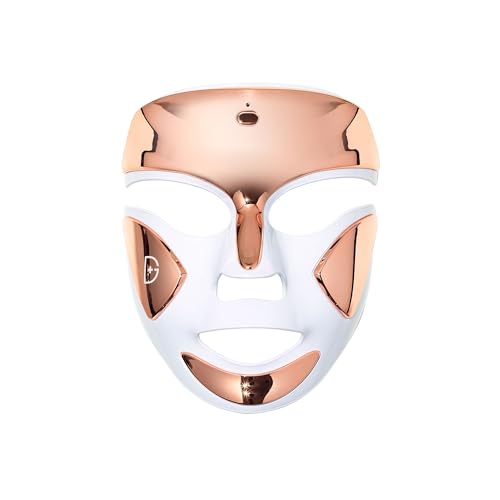
You’re treating persistent acne alongside aging (Dr. Dennis Gross SpectraLite)
You plan to use the device long-term as part of a consistent skincare routine
You want the absolute best technology available (CurrentBody S2 with 1072nm)
The Middle Path
The best affordable red light therapy mask isn’t the cheapest option — it’s the one that balances correct wavelengths, safe power, comfort, and consistency. Choosing thoughtfully and using consistently matters far more than price alone.
A $199 mask used five times a week for twelve weeks will outperform a $499 mask used twice a week for three weeks every single time. Compliance is the variable that matters most at any price tier.
The Best Devices at Every Price Point
All products below are verified available on Amazon US with confirmed ASINs.
Best Budget Pick (~$169)
Solawave 4-in-1 Red Light Therapy Wand FDA Cleared · 630nm · Galvanic + Warmth + Massage
Before closing, here are the signals that should make you walk away from any device regardless of price:
No irradiance (mW/cm²) published at a specified treatment distance
“FDA Registered” only — not FDA Cleared
No exact wavelengths listed in nm — just “red light” or “LED therapy”
Wattage claims without wall-draw specs — “1000W panel” at $89 is not real
No warranty or return policy — a sign of a disposable product
Claims that exceed clinical evidence — weight loss, detox, cancer treatment, anti-aging “reversal”
No company contact information or customer support
Frequently Asked Questions
Do cheap red light therapy devices actually work?
It depends entirely on the device’s specifications — not its price. The key question is whether it delivers therapeutic irradiance (30+ mW/cm²) at the correct wavelengths (630–660nm red, 810–850nm NIR). Most devices under $75 deliver 5–15 mW/cm², which is below the therapeutic threshold — meaning they look exactly like more expensive devices but produce no meaningful cellular response. Devices priced $75–$200 from reputable brands that disclose real specs can produce genuine results. If a device doesn’t publish its irradiance in mW/cm² at a specified distance, don’t buy it regardless of price.
Is a $400+ red light therapy mask worth it?
For most people with serious anti-aging goals, yes — with caveats. Premium devices like the CurrentBody Series 2 (~$470) or HigherDOSE (~$269) offer FDA clearance, verified wavelengths, published irradiance, and the highest confidence that the device will perform as advertised. The difference between a $349 mid-range mask and a $499 premium mask is roughly 5–15% better results — meaningful if you have visible aging concerns, but potentially overkill for general skin maintenance. A professional LED facial costs $150–$300 per session; a premium mask pays for itself within 2–3 months of consistent use.
What is irradiance and why does it matter for red light therapy?
Irradiance (measured in mW/cm²) is the amount of light energy delivered per unit area at your skin surface. It’s the single most important specification in red light therapy — and the one most frequently hidden or manipulated by budget brands. Clinical research shows that studies using 35–55 mW/cm² had the strongest evidence of measurable skin improvement. Devices delivering under 15 mW/cm² are unlikely to produce meaningful results regardless of how long you use them. Always check that irradiance is measured at a specified treatment distance (not at the LED surface), and that the number falls between 30–65 mW/cm² for facial applications.
What’s the minimum I should spend on a red light therapy device?
For a handheld wand: ~$75 minimum, with the Solawave 4-in-1 (~$169) being our recommended entry point for its FDA clearance and multi-technology approach. For a full LED face mask: ~$150 minimum from a brand that publishes real specs. If your budget is genuinely under $75, we recommend saving until you can reach the $150–$200 tier rather than buying a sub-therapeutic device that produces no results and leaves you convinced red light therapy doesn’t work — when the technology is sound but your device wasn’t.
Can I use a longer session with a budget device to compensate for lower irradiance?
Partially — but not fully. Session dose (measured in J/cm²) equals irradiance multiplied by time. So a device delivering 20 mW/cm² for 20 minutes delivers the same surface dose as one delivering 40 mW/cm² for 10 minutes. However, lower irradiance also means fewer photons penetrating to therapeutic tissue depth where collagen-producing fibroblasts live. At 20 mW/cm² surface irradiance, the dose reaching dermal depth (1–2mm) drops significantly. A budget device at 10 mW/cm² cannot compensate with longer sessions — the light simply isn’t powerful enough to reach the target tissue, regardless of duration. This is why irradiance is not just a convenience spec, but a fundamental determinant of whether the therapy can work at all.
What does FDA Cleared mean for red light therapy devices?
FDA Cleared means the device has been reviewed by the FDA and found substantially equivalent to a legally marketed device with demonstrated safety and efficacy for specific claims. It requires clinical testing and regulatory review — not just facility registration. “FDA Registered” — which many cheap devices claim — only means the manufacturing facility is registered, not that the device itself has been reviewed or tested. “FDA Approved” is a more rigorous process reserved for higher-risk medical devices; most consumer LED masks are cleared, not approved, which is entirely appropriate for their risk category. Never buy a red light therapy device that claims neither clearance nor approval.
Does a higher LED count mean a better device?
No — and this is one of the most common marketing tricks in the category. More LEDs is not automatically better. 100 high-quality, tightly binned medical-grade LEDs will outperform 300 cheap generic LEDs every time. Budget devices frequently advertise high LED counts using low-quality emitters that degrade quickly and deliver inconsistent irradiance across the treatment surface. What matters is LED quality (the manufacturer, binning tolerance, wavelength accuracy), density and distribution across the mask, and total irradiance delivered at your skin. LED count is a secondary spec — check irradiance and wavelength accuracy first.
Which is the best value red light therapy device in 2026?
For facial anti-aging, the Solawave Wrinkle Retreat Pro (~$199) offers the best combination of price and performance: 320 LEDs, 4 wavelengths (630+660+830+605nm), FDA Cleared, 65 mW/cm² irradiance, and a 3-minute session protocol that makes daily compliance realistic. For those ready to invest in a premium device, the HigherDOSE Red Light Face Mask (~$269) offers FDA clearance, FSA eligibility, and wireless convenience at the most accessible premium price point. For maximum technology, the CurrentBody Skin LED Mask Series 2 (~$470) remains the most technically advanced mask available with its unique 1072nm deep NIR wavelength and Veritace® per-LED verification.