CurrentBody Red Light Therapy Review: Is Veritace Worth the Premium?
Spread the love
This CurrentBody red light therapy review looks at a brand that occupies an unusual position in this category: it’s the most recognizable premium name in consumer LED therapy, but it didn’t start as a photobiomodulation company at all. CurrentBody built its business selling other people’s beauty devices for a decade before launching its own LED line — and that origin story shapes everything about how the brand operates today, from its pricing to its marketing to the specific technical claims it makes. This review covers the company’s full product lineup, the testing program it uses to differentiate itself, where the pricing actually sits relative to the category, and an honest look at customer reputation across platforms — not just the polished version CurrentBody presents on its own site.
Table of Contents
Company Overview
CurrentBody was founded in 2009, originally as an online retailer for third-party beauty devices — stocking brands like NuFACE, FOREO, and Tripollar rather than manufacturing anything itself. The company launched its own-brand LED products around 2019, starting with the CurrentBody Skin LED Light Therapy Mask, and has since expanded into a full line spanning face masks, a body panel, and a hair growth helmet. Headquartered in Manchester, UK, CurrentBody has positioned itself firmly as a premium beauty-tech brand rather than a clinical or medical-device company, and its retail footprint reflects that positioning: alongside its own site and Amazon, its products are sold through Harrods, Selfridges, and a range of international beauty retailers most competitors in this category never reach. This retail pedigree is worth understanding upfront, because it explains both the brand’s biggest strength (polish, marketing sophistication, retail credibility) and its most common criticism (you’re paying a meaningful premium for that positioning, not just for the hardware inside the device).
CurrentBody’s core lineup centers on three products, each aimed at a different use case within the same underlying technology.
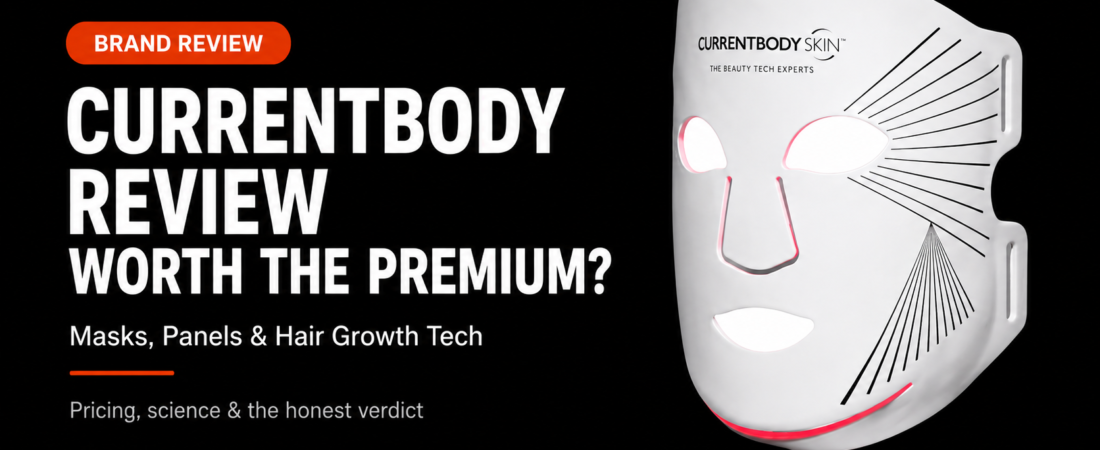
CurrentBody Skin LED Light Therapy Mask: Series 2 is the flagship and the product most associated with the brand. It uses 236 LEDs across three wavelengths — 633nm red, 830nm near-infrared, and a less common 1072nm deep near-infrared — in a flexible silicone mask with a multiway strap, running 10-minute sessions at a typical price of $469.99. This is covered in more detail in our best LED face masks roundup, where it ranks among the top premium options for its clinical documentation. The earlier Series 1 mask, still sold on secondary markets, used a simpler 132-LED, two-wavelength (633nm/830nm) design.
CurrentBody Skin LED Light Therapy Panel is the brand’s body-focused expansion, launched more recently to meet demand from customers who wanted the same technology beyond the face. It offers four pre-programmed settings — two blue-and-red combinations and two red-and-near-infrared combinations — with 10- and 20-minute session options, designed to be used roughly six inches from the skin rather than in direct contact.
CurrentBody Skin LED Hair Growth Device rounds out the lineup as a helmet-format device using 120 bulbs at a single 620nm wavelength, backed by a notably generous four-month money-back guarantee — the longest trial period across CurrentBody’s own catalog — and priced around $859.99, the most expensive item in the brand’s range. Dermatologists quoted in outside coverage describe it as comfortable and hands-free, with Bluetooth speaker integration as a genuinely unusual comfort feature for this device category.
What Makes This Brand Different
CurrentBody’s central differentiator is a proprietary testing program called Veritace®, which the company describes as testing every individual bulb in every device against a clinical-grade standard before it ships — a claim no other brand in this category makes in the same specific way. In principle, this addresses a real, well-documented problem in the red light therapy market: manufacturing variance, where a device’s marketed wavelength doesn’t always match what individual units actually emit. If Veritace® genuinely catches and corrects that variance at scale, it’s a legitimate engineering differentiator, not just marketing language. The honest caveat is that Veritace® is an internal, brand-run program rather than an independent third-party certification — buyers are trusting CurrentBody’s own testing claims rather than a neutral lab’s verification, which is a meaningfully different standard of proof than, for example, Mito Red Light’s independently lab-verified irradiance figures covered in our panels roundup. That doesn’t make the claim false, but it’s worth knowing the difference between “we test our own products rigorously” and “an outside party verified our products independently.”
The Science / Technology Approach
CurrentBody’s wavelength choices are solidly within the research-supported ranges used across this category — 633nm and 660nm-adjacent red light, 830nm near-infrared, and the less common 1072nm deep near-infrared included in the Series 2 mask. That 1072nm inclusion is a genuine differentiator worth explaining: most consumer devices in this category top out around 850-940nm, and 1072nm sits in a wavelength range more commonly associated with deeper tissue and structural healing applications in professional and surgical-adjacent contexts, though consumer-device-specific evidence at that exact wavelength is thinner than for the more established 660nm/850nm pairing. CurrentBody’s devices are FDA-cleared, which is a genuine regulatory bar most budget competitors in this category skip, and the brand’s own published irradiance and dosing claims are generally more detailed than typical marketing copy in this space, even if independent third-party verification of those specific numbers is limited.
Pricing & Value Positioning
CurrentBody sits firmly in the premium tier across its entire lineup. The Series 2 mask at $469.99 costs roughly five times more than an entry-level mask like the XSSNVV ($94.99, covered in our masks roundup), and the hair growth helmet at $859.99 is priced above even HairMax’s most documented device in our hair growth roundup. What buyers are actually paying for at this price point is the combination of FDA clearance, the Veritace® testing claim, the 1072nm wavelength addition, and — realistically — the retail credibility of a brand sold through Harrods and Selfridges rather than only through Amazon third-party listings. Whether that combination justifies a 5x price premium over a well-specced budget alternative is a genuinely personal calculation; the underlying photobiomodulation mechanism doesn’t change based on brand prestige, but the documentation, testing rigor, and retail experience meaningfully do.
Reputation & Customer Feedback
Customer feedback for CurrentBody varies notably by platform, which is worth flagging honestly rather than citing a single flattering number. On Walmart’s marketplace, the Series 1 mask carries a 3.9-star average across 793 reviews — a solid but not exceptional score. Amazon listings for the Series 2 mask, covered in our own review, run closer to 4.2 stars. Secondary-market listings on eBay show generally positive individual reviews (“comfortable, doesn’t take long, recharges quickly,” “feels very effective, no problems”), though the presence of numerous third-party eBay resellers at wildly varying prices ($150 to $528 for what should be the same product) is itself worth noting — a sign that CurrentBody devices see meaningful gray-market resale, which raises the usual counterfeit and warranty-validity risks buyers should be aware of when purchasing outside official channels. Independent editorial coverage is broadly positive, with dermatologists quoted favorably in mainstream outlets about the hair growth helmet specifically, and CurrentBody products frequently appear in “best of” roundups from established beauty and wellness publications. The most consistent criticism across sources isn’t about efficacy — it’s about price relative to competitors offering similar core wavelength technology at a fraction of the cost.
Comparison vs Competing Brands
CurrentBody vs Other Premium Brands
How its flagship mask compares on price, evidence, and testing.
← Scroll to see all →
Brand / Product
Wavelengths
FDA Cleared
Testing Claim
Rating
Price
CurrentBody Series 2RETAIL PREMIUM236 LEDs, 3 wavelengths
Against the field, CurrentBody’s clearest edge is retail polish and its internal testing narrative — no competitor here matches its multi-channel retail presence or makes as specific a manufacturing-consistency claim. Where it loses ground is price-to-spec efficiency: Solawave and TheraFace Mask Glo, both covered in our masks roundup, offer FDA clearance and published or independently-verified irradiance data at meaningfully lower prices, without the added cost of CurrentBody’s retail and marketing overhead.
Common Misconceptions About This Brand
The most common misconception is assuming CurrentBody’s premium price and retail presence mean it’s using fundamentally different, more advanced core technology than budget competitors — it isn’t. The underlying photobiomodulation mechanism (red and near-infrared light stimulating mitochondrial ATP production) is identical across this entire category regardless of brand. What CurrentBody is genuinely offering at its price point is documentation, an internal testing claim, one additional wavelength option (1072nm), and retail credibility — not a different scientific mechanism. A second common misconception is treating “FDA cleared” as synonymous with “clinically proven to work for my specific concern” — FDA clearance for a device category establishes a safety and manufacturing standard, not a guarantee of the specific results marketing copy implies for every individual user.
Who Should Buy From This Brand
CurrentBody is a strong fit for buyers who specifically value an internally-tested consistency claim and are willing to pay a premium for it, buyers who want the reassurance of purchasing from a brand with a decade-plus retail track record and physical availability at recognizable retailers, and buyers for whom the 1072nm deep NIR wavelength addition in the Series 2 mask is a specific, informed priority rather than an unfamiliar spec. It also suits gift-buyers who want a recognizable, retail-credible name rather than an Amazon-native brand. It’s a weaker fit for budget-conscious buyers, since the core mechanism doesn’t differ meaningfully from devices costing a fraction of the price, and for buyers who prioritize independently (not brand-internally) verified testing data, where alternatives like Mito Red Light offer that specific assurance at a lower price point.
Our Verdict
4.0/5. CurrentBody earns real credit for genuine retail credibility, a consistent (if internally-verified) testing narrative, and a wavelength lineup that includes at least one genuinely uncommon option (1072nm) most competitors skip. What keeps it from a higher score is straightforward: the core technology isn’t meaningfully more advanced than several competitors charging a fraction of the price, and the brand’s biggest differentiator (Veritace®) rests on the company’s own testing claims rather than independent verification. If retail polish, brand recognition, and internal quality-control claims matter to you specifically, CurrentBody delivers on those terms. If you’re optimizing purely for documented technical value per dollar, this site’s other reviewed brands offer stronger cases at lower prices.
FAQ
Frequently asked questions
Common questions about CurrentBody’s red light therapy products.
Yes. CurrentBody has been operating since 2009, sells through major retailers including Harrods and Selfridges, and its LED devices carry FDA clearance. It’s one of the more established, retail-credible names in this category, even though it entered the manufacturing side of the business later than some competitors.
Buying Decision
Veritace® is CurrentBody’s internal program for testing individual bulbs in every device before shipping, addressing a real manufacturing-variance problem in this category. It’s a genuine engineering effort, but it’s brand-run rather than independently verified by an outside lab, which is a different (lower) standard of proof than third-party verification.
Science
You’re paying primarily for FDA clearance, the Veritace® testing claim, the additional 1072nm wavelength, and retail credibility built over more than a decade — not for a fundamentally different underlying mechanism. Budget and mid-tier competitors use the same core photobiomodulation science at a fraction of the price.
Buying Decision
CurrentBody products see significant gray-market resale at widely varying prices, which raises real counterfeit and warranty-validity risks. Buying through Amazon, CurrentBody’s own site, or an authorized retailer (Harrods, Selfridges) is the safer route if warranty coverage matters to you.
Safety
Series 1 uses 132 LEDs across two wavelengths (633nm, 830nm). Series 2 upgrades to 236 LEDs across three wavelengths, adding a 1072nm deep near-infrared option and an improved layout with a chin strap for fuller coverage.
Usage
Not necessarily in terms of the underlying biology — the core mechanism is the same across this category regardless of price. Whether CurrentBody’s specific advantages (extra wavelength, testing claim, retail credibility) translate to meaningfully better real-world results depends on your specific priorities and skin concern.
Results
Policies vary by retailer — check the specific return window for wherever you purchase (Amazon, CurrentBody’s own site, or an authorized retailer). The hair growth device specifically carries a four-month money-back guarantee, the longest trial period across the brand’s catalog.
Usage
Both Solawave and TheraFace’s Mask Glo offer FDA clearance and stronger independent evidence standards (published irradiance for Solawave, an independent clinical study for TheraFace) at meaningfully lower prices than CurrentBody’s Series 2. CurrentBody’s edge is retail polish and its internal testing narrative, not superior underlying evidence.
Buying Decision
Yes — beyond the flagship face mask, CurrentBody sells a body-focused LED panel and a hair growth helmet, both using the same core red and near-infrared technology adapted for different treatment areas.
Usage
See CurrentBody’s flagship maskSeries 2 — 236 LEDs, FDA cleared, 3 wavelengths
CurrentBody’s story is a useful lens for understanding this entire product category: a company that built retail expertise first and manufacturing credibility second, now competing against brands that took the opposite path. Neither approach is inherently better — but they produce genuinely different value propositions, and CurrentBody’s is built around trust, polish, and an internal testing claim rather than the lowest price or the most independently-verified spec sheet. For a fuller picture of where CurrentBody’s flagship mask ranks against the category, see our best LED face masks roundup, and for the underlying wavelength science referenced throughout this review, our wavelengths explainer covers the fundamentals.
Red light therapy devices are not intended to diagnose, prevent, or treat any medical condition. Individual results may vary. Consult a healthcare provider before starting any new health regimen.