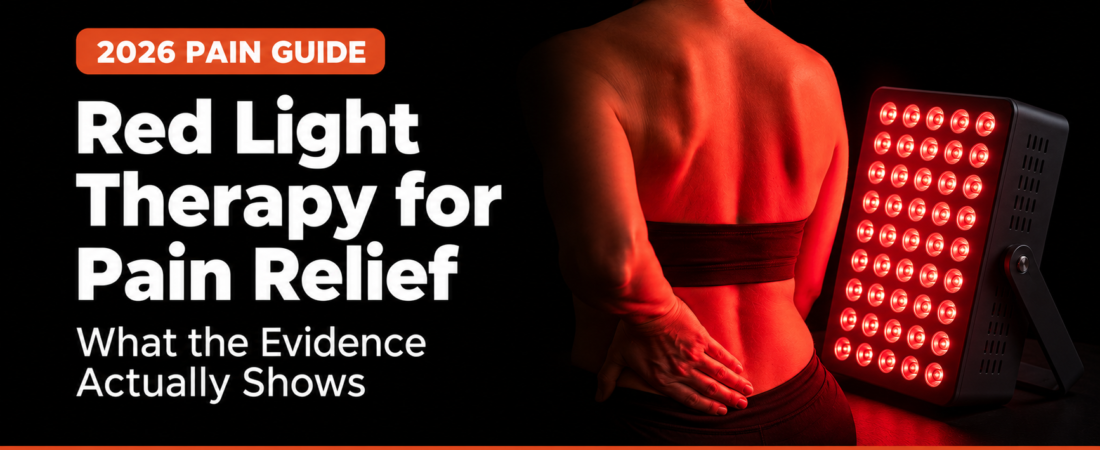
Red Light Therapy for Pain Relief: What the Evidence Actually Shows
Spread the love
Pain management is where red light therapy — more accurately called photobiomodulation (PBM) — has some of its most substantial clinical evidence. Unlike its use for skin rejuvenation, where the research is strong but not yet formally endorsed by major dermatology guidelines, the pain literature includes large-scale meta-analyses published in top-tier journals, including The Lancet.
That does not mean it works for everything, or that consumer devices reliably replicate clinical results. This guide covers what the research actually supports, which conditions have the strongest evidence, what the realistic expectations are, and where the honest gaps remain.
Table of Contents
How Red Light Therapy Addresses Pain
The mechanism is not primarily analgesic — red light does not block pain signals the way anti-inflammatory drugs or opioids do. Instead, it addresses pain by modifying the underlying biological conditions that generate it.
At the cellular level, near-infrared wavelengths (810–850nm) penetrate 30–50mm below the skin surface, reaching muscle fibres, joint capsules, connective tissue, and in thinner body areas, bone. Once absorbed by cytochrome c oxidase in the mitochondria, the photons trigger increased ATP production, which gives cells more energy for repair processes. Simultaneously, PBM modulates pro-inflammatory cytokine expression — reducing TNF-α, IL-1β, and IL-6, which are key drivers of chronic inflammation — while upregulating anti-inflammatory mediators.
The practical result is that the tissue generating the pain signal becomes less inflamed, better supplied with cellular energy for repair, and more capable of recovering from the insult — whether that insult is exercise-induced muscle damage, articular cartilage breakdown, nerve compression, or chronic inflammatory disease.
This is also why the wavelength distinction matters for pain applications more than for skin applications. Red light at 660nm works well for superficial tissue — skin, surface wounds, follicles. For muscle, joint, and nerve pain, near-infrared at 810–850nm is the primary therapeutic wavelength. Devices without adequate NIR output are unlikely to reach the tissue depth where pain-generating pathology actually sits.
Muscle Recovery and Exercise-Related Pain
This is one of the most consistently replicated areas in photobiomodulation research, with a particularly strong evidence base.
A 2021 study involving 32 resistance-trained athletes found that using red light therapy immediately after intense exercise reduced muscle soreness by 39% and accelerated strength recovery. Research in Photomedicine and Laser Surgery showed that using red light therapy before exercise can significantly reduce delayed-onset muscle soreness and cut recovery time by up to 60%.
A 2025 meta-analysis of 14 studies confirmed 47% less delayed-onset muscle soreness (DOMS) at 48 hours versus placebo. A Bayesian network meta-analysis published in October 2024 comparing physical therapy modalities for DOMS ranked photobiomodulation therapy as the top-ranked intervention at 24 hours post-exercise.
The mechanism is well understood. 850nm boosts mitochondrial ATP in muscle fibres and reduces pro-inflammatory cytokines. The effect is not merely symptomatic — the underlying inflammatory cascade that produces DOMS is genuinely attenuated, which is why recovery time, not just perceived soreness, improves in the trials.
An important practical note: timing matters. The research suggests that treatment either immediately before or immediately after exercise produces the best outcomes. Sessions performed hours later show attenuated effects.
What this means in practice
For athletes, active people, and anyone dealing with recurring exercise-related muscle soreness, the evidence for red light therapy is strong enough to take seriously. The effect sizes in DOMS research are among the largest in the pain literature — a 47% reduction in soreness is clinically meaningful, not marginal.
For general muscle pain unrelated to exercise, the evidence is less specific but the anti-inflammatory mechanism remains relevant.
Joint Pain and Osteoarthritis
The joint pain literature is extensive and includes high-quality trials across multiple joints — knee, hand, shoulder, and spine.
A 2024 randomised, triple-blind, sham-controlled study published in the Journal of Biophotonics examined 47 patients with osteoarthritis of the knee. Half received active red light therapy at 660nm and 970nm twice weekly for 8 weeks. The active group showed a 62% reduction in pain scores compared to 18% in the sham group. Knee swelling decreased noticeably, and participants reported improved mobility. Notably, improvements continued for four weeks after treatment ended, suggesting lasting tissue changes.
A meta-analysis of over 1,000 knee osteoarthritis patients found that wavelengths between 785–860nm, at doses of 4–8 joules per treatment spot, significantly reduced both pain and disability scores. Near-infrared at 850nm specifically increases collagen type II synthesis and glycosaminoglycan production — building blocks for healthy cartilage — indicating the effect is not purely analgesic but includes structural repair mechanisms. Effects were maintained at 3-month follow-up in clinical trials.
A 2023 mechanistic review cited a long-term outcome study in 100 osteoarthritis patients. After 6 years, only 1 patient in the photobiomodulation group required joint replacement, versus 9 in controls. This is a single cohort study and requires replication before drawing strong conclusions — but it points toward the possibility of structural benefit beyond symptom management.
Another study on hand osteoarthritis using 808nm near-infrared light found 40–60% reductions in pain and improved grip strength after 12 weeks of twice-weekly treatment.
The honest caveat on arthritis
A 2025 umbrella review concluded that benefits for rheumatoid arthritis are not yet supported. The distinction between osteoarthritis — a degenerative joint condition where the anti-inflammatory and tissue-repair mechanisms of PBM are directly relevant — and rheumatoid arthritis, an autoimmune condition, is clinically important. The evidence supports PBM as a credible adjunct for osteoarthritis pain. It does not support it as a treatment for autoimmune arthritis.
For musculoskeletal pain, PBM is best used as part of a comprehensive approach that includes appropriate exercise, manual therapy, and lifestyle modification. It is an adjunct, not a replacement for established care.
Neck Pain: The Strongest Evidence in Pain Management
The Chow 2009 Lancet meta-analysis for neck pain and the Stausholm 2019 meta-analysis for knee osteoarthritis represent landmark evidence — published in high-impact, peer-reviewed journals — demonstrating clinically meaningful pain reduction with minimal side effects.
The Chow et al. Lancet 2009 meta-analysis produced a VAS pain effect size of −2.26 versus sham, and is WALT (World Association for Laser Therapy) endorsed for neck pain. An effect size of that magnitude in a pain meta-analysis is substantial — comparable to or exceeding the effects of commonly used pharmaceutical interventions for neck pain.
For people dealing with chronic neck pain — whether from posture, injury, disc issues, or muscle tension — the evidence is strong enough that photobiomodulation appears in clinical guidelines from professional organisations, not just consumer wellness content.
Nerve Pain and Neuropathy
A 2022 clinical trial focusing on diabetic neuropathy found a 33% reduction in pain scores after 8 weeks of red light therapy. Researchers documented improvements in actual nerve conduction velocity — suggesting the therapy may support nerve repair, not just symptom relief.
A small 2023 study on chemotherapy-induced peripheral neuropathy found that 30 minutes of 850nm near-infrared light twice weekly reduced pain significantly.
Neuropathic pain is one of the harder pain categories to treat pharmacologically — standard analgesics are often ineffective, and the options that do work (gabapentinoids, SNRIs) carry significant side effect profiles. The emerging evidence for PBM in neuropathy is therefore clinically interesting, even though the evidence base is thinner and more preliminary than for musculoskeletal pain.
The mechanism here involves nerve regeneration pathways — 850nm NIR has been shown to upregulate nerve growth factor and support axonal repair — rather than purely anti-inflammatory effects.
Back Pain and Chronic Pain
A 2019 review analysing 18 controlled trials found consistent pain reduction across various conditions. A 2018 study documented approximately 30% pain reduction for chronic pain sufferers.
For back pain specifically, the research is promising but more heterogeneous than for neck pain or knee osteoarthritis — partly because “back pain” encompasses a wide range of underlying conditions with different pathophysiology. The anti-inflammatory and tissue-repair mechanisms are relevant for most of them, but the depth of penetration required varies considerably by the specific anatomical target.
What Determines Whether It Works
The critical success factor is correct dosing. Near-infrared wavelengths (810–850nm), adequate power, and appropriate treatment protocols make the difference between success and failure. Subtherapeutic dosing is the primary explanation for negative results in both clinical trials and home use.
This is the most important sentence in the pain literature for anyone using a consumer device. The studies that produce significant results use devices capable of delivering 4–8 joules per treatment spot at adequate irradiance. Entry-level consumer panels typically deliver this at 6 inches with appropriate session length. Devices with low power output, or sessions that are too short, may not reach therapeutic dose — which is the most common reason home users do not replicate clinical results.
What to look for in a device for pain:
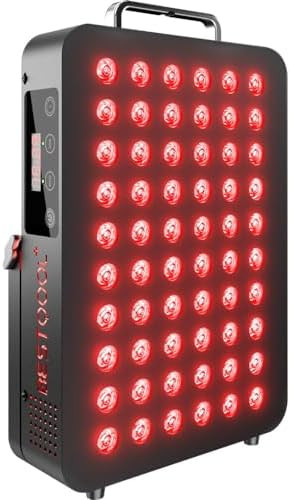
NIR at 810–850nm is non-negotiable — 660nm red light does not penetrate to the tissue depth where most pain-generating pathology sits. Panel format is generally more suitable for pain applications than masks or wands, because adequate irradiance over a meaningful coverage area is needed. Treatment distance matters — most panels should be used at 6 inches for pain applications, not 12–18 inches.
Realistic Expectations
For muscle recovery, effects are acute — improvement in DOMS is measurable within 24–48 hours of treatment, which is why timing around exercise matters.
For joint pain and osteoarthritis, the clinical trials show meaningful improvement at 8–12 weeks of regular sessions. Some improvement may be felt earlier, but the structural tissue changes that contribute to lasting pain reduction accumulate over weeks.
For neuropathy and chronic pain, timelines are more variable and depend significantly on the underlying condition, severity, and individual response. The 8-week timeframe from the diabetic neuropathy study is a reasonable reference point.
Red light therapy is not a replacement for medical care in any of these conditions. It is an adjunct — something that may meaningfully reduce pain and support recovery alongside appropriate medical management, not instead of it. Anyone with significant or worsening pain should be under appropriate medical care.
Recommended Devices for Pain Relief
For pain applications, panel format is recommended over masks or wands. The coverage area and irradiance output required to reach muscle and joint depth are not achievable with compact devices.
Hooga HG300 — 660nm + 850nm, compact panel, timer, stand
Common questions about red light therapy for pain relief and recovery.
The evidence goes considerably beyond placebo. The Chow et al. 2009 meta-analysis published in The Lancet — one of the highest-impact medical journals — demonstrated a VAS pain effect size of −2.26 versus sham for neck pain, an effect size comparable to or exceeding many pharmaceutical interventions. A 2024 triple-blind RCT on knee osteoarthritis showed 62% pain reduction in the active group versus 18% in the sham group. A 2025 meta-analysis of 14 studies ranked photobiomodulation as the top-ranked intervention for delayed-onset muscle soreness at 24 hours post-exercise. The evidence is not unanimous across all conditions — rheumatoid arthritis, for example, lacks adequate support — but for musculoskeletal pain, neck pain, and exercise recovery, the research is substantive.
Clinical evidence
850nm near-infrared is the primary therapeutic wavelength for pain applications. It penetrates 30–50mm below the skin surface, reaching muscle fibres, joint capsules, and connective tissue — the depths where most musculoskeletal pain originates. Red light at 660nm is absorbed in the upper 8–10mm of tissue, which is insufficient for most pain targets beyond superficial wound healing. Devices marketed for pain that lack an 850nm NIR channel are unlikely to deliver meaningful results for joint or muscle conditions, regardless of their red light output.
Clinical evidence
It depends on the condition. For muscle recovery and DOMS, effects are measurable within 24–48 hours of treatment — which is why timing around exercise matters and why the research is so consistent in this area. For joint pain and osteoarthritis, meaningful improvement typically accumulates over 8–12 weeks of regular sessions, with some earlier symptom relief possible. For neuropathic pain, the 8-week timeframe from the diabetic neuropathy trial is a reasonable reference point, though individual response varies more in this category. Red light therapy is not a fast-acting analgesic — it works by modifying the underlying inflammatory and tissue conditions rather than blocking pain signals directly.
Results timeline
The answer depends on the type of arthritis. For osteoarthritis — the degenerative joint disease affecting cartilage — the evidence is substantive. Multiple RCTs and a meta-analysis of over 1,000 patients have confirmed significant reductions in pain and disability. A 2024 study showed 62% pain reduction in knee OA with active treatment versus 18% with sham. Near-infrared at 850nm has been shown to increase collagen type II synthesis and glycosaminoglycan production, suggesting structural benefit rather than purely symptomatic relief. For rheumatoid arthritis — an autoimmune condition — a 2025 umbrella review concluded the evidence does not yet support PBM as an effective treatment. The mechanism that helps OA is not the same mechanism relevant to autoimmune joint disease.
Clinical evidence
Both before and immediately after exercise show benefits in the research, with slightly different mechanisms. Pre-exercise treatment appears to reduce the inflammatory cascade that produces DOMS — essentially attenuating the damage before it occurs. One study showed up to 60% reduction in recovery time with pre-exercise treatment. Post-exercise treatment within the first hour accelerates recovery from damage that has already occurred, with a 2021 study showing 39% reduction in muscle soreness. Treatment performed hours after exercise or the following day shows attenuated effects. If only one timing option is practical, immediately post-exercise is the more commonly studied and slightly more flexible protocol.
Usage & protocol
For most pain applications, a panel is significantly more appropriate than a mask or wand. The reasons are coverage and irradiance. Reaching muscle and joint tissue at therapeutic dose requires adequate power density over a meaningful area — an LED mask delivers 5–15 mW/cm² to the face only; a panel delivers 50–150 mW/cm² across a much larger treatment zone at 6 inches. A wand covers 2–6 cm² per pass, which is impractical for treating a knee joint or lower back. There is one exception: for very localised, superficial pain — a specific small joint, for example — a high-quality wand with 850nm NIR may deliver adequate dose to that specific target. But for any condition requiring broad or deep tissue coverage, a panel is the appropriate format.
Device selection
Looking for a panel for pain relief?Top picks with confirmed 850nm NIR output