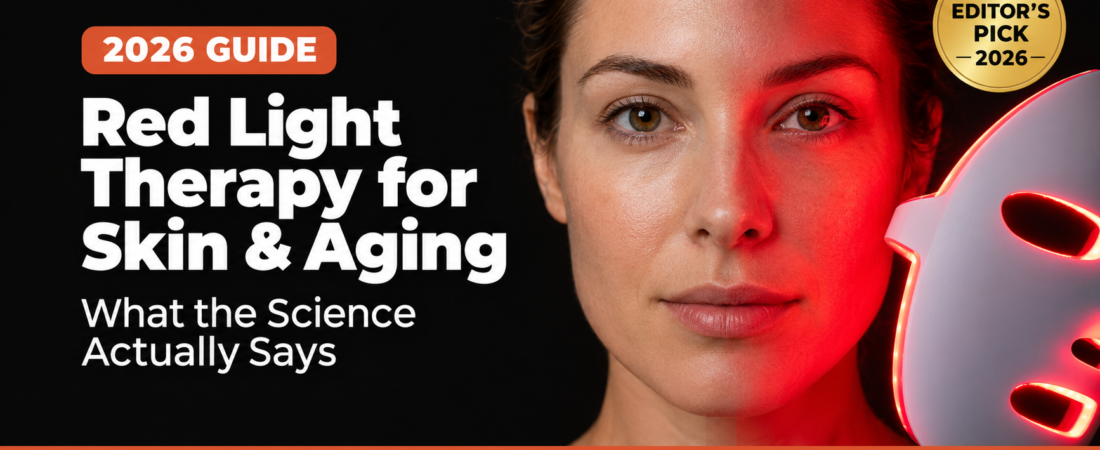
Red Light Therapy for Skin & Anti-Aging: What the Science Actually Says
Spread the love
The anti-aging industry has a long history of attaching scientific language to things that do not work particularly well. Red light therapy is different — not because the marketing is more honest, but because the underlying research is genuinely substantial. Over 500 peer-reviewed studies on photobiomodulation for skin exist in the indexed literature. The evidence for collagen stimulation and wrinkle reduction is among the strongest in non-invasive aesthetics.
That said, what the research supports and what device marketing claims are two different things. This guide covers both — what red light therapy can realistically do for skin, what the timeline actually looks like, which wavelengths the evidence points to, and where the current science has honest gaps.
Table of Contents
What Happens to Skin as It Ages
To understand why red light therapy produces the outcomes it does, it helps to understand what aging skin is actually losing.
Collagen — primarily type I and type III — provides the structural scaffolding of the dermis. From around the mid-twenties onward, the body produces roughly 1% less collagen per year. The fibroblasts responsible for synthesising it become less active; the enzymes that break collagen down (matrix metalloproteinases, or MMPs) become relatively more dominant. The net result is thinner, less elastic skin with reduced ability to retain water and recover from deformation — the biological basis of fine lines, wrinkles, and loss of firmness.
UV exposure accelerates this process by directly damaging fibroblasts, increasing MMP activity, and generating reactive oxygen species that disrupt the dermis at a cellular level. By the time visible wrinkles appear, the structural change in the dermis has typically been underway for years.
Elastin, the protein responsible for skin’s ability to spring back into shape, degrades similarly. Unlike collagen, the body’s capacity to produce new elastin is limited in adult tissue — which is why elastin loss tends to be more permanent than collagen loss, and why prevention is considerably more valuable than correction.
The Mechanism: How Red Light Interacts With Skin Cells
Red light in the 630–660nm range is absorbed by cytochrome c oxidase, a photoreceptor enzyme in the mitochondria of skin cells — specifically in dermal fibroblasts and epidermal keratinocytes. This absorption triggers a cascade of downstream effects:
Increased ATP production gives fibroblasts more energy to synthesise collagen and elastin. Modulation of reactive oxygen species at therapeutic doses (rather than the damaging excess generated by UV) activates transcription factors that upregulate collagen genes — specifically COL1A1 and COL3A1. Simultaneously, red light reduces MMP activity, shifting the collagen balance toward production rather than degradation. Transforming growth factor-beta (TGF-β), a key regulator of dermal remodelling, is upregulated.
The practical result of this cascade: more collagen precursor produced, less collagen broken down, and a dermis that is structurally denser over time.
Near-infrared at 850nm participates in the same mechanism but at greater depth — reaching the lower dermis and subcutaneous layers where collagen remodelling also occurs, and where inflammation that accelerates skin aging is often rooted.
What the Research Actually Shows
The clinical literature on red light therapy for skin is substantial enough to draw meaningful conclusions, with important caveats about study quality and applicability to consumer devices.
A 2014 randomised controlled trial in Photomedicine and Laser Surgery — frequently cited as a landmark in this field — treated 136 subjects with combined 633nm and 830nm light over 30 sessions across 15 weeks. Results showed significant improvements in skin complexion in 91% of subjects and skin tone in 87%, along with a mean 29% increase in collagen density measured by ultrasound. Control subjects showed no significant change over the same period. Better Life Lab
A tissue-engineered skin model study combined with a split-face human trial reported a 31% increase in type-1 procollagen and an 18% reduction in MMP-1 after eleven 660nm pulsed LED sessions. The increase in collagen precursor alongside a reduction in the enzyme that degrades it represents exactly the mechanism described above, confirmed in human tissue.
A 2023 randomised controlled trial demonstrated that red light at 660nm and amber light at 590nm produced 31.6% and 29.9% reductions in periocular wrinkle volume respectively after 10 sessions over 4 weeks.
A landmark 2023 study published in Skin Research and Technology documented quantified improvements including a 38.3% reduction in wrinkle depth, a 47.7% increase in dermal density, and a 23.6% improvement in skin firmness following 12 weeks of twice-weekly treatment. Optimal Health
A 2023 meta-analysis found red light therapy to have significant anti-aging outcomes including decreased appearance of wrinkles and improvement in skin texture, while noting variability in patient response and the need for multiple treatment sessions. ResearchGate
These are not marginal effects. A 30–38% reduction in wrinkle depth and a 29–47% increase in collagen density, confirmed across multiple independent trials, places red light therapy among the better-evidenced non-invasive anti-aging interventions available.
Honest caveats
Major dermatology guidelines from the American Academy of Dermatology and the British Journal of Dermatology address red light therapy only in the context of photodynamic therapy for medical conditions, not for cosmetic anti-aging purposes. This means red light therapy for skin aging sits in a well-researched but not yet formally guideline-endorsed space. The evidence is strong enough to take seriously; it is not yet integrated into standard dermatology practice.
Study quality varies considerably. Many trials use medical-grade devices at irradiance levels that consumer products may not match. Placebo controls are difficult in light therapy research. And most studies are conducted over 8–15 weeks — long-term maintenance data beyond six months is limited.
Realistic Timeline: What to Expect and When
One of the most common mismatches between expectation and reality in red light therapy is timeline. Marketing implies results in days; users expect visible change in weeks; the research confirms meaningful outcomes at months.
Weeks 1–2: Circulatory and anti-inflammatory effects may produce early improvements in skin radiance, hydration, and puffiness reduction. These are real but not structural — they reflect improved blood flow and reduced low-grade inflammation rather than new collagen.
Weeks 3–6: Fibroblast activation and early collagen upregulation begin to translate into visible improvements in skin texture and tone. Users with acne-prone skin may notice earlier results as the anti-inflammatory effects address active breakouts.
Weeks 8–12: Fine line softening typically appears at eight to twelve weeks. The clinical photography in published trials documents change at twelve weeks, not at four. This is the timeframe where meaningful structural changes in the dermis become visible — reduced wrinkle depth, improved firmness, measurable increases in collagen density on imaging.
Beyond 12 weeks: Continued improvement with consistent use, followed by a maintenance plateau. Most users sustain results with 3–4 sessions per week rather than daily use once the initial improvement phase is complete.
The single most reliable predictor of outcome is consistency. Irregular use — two sessions one week, none the next — does not allow the cumulative cellular signalling required for structural change. The research protocols that produce the results above all involve regular, repeated sessions over months.
Which Wavelengths Have the Best Skin Evidence
The strongest evidence for facial anti-aging concentrates in a relatively narrow wavelength range.
630–660nm red light has the most direct evidence for collagen stimulation in skin. It is absorbed efficiently by fibroblasts in the upper and middle dermis — exactly where the structural proteins that determine skin appearance are produced. Effective wavelengths range from 590–660nm, with doses between 0.3–5 J/cm² showing beneficial effects.
810–850nm near-infrared reaches deeper tissue and contributes to collagen remodelling in the lower dermis, while also addressing the sub-dermal inflammation that can accelerate visible aging. The Wunsch and Matuschka 2014 trial used a combined 633nm/830nm protocol — suggesting that dual-wavelength treatment covering both depths produces superior outcomes to either wavelength alone.
590nm amber light has emerging evidence specifically for periocular wrinkle reduction, as reflected in the 2023 RCT cited above. Some masks now include this wavelength as a fourth channel alongside red, NIR, and blue.
What the evidence does not support is the marketing claim that more wavelengths equals better outcomes. The quality of light delivery — irradiance, consistency, skin contact — matters considerably more than the number of wavelengths listed on a product page.
Who Is Most Likely to Benefit
Red light therapy has demonstrated significant improvement in skin appearance across a wide age range, particularly 30 to 60 years old. This aligns with the mechanism: people in this range have experienced measurable collagen loss but retain sufficient fibroblast activity to respond meaningfully to stimulation.
Users under 30 with minimal existing collagen loss may see less dramatic anti-aging results but can benefit from preventive collagen maintenance and acne-related applications. Users over 60 can still benefit, though the response may be slower and less pronounced as fibroblast activity naturally declines with age.
Skin tone does not appear to significantly affect outcomes for red and NIR wavelengths. LED has no thermal injury risk, no documented hyperpigmentation risk across Fitzpatrick types, no contraindication for fillers or implants in the treatment field, and no protected-area restriction beyond reasonable eye protection. This safety profile across all skin tones is one of red light therapy’s genuine advantages over more aggressive interventions.
Users on photosensitising medications, with photosensitive conditions, or who are pregnant should consult a dermatologist before beginning.
How Red Light Compares to Other Anti-Aging Approaches
Red light therapy does not exist in isolation — most people considering it are already using other approaches or weighing it against alternatives.
Retinoids (retinol, tretinoin) have a larger evidence base for collagen stimulation and are endorsed by dermatology guidelines. They cause photosensitivity and initial skin irritation in many users, and require slow introduction. Red light therapy and retinoids are not mutually exclusive — many users use both, with red light sessions on days when retinoids are not applied.
Radiofrequency and focused ultrasound (e.g., Thermage, Ultherapy) deliver more dramatic tissue tightening in fewer sessions but involve thermal energy that carries burn and scarring risk, is contraindicated around implants, and is significantly more expensive per treatment.
Chemical peels and lasers produce faster visible results through controlled skin injury and remodelling, but involve downtime, risk of hyperpigmentation (particularly in darker skin tones), and require professional administration.
Red light therapy sits in a different category: lower per-session impact, no downtime, no injury mechanism, safe across all skin types, and cumulative benefits that accrue over months of consistent use at home. It is more accurately compared to a topical skincare routine — gradual, maintenance-oriented, and dependent on consistency — than to a clinical procedure.
Recommended Devices
The evidence base for red light therapy skin benefits was largely developed using professional and research-grade devices. Consumer devices vary considerably in whether they deliver adequate irradiance at the wavelengths claimed.
For facial anti-aging specifically, the most important specifications are confirmed 630–660nm red light output, confirmed 850nm NIR, adequate LED density for full facial coverage, and ideally some form of independent output verification.
XSSNVV LED Face Mask — 620nm + 850nm NIR + 460nm blue + 580nm amber, 272 LEDs, cordless, 145g
Common questions about red light therapy for skin and anti-aging.
The clinical evidence is substantial. Multiple independent randomised controlled trials have confirmed measurable reductions in wrinkle depth (30–38% in the strongest studies), increases in collagen density (up to 47%), and improvements in skin firmness and elasticity at 12 weeks of consistent use. The mechanism is well understood: red light at 630–660nm activates cytochrome c oxidase in dermal fibroblasts, increasing ATP production and upregulating collagen synthesis while reducing collagen-degrading enzymes. These are not subtle effects — they are documented with histological analysis and clinical imaging. What the evidence does not support is fast results: meaningful structural change in the dermis takes 8–12 weeks of regular sessions, not days.
Clinical evidence
Early circulatory effects — improved radiance, reduced puffiness, slightly more even tone — may appear within 2–4 weeks. These are real but not structural. Meaningful improvements in fine lines, skin texture, and elasticity typically become visible at 8–12 weeks of consistent use, which is when the clinical photography in published trials documents visible change. Expecting dramatic anti-aging results in under a month is a mismatch with how collagen remodelling works — fibroblasts need time and repeated stimulation to accumulate structural change in the dermis.
Results timeline
Generally yes, but with timing awareness. Retinoids increase photosensitivity and can cause irritation — using red light on the same evening as a retinoid application may amplify that sensitivity for some users. A practical approach many users follow: red light therapy on alternating evenings from retinoid application, or at a different time of day. Both work on collagen stimulation through different mechanisms and are not contraindicated together. If in doubt, ask a dermatologist about sequencing for your specific skin type and retinoid strength.
Usage & routine
Yes. Red and near-infrared light does not stimulate melanin production and carries no documented hyperpigmentation risk across Fitzpatrick skin types I–VI. This is one of the genuine safety advantages of red light therapy over alternatives like chemical peels, lasers, and some radiofrequency treatments, which carry significantly higher risks of post-inflammatory hyperpigmentation in darker skin tones. The one wavelength that does carry melanin-related risk is blue light (460nm) in some devices — in darker phototypes, blue light may worsen hyperpigmentation through a different melanogenesis pathway.
Safety
The protocols used in the most effective clinical trials range from daily use to 3–5 sessions per week, with 10–20 minutes per session. For practical home use, 4–5 sessions per week during the first 8–12 weeks is the recommendation most consistent with the research. After initial results are established, a maintenance frequency of 3–4 sessions per week is generally sufficient. The key variable is not any individual session but the cumulative signalling over weeks — which is why consistency over months outperforms intensity in any single week.
Usage & routine
Retinoids have a larger and longer-established evidence base and are formally endorsed by dermatology guidelines for anti-aging — red light therapy is not yet at that status despite strong research. Retinoids work primarily by increasing cell turnover and directly stimulating collagen gene expression; red light works through mitochondrial ATP upregulation. Both stimulate collagen, through different pathways. Retinoids cause photosensitivity and initial irritation for many users; red light therapy does not. Red light therapy has no downtime, no irritation risk, and no contraindication for sensitive skin or rosacea. The honest comparison is that retinoids are more potent per unit of time; red light therapy is more accessible, better tolerated, and complementary rather than competing.
Clinical evidence
Looking for a device to start with?Top picks with confirmed 660nm + 850nm NIR output