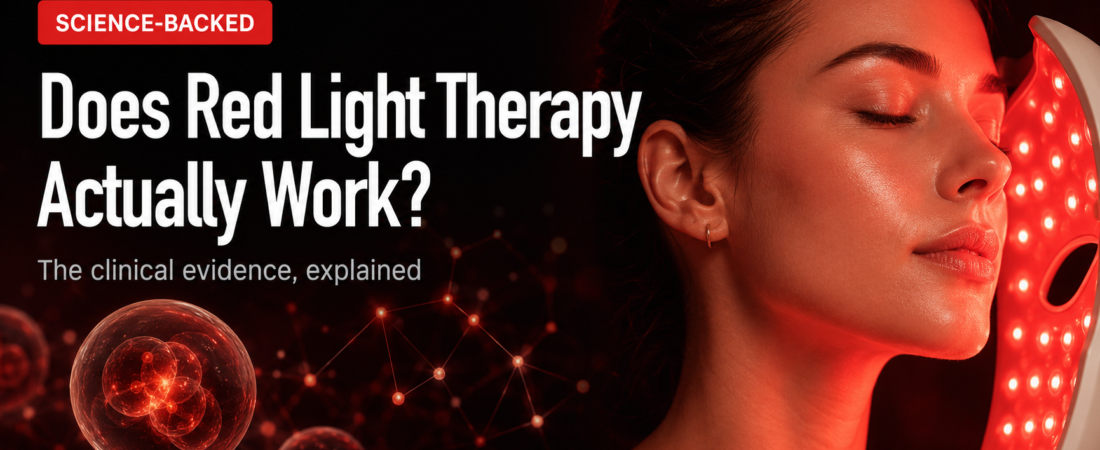
Does Red Light Therapy Actually Work? What the Science Says
Spread the love
Red light therapy is everywhere right now. TikTok creators swear it fixed their skin, reduced their joint pain, grew their hair back, and even helped them sleep better. Wellness influencers call it a cornerstone of any serious health routine. And device companies — selling everything from $30 LED wands to $4,000 full-body panels — are more than happy to amplify every claim.
So what does the science actually say?
The honest answer is more nuanced than either the enthusiasts or the skeptics want to admit. Red light therapy is real science with a legitimate body of clinical research behind it — but that research is stronger for some applications than others. Understanding where the evidence is solid, where it’s promising but incomplete, and where it’s essentially nonexistent is the difference between making a smart purchase and wasting $400 on a glorified nightlight.
This guide breaks it all down.
Table of Contents
What Is Red Light Therapy?
Red light therapy — also called photobiomodulation (PBM), low-level light therapy (LLLT), or LED therapy — involves exposing the skin to specific wavelengths of red and near-infrared light at low power levels. The light penetrates the skin and is absorbed by cells, triggering biological responses at the cellular level.
Unlike UV light (which damages DNA and causes sunburn), red and near-infrared wavelengths are non-ionizing — they don’t carry enough energy to damage cells. Instead, they appear to stimulate cellular activity, particularly in the mitochondria.
The wavelengths used in red light therapy typically fall into two ranges:
Red light: 630–660nm — penetrates 1–3mm into skin, primarily affecting the epidermis and superficial dermis
Near-infrared (NIR): 810–850nm — penetrates deeper (5–10mm), reaching the dermis, subcutaneous tissue, and in some cases underlying muscle
Devices range from handheld wands and LED face masks to full-body panels and clinical-grade systems. The key difference between them is power output (irradiance), wavelength accuracy, and total light dose delivered per session.
How Does Red Light Therapy Work?
The leading mechanism involves the mitochondria — the energy-producing organelles inside every cell. Specifically, red and near-infrared light appears to be absorbed by cytochrome c oxidase, a protein complex in the mitochondrial respiratory chain responsible for producing adenosine triphosphate (ATP), the cell’s primary energy currency.
When mitochondria absorb this light, the current scientific understanding suggests:
ATP production increases — cells have more energy available for repair, regeneration, and normal function
Reactive oxygen species (ROS) are temporarily modulated — at low doses, this may trigger beneficial adaptive responses
Nitric oxide is released — improving local circulation and reducing inflammation
Gene expression is altered — particularly genes involved in collagen synthesis, inflammation regulation, and cellular repair
A 2026 review published in Nature described an emerging pattern in the research: when cells are healthy, external light often has little measurable effect. But during illness or metabolic stress — when mitochondrial dysfunction is common — the impact appears stronger. This may partly explain why results vary so widely across individuals and studies.
One important nuance: the mechanism is non-thermal at cosmetic doses. You are not heating collagen or burning away skin — you are providing cellular energy and signaling to support the body’s own repair processes. This is why devices must deliver adequate irradiance (power per area) and be used consistently to produce results.
What the Science Actually Shows — By Use Case
Red Light Therapy: Evidence by Use Case
How strong is the clinical research for each application? Updated June 2026.
Use Case
Evidence Level
Key Wavelengths
Timeline
Notes
✨Skin Anti-Aging & Collagen
✓ Strong
630–660nm + 830nm NIR
4–12 weeks
136-volunteer RCT; 31% collagen increase in studies
💇Hair Loss (Androgenic)
✓ Strong
630–660nm
12–26 weeks
2025 consensus review (20+ specialists); FDA cleared
🩹Wound Healing
✓ Strong
630–660nm + 830nm NIR
Days to weeks
In clinical guidelines since 2020 (oral mucositis)
🔬Post-Procedure Recovery
✓ Strong
633nm + 830nm
Days to weeks
Used clinically post-laser; reduces inflammation
🫧Acne Treatment
~ Moderate
415nm blue + 630nm red
4–8 weeks
Stronger for mild–moderate; not for severe cystic acne
🦵Joint Pain & Inflammation
~ Moderate
810–850nm NIR
4–8 weeks
Variable results; more large-scale trials needed
🧠Peripheral Neuropathy
↗ Emerging
630nm + 830nm
8–12 weeks
2025 consensus review; evidence still developing
👁️Dry AMD (Eye)
↗ Emerging
670nm
Varies
FDA approved one device in 2024; clinical use only
⚖️Weight / Fat Loss
✗ Not Supported
—
—
No credible clinical evidence; avoid devices claiming this
🧪Detoxification
✗ Not Supported
—
—
No scientific basis; red flag marketing claim
✓ Strong Multiple RCTs + consensus review
~ Moderate Positive studies, more trials needed
↗ Emerging Promising early evidence
✗ Not Supported No credible clinical evidence
Acne Treatment — Moderate Evidence
Blue light (415nm) has established antibacterial effects against Propionibacterium acnes (P. acnes), the bacteria primarily responsible for inflammatory acne. Red light at 630nm reduces inflammation and supports skin healing. Several studies have shown that combined red and blue LED therapy may help improve mild to moderate acne, and the FDA has cleared multiple devices for this use.
A 2021 controlled trial comparing once-weekly and twice-weekly blue and red LED combination therapy for moderate-to-severe acne vulgaris found measurable improvement in both groups, with twice-weekly use showing stronger results.
The important caveat: the evidence is stronger for mild to moderate acne than for severe cystic acne. Red or blue LED therapy should not replace dermatologist-prescribed treatments for serious acne conditions.
Verdict: Moderate evidence, particularly for mild to moderate acne with combined red + blue wavelengths.
Hair Loss (Androgenic Alopecia) — Strong Evidence
This is one of the most consistently supported applications of red light therapy outside of skin care. A 2025 consensus review involving more than 20 specialists — published in the Journal of the American Academy of Dermatology — concluded that red light therapy was safe and effective for androgenic alopecia (male and female pattern hair loss). The FDA has cleared multiple devices for this indication.
Multiple clinical trials show measurable improvement in hair density for users with androgenic alopecia. The mechanism is thought to involve increased blood flow to follicles and stimulation of follicle cells during the growth phase of the hair cycle.
Verdict: Strong evidence. One of the most robustly supported applications.
Wound Healing and Skin Recovery — Strong Evidence
Red light therapy has been included in clinical guidelines since 2020 for preventing and treating oral mucositis — painful mouth ulcers that develop in patients undergoing chemotherapy and radiation. A 2025 consensus review confirmed the therapy as safe and effective for several types of chronic ulcers and acute radiation dermatitis.
For skin recovery after procedures (laser treatments, chemical peels), several studies suggest red and near-infrared LED therapy may reduce inflammation, accelerate healing, and improve outcomes. Some dermatologists now routinely use LED panels post-procedure.
Verdict: Strong evidence for wound healing and post-procedure recovery.
Joint Pain and Inflammation — Promising Evidence
Several studies suggest red and near-infrared light may help reduce joint pain and inflammation, particularly for conditions like knee osteoarthritis and musculoskeletal pain. A 2025 study published in Sports Health found measurable benefits for recovery applications.
The evidence is more variable here than in skin applications — study designs differ widely, device parameters vary significantly, and effect sizes range from modest to meaningful. The Cleveland Clinic notes that more large-scale controlled trials are needed to draw firm conclusions.
Verdict: Promising but not yet conclusively established. More research needed.
Peripheral Neuropathy — Emerging Evidence
The 2025 consensus review referenced above also found evidence supporting red light therapy for peripheral neuropathy. This is a relatively newer area of clinical investigation and the evidence base, while positive, is still developing.
Verdict: Emerging evidence. Consult a physician before using for medical conditions.
What Red Light Therapy Cannot Do
This matters as much as what it can do. The evidence does not support red light therapy as a treatment for:
Weight loss or fat reduction — no credible clinical evidence
Cancer treatment — not a treatment for cancer; consult an oncologist before using if you have or have had cancer
Depression or SAD — red light therapy is distinct from bright light therapy used for seasonal affective disorder; do not confuse the two
Cellulite removal — no meaningful clinical evidence
“Detoxification” — this claim has no scientific basis
A 2026 PMC study analyzing social media promotion of red light therapy found that most TikTok and Instagram content promoting at-home devices made claims that significantly exceeded the current evidence base. Claims about detoxification, systemic disease treatment, or complete age reversal are marketing language — not science.
A useful rule: if a device claims to “reverse aging completely,” “cure chronic disease,” or “detox your body,” treat that as a red flag, not a selling point.
Does At-Home Red Light Therapy Work as Well as Clinical Devices?
This is the practical question most buyers need answered.
Clinical devices used by dermatologists and medical professionals deliver significantly higher irradiance (power per unit area) than consumer products. A professional Omnilux Medical unit, for example, delivers substantially more energy per session than its consumer Contour counterpart.
However, at-home devices compensate through proximity. As Omnilux explains in their own clinical documentation: professional units shine from a distance; at-home devices sit directly against the skin. Because light intensity drops off sharply with distance (following the inverse square law), a consumer mask pressed against your face can deliver a comparable total dose to a professional unit used at a greater distance — even with lower raw output.
A 2026 PMC review on at-home devices noted that efficacy is highly dependent on specific wavelengths, power, and dose duration parameters that vary by treatment goal and remain less studied than clinical applications. Translation: the technology works, but the quality gap between devices is real and significant.
What this means practically:
An FDA-cleared consumer mask from a brand like Omnilux, CurrentBody, or HigherDOSE will deliver meaningful results with consistent use
Budget devices with unverified wavelengths, low LED counts, and no clinical backing will likely underperform
Consistency of use matters more than any single session — 8–12 weeks of regular use is where results accumulate
What to Look for in a Device
If you’re considering an at-home device based on this evidence, here is what actually matters:
Wavelength Accuracy
The device must emit light in the clinically validated ranges: 630–660nm for red, 810–850nm for near-infrared. Many cheap devices emit light outside these ranges or use mixed-spectrum LEDs that look red but don’t deliver therapeutic wavelengths. Brands with FDA clearance and Veritace-style verification (like CurrentBody) give the most confidence here.
FDA Clearance
FDA Cleared devices have been reviewed and found substantially equivalent to legally marketed devices with demonstrated safety and efficacy. This is not a guarantee of results, but it filters out devices that haven’t met any regulatory standard.
Irradiance
Measured in milliwatts per square centimeter (mW/cm²). Reputable manufacturers publish this figure. Devices that don’t disclose irradiance should be treated with caution. As a rough guide, effective at-home masks typically deliver 30–65 mW/cm².
LED Count and Coverage
For full-face treatment, look for at least 100 LEDs with good coverage distribution. Higher counts (300+) can allow shorter sessions for equivalent doses.
Based on the clinical evidence and real-world use, here is a realistic timeline:
Weeks 1–2: Subtle improvements in skin radiance and hydration appearance. Most users report skin looks more even.
Weeks 3–4: Initial changes in fine line appearance. Pore size may appear refined. Skin texture begins improving.
Weeks 5–8: Noticeable firmness improvement as collagen remodeling takes effect. Fine lines visibly softer.
Months 3–6: Continued collagen restructuring. Results compound. Age spots may begin fading.
Long-term: Benefits are maintained with consistent maintenance use — collagen production doesn’t stop, but it does slow if sessions are discontinued entirely.
The single biggest predictor of poor results is inconsistency. Collagen remodeling is a biological process that requires sustained stimulation. Three sessions a week maintained for 12 weeks will dramatically outperform daily sessions for two weeks followed by abandonment.
Is Red Light Therapy Safe?
For most people, at the wavelengths used in consumer devices, yes. Red and near-infrared light at 630–850nm does not emit UV radiation, does not cause thermal damage at recommended doses, and has a strong safety record across decades of clinical use and multiple consensus reviews.
That said, specific groups should exercise caution:
Pregnant or breastfeeding individuals — insufficient safety data exists; avoid until more research is available
People taking photosensitizing medications — certain antibiotics (tetracyclines), diuretics, and acne medications (isotretinoin) increase photosensitivity; consult your doctor
Active skin cancer — do not use without explicit clearance from your oncologist
History of seizures or photosensitive epilepsy — consult a neurologist before use
Recent cosmetic procedures — wait until fully healed after peels, injectables, or laser treatments
Certain skin conditions — lupus, photosensitive conditions, and melasma with heat sensitivity warrant medical consultation before use
Side effects at recommended doses are rare and mild — typically temporary redness or warmth that resolves within an hour of use.
Frequently Asked Questions
Does red light therapy actually work?
Yes — for specific applications. The evidence is strongest for skin anti-aging and collagen production, androgenic alopecia (pattern hair loss), wound healing, and post-procedure recovery. A 2025 consensus review signed by 20+ specialists confirmed several of these as clinically evidence-based. For other claimed uses such as weight loss, detoxification, or systemic disease treatment, there is no credible clinical evidence.
How long does it take for red light therapy to work?
Initial improvements in skin texture and radiance are typically visible within 4–6 weeks of consistent use (3–5 sessions per week). More significant changes in fine lines and collagen density develop over 8–12 weeks. Results are cumulative — skipping sessions significantly slows progress. Collagen remodeling is a biological process that cannot be rushed.
Is red light therapy scientifically proven?
The underlying mechanism — photobiomodulation via mitochondrial cytochrome c oxidase — is well-established in peer-reviewed literature. Clinical evidence is strongest for skin rejuvenation, androgenic alopecia, wound healing, and oral mucositis. A 2025 consensus review by 20+ specialists confirmed multiple medical applications. That said, the evidence for many popular wellness claims (fat loss, detox, anti-aging “reversal”) does not meet the same standard.
Can I use red light therapy every day?
Most clinical protocols recommend 3–5 sessions per week rather than daily use. Some research suggests excessive daily use may trigger diminishing returns or temporary cellular adaptation. Following the protocol recommended by your specific device is the safest and most effective approach. Consistency over weeks matters far more than session frequency.
What wavelength is most effective for red light therapy?
630–660nm (red) targets surface and mid-dermal layers — best for collagen stimulation, fine lines, texture, and skin radiance. 810–850nm (near-infrared) penetrates 5–10mm deeper, targeting the dermis and supporting structural firming. Most quality FDA-cleared masks use both simultaneously for complementary effects. Devices that only publish “red light” without specifying nm should be treated with caution.
Does red light therapy help with wrinkles?
Yes — this is one of the strongest use cases. A controlled trial of 136 volunteers found measurably reduced skin roughness, improved skin texture, and increased intradermal collagen density after consistent red light therapy. Multiple independent studies confirm that 630–660nm light stimulates fibroblast collagen production, leading to visible improvement in fine lines and wrinkles over 8–12 weeks of consistent use. Results are real but gradual — not overnight.
Is red light therapy the same as infrared sauna?
No — they are fundamentally different technologies. Infrared saunas use far-infrared wavelengths (above 1000nm) primarily to generate heat and induce sweating. Red light therapy uses near-infrared wavelengths (810–850nm) at low doses that do not generate significant heat. The mechanisms, devices, applications, and evidence bases are distinct. Confusing the two is a common marketing error to watch for.
The Bottom Line
Red light therapy is not magic. It is also not a scam.
It is a legitimate, evidence-backed technology with real clinical applications — strongest for skin anti-aging and collagen production, androgenic alopecia, wound healing, and post-procedure recovery. The science behind it is real, the FDA clearance process that governs quality devices is real, and the results reported by consistent users are broadly consistent with what the clinical trials show.
What red light therapy cannot do is reverse aging overnight, cure chronic disease, or replace medical care for serious conditions. Any device or influencer claiming otherwise is selling you marketing, not science.
If you’re considering adding red light therapy to your skincare routine, the evidence justifies doing so — provided you choose an FDA-cleared device with verified wavelengths and commit to consistent use over at least 8–12 weeks. Done right, the investment pays off.