The Science-Backed Glow Up Guide: How to Get Better Skin in 90 Days
Spread the love
A real glow up skin care routine isn’t a single product or a single week — it’s a biological process with a timeline, and that timeline is roughly 90 days. That number isn’t arbitrary. It comes from how skin actually repairs itself: fibroblasts activate, collagen production ramps up, and structural remodeling happens in phases that take weeks to unfold, not days. This guide walks through those three phases month by month, explains what’s actually happening under the surface at each stage, and lays out a realistic, staggered product approach so you’re not overspending in month one for results that won’t show up until month three anyway.
Table of Contents
Why 90 Days, Specifically
Most skincare marketing either promises instant results or stays vague about timing entirely, and both are dishonest in their own way. The 90-day window comes directly from the clinical literature on photobiomodulation and collagen remodeling: reviews of red and near-infrared light therapy trials consistently show measurable improvements in collagen production, elasticity, and wrinkle depth emerging in a four-to-twelve-week window, with collagen remodeling specifically beginning around week three and becoming more clinically evident by week eight to twelve. That’s not a slogan — it’s the actual biological pace of the process this guide is built around. If you’re looking for a transformation by Friday, this isn’t that guide. If you’re willing to trade three consistent months for a change that’s actually structural rather than cosmetic, keep reading.
The Core Mechanism: What’s Actually Happening in Your Skin
The Core Mechanism
Red and near-infrared light in the 620–850nm range is absorbed by mitochondria in your skin cells, increasing ATP production. That energy boost triggers fibroblasts — the cells responsible for producing collagen and elastin — to increase output of type I and III collagen, the structural proteins that give skin its firmness. At the same time, the process reduces pro-inflammatory signaling, which is part of why redness and irritation tend to calm down well before the more dramatic collagen effects show up. This is a biphasic, dose-dependent process: consistent, moderate daily exposure works better than sporadic long sessions, which is the biological reason this guide is built around daily habit-forming rather than occasional deep treatments.
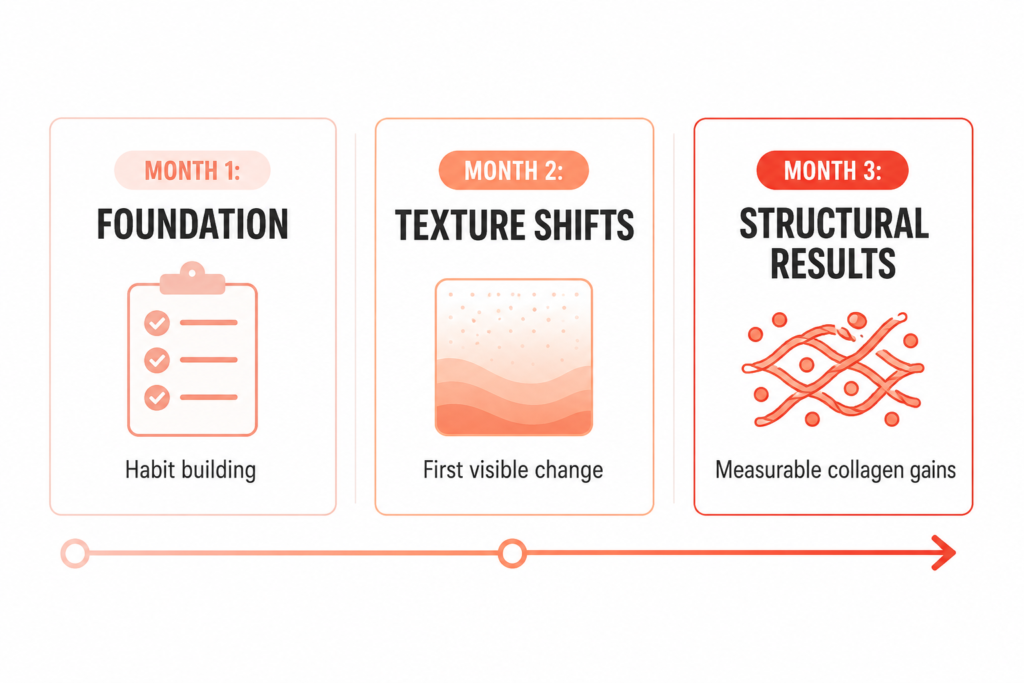
Month 1: Foundation (Weeks 1–4)
This is the least visually exciting month, and it’s worth saying that plainly upfront so you don’t quit before the biology has caught up. Weeks one through four are about establishing two things: a consistent cleansing and skincare foundation, and your first red light therapy sessions. At the cellular level, this is when fibroblasts are being activated and collagen synthesis is ramping up — but structural collagen remodeling hasn’t caught up to the signal yet, so visible change is minimal to none for most people during this phase. What you’re building instead is the habit itself. A simple foundation works best here: gentle cleanser, a lightweight hydrating serum, 10 minutes of red light exposure daily, moisturizer, and SPF every morning without exception. Skip actives like retinol or exfoliating acids during your first two weeks of light therapy while your skin adjusts, then reintroduce them at a different time of day than your light sessions.
Month 2: Texture Shifts (Weeks 5–8)
This is typically when the first visible changes appear — most clinical reviews place the earliest noticeable texture and tone improvements in the four-to-eight-week range of consistent use. What’s happening biologically is that the collagen signaling from month one has started producing enough new structural protein to show up in surface texture: smaller pores, more even tone, a subtle “bounce” to the skin that’s hard to describe until you notice it’s there. This is also, unfortunately, the month where people most often stop — the change is real but modest, and it’s easy to conclude the routine “isn’t working” right before the more substantial results arrive. If you’ve been consistent through month one, this is the month to hold the line rather than escalate. Adding more sessions or a stronger device doesn’t accelerate biology that’s already running on its own schedule.
Month 3: Structural Results (Weeks 9–12)
By week eight through twelve, the research shows more consistent, measurable improvements in collagen density, elasticity, and wrinkle depth — this is where the “structural” part of a glow up actually lands. Clinical trials on LED facial rejuvenation protocols run over this same roughly 12-week window precisely because this is when collagen remodeling and cross-linking mature enough to produce durable change, not just surface-level glow. Some people continue seeing incremental improvement for months beyond this point, since collagen remodeling doesn’t have a hard stop at day 90 — it’s simply the point where most clinical protocols draw their measurement line because the trend is clear by then.
Building the Routine by Budget
Not everyone needs to start at the same price point, and starting too expensive too early is a common way people abandon a 90-day commitment. Here’s how the same core routine scales across three budget tiers.
The 90-Day Routine, Staggered by Budget
Same protocol, three entry points — pick the one you’ll actually use daily.
The differences between tiers are output, coverage area, and comfort of daily use — not whether the underlying biology works. A $95 device used consistently for 90 days will outperform a $470 device used inconsistently for three weeks, every time.
What Can Derail the 90 Days
Being honest about failure points matters more than being motivational here. The most common reason people don’t see the month-three results is simple: they stop somewhere in month two, right when the visible payoff is smallest relative to the effort invested. Skipping SPF is the second-most common derailment — sun damage actively works against the collagen gains you’re building, so an otherwise perfect routine without daily SPF is fighting itself. Inconsistent timing is a smaller factor than people assume; missing an occasional day won’t reset your progress, but skipping more than half your sessions in a given month will meaningfully slow the timeline. And using retinoids or exfoliating acids in direct combination with light sessions, rather than at a separate time, can cause irritation that derails the whole routine out of frustration rather than biology.
Who This Realistically Works For
This 90-day framework is built around consistent, cumulative use of red and near-infrared light for general skin tone, texture, and mild-to-moderate fine lines — the concerns photobiomodulation research supports most consistently. It is not positioned as a replacement for treating significant acne scarring, deep wrinkles, or advanced photodamage, where options like professional microneedling or chemical peels may deliver faster, more targeted change — see our full comparison if that’s closer to your actual concern. If you’re pregnant, immunosuppressed, or on photosensitizing medication, check with a healthcare provider before starting any light therapy routine. And if you’re brand new to red light therapy devices generally, our guide to choosing a red light therapy device covers the buying criteria this article assumes you already understand — irradiance, wavelength selection, and coverage area, all explained in our wavelengths guide as well.
FAQ
Frequently asked questions
Common questions about a 90-day red light therapy glow up.
Collagen remodeling is a biological process, not an instant reaction. Research on photobiomodulation shows collagen signaling begins around week three, with more measurable, structural improvements typically emerging between weeks eight and twelve of consistent use.
Science
Missing an occasional day won’t meaningfully set you back — photobiomodulation effects are cumulative, not dependent on an unbroken streak. Skipping more than half your sessions in a given month is what noticeably slows the timeline.
Usage
No. The underlying biology responds to consistent red and near-infrared exposure regardless of price tier. A budget device used daily for 90 days will outperform a premium device used inconsistently — consistency matters more than output power for most users’ goals.
Buying Decision
Often, yes. Ninety days is where most clinical protocols measure results because the trend is clear by then, but collagen remodeling doesn’t have a hard stop at that point — continued consistent use can produce incremental improvement well beyond the initial three months.
Results
Yes, and most people should. A basic cleanser, hydrating serum, moisturizer, and daily SPF work alongside light therapy rather than against it. Just avoid layering retinol or exfoliating acids directly before or after your light session — use them at a separate time of day.
Usage
For most people, daily 10-minute sessions fall within the ranges studied in photobiomodulation research and are considered safe for ongoing home use. Those who are pregnant, immunosuppressed, or on photosensitizing medication should check with a healthcare provider before starting.
Safety
Start your 90 days todayBudget-friendly XSSNVV LED Face Mask, ready for daily use
A real glow up isn’t a single dramatic before-and-after — it’s three quiet months where fibroblasts do work you can’t see until, gradually, you can. Month one builds the habit. Month two shows the first honest signs it’s working. Month three is where the structural change actually lands. The device you choose matters less than whether you’re still using it on day 75. Pick a tier you can actually afford to use daily without resentment, and let the biology run its course.
Red light therapy devices are not intended to diagnose, prevent, or treat any medical condition. Individual results may vary. Consult a healthcare provider before starting any new health regimen.