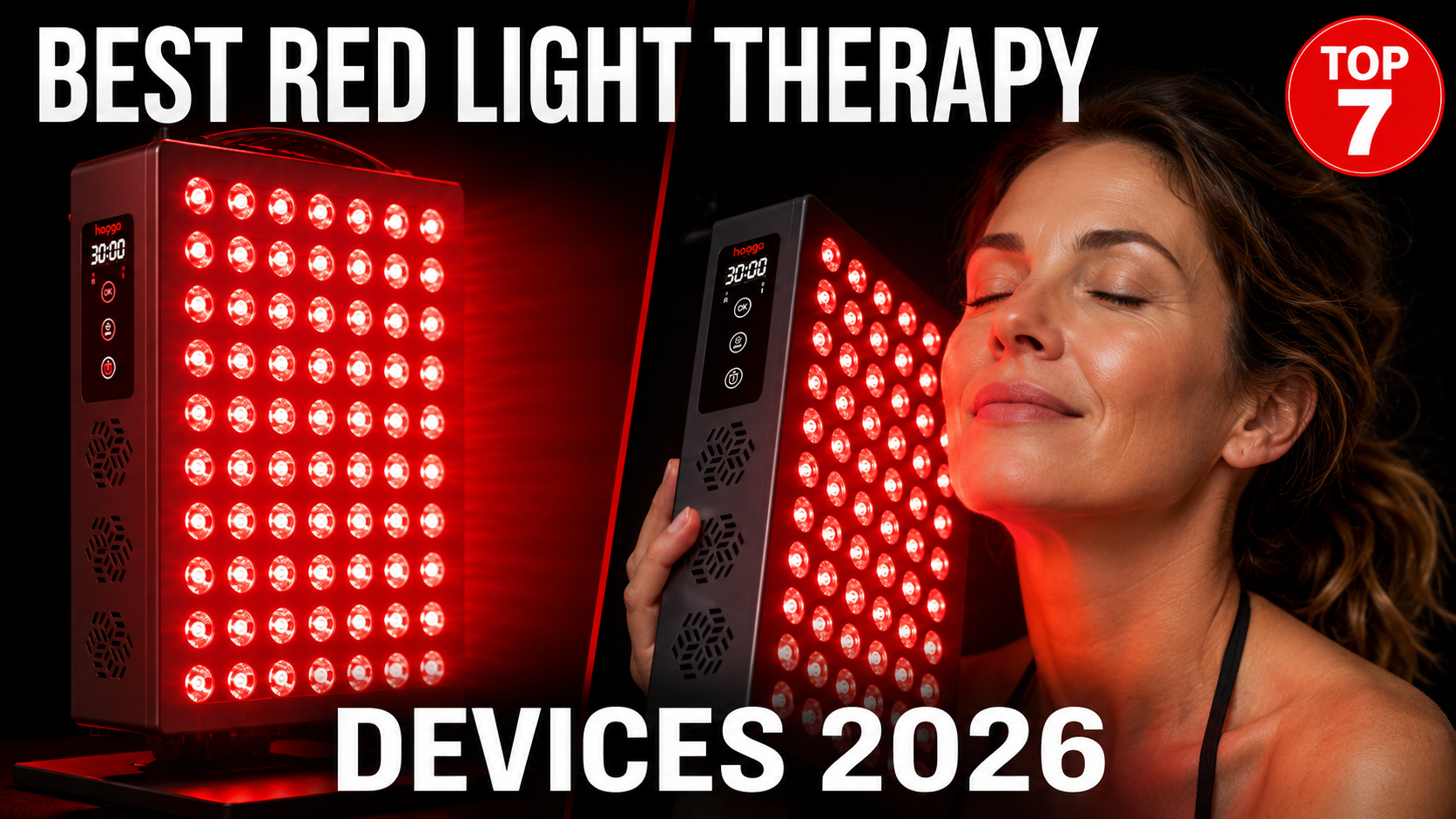
Finding the best red light therapy panels for home use means sorting through a category where irradiance claims are printed freely and verified rarely. Panels differ from face masks in one important way: they’re built for larger-area, higher-output sessions — back, shoulders, full body — which means power output and independent verification matter more here than in the LED mask category. For this ranking, we evaluated panels across the full price spectrum, from a $95 tabletop unit to an $899 professional-grade COB panel, weighting heavily toward brands that publish actual irradiance figures backed by third-party lab testing rather than self-reported marketing numbers.
Every panel here has an active, verifiable Amazon listing and at least one of the two most research-backed wavelengths (660nm red, 850nm near-infrared), with several offering additional wavelengths beyond that baseline. We prioritized brands that disclose specific irradiance figures (mW/cm² at a stated distance) over those making vague “clinical-grade” claims with no number attached, and we gave particular weight to third-party lab-verified output, which only a handful of brands in this category actually provide. We also deliberately excluded one product we’d previously misattributed to this category after a listing mix-up — a lesson in why direct ASIN verification against the live Amazon page, not third-party aggregator data, is the only reliable method. As with our LED mask ranking, we kept a genuine spread across budget, mid, and premium tiers rather than assuming higher price always means a better outcome.
Quick Comparison
Best Red Light Therapy Panels — Quick Comparison
All 10 picks ranked, side by side.
← Scroll to see all →
Rank / Panel
Irradiance
FDA/FSA
Best For
Price
1Mito Red Light MitoMIN 2.0TOP PICK3rd-party lab verified
Mito Red Light earns the top spot for a combination almost no competitor on this list matches in full: FDA Class II medical device registration (making it HSA/FSA eligible), independent third-party lab verification of its irradiance claims, and ETL, BSCI, and ISO 9001/14001 certification — a level of documented verification that’s genuinely rare at this price point. The 60-LED panel delivers 660nm red and 850nm near-infrared simultaneously or separately across three modes, with independent testing confirming 21,720 joules of energy delivery in a 10-minute session — a specific, externally verified number rather than a brand-invented percentage claim. At roughly $249–$269, it undercuts most panels making comparable verification claims, several of which sit at $500+. Its main limitation is scope: at 60 LEDs and a compact 12″x9″x3″ footprint, it’s built for targeted sessions (face, a shoulder, a knee) rather than full-body coverage — for that, Mito’s own larger MitoMID, MitoMAX, and MitoMEGA panels scale up the identical, verified spectral output.
Best for: Buyers who want the strongest independently-verified trust signals in the category without paying premium-tier prices.
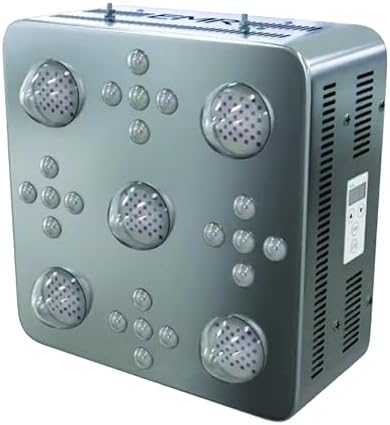
EMR-TEK takes a genuinely different engineering approach than every other panel on this list: Chip-on-Board (COB) technology instead of the standard discrete-LED arrays everyone else uses, packed into 5 COB modules with 320 total diodes. The brand claims up to 14,500 mW/cm² at the lens — several times higher than any discrete-LED panel here — backed by Meanwell industrial drivers for zero flicker and near-zero EMF, with third-party IEC testing behind the irradiance claims. This is meaningfully more power than most home users need for basic maintenance, but for buyers specifically chasing maximum output — serious biohackers, or those treating larger areas quickly — it’s a legitimate step beyond what discrete-LED panels can achieve. Compared to Mito Red Light above, EMR-TEK trades FDA/HSA-FSA eligibility and a longer independent track record for raw power and COB engineering; which matters more depends on whether you’re optimizing for documented trust signals or maximum output.
Best for: Buyers who want the highest raw power output in this category and are comfortable paying premium prices for COB engineering.
Pros:
COB technology — genuinely different from standard discrete-LED panels
Claimed up to 14,500 mW/cm² at the lens, third-party IEC tested
Meanwell industrial drivers, zero flicker, near-zero EMF
Modular rear-port expansion for larger custom setups
Cons:
Premium price (~$899.99) puts it out of reach for casual users
Newer brand with a shorter independent track record than Hooga or Mito
Not FDA-cleared/HSA-FSA eligible, unlike Mito Red Light
BestQool’s Pro300 is built specifically for full-body coverage: 300 elite-grade dual-chip LEDs across four wavelengths (630nm, 660nm, 850nm, 940nm), 500W output, and a modular design that connects to additional BestQool panels for even wider coverage. It’s FSA/HSA eligible and publishes irradiance at 106 mW/cm² at 3 inches — a real, disclosed number rather than a vague superlative. At 36.4″x13.5″x2.6″ and 19.1 lbs, this is meant to be wall-mounted or floor-standed for genuine full-body sessions rather than targeted spot treatment, which is exactly where it separates itself from smaller panels on this list. The tradeoff is straightforward: at $719–$749, it’s a serious financial commitment, and its size means it needs dedicated wall or floor space most apartment-dwellers won’t have readily available.
Best for: Buyers who specifically want full-body coverage in a single panel and have the wall space to mount it.
Pros:
300 LEDs across 4 wavelengths, genuinely full-body scale
FSA/HSA eligible
Published irradiance figure (106 mW/cm² at 3″)
Modular — connects with additional BestQool panels for wider coverage
2-year warranty
Cons:
High price ($719–$749) and large physical footprint
Requires dedicated wall or floor space
Heavier and less portable than any other panel on this list
Comfytemp’s 55W panel — three times the output of the brand’s entry-level 20W models, per the company — pairs 660nm red and 850nm NIR with a genuinely useful mechanical design: a reinforced metal base (4.9 lbs, 1.5x heavier than comparable panels) and a 360° ball-joint arm extending up to 40 inches, letting you position it overhead to lie beneath for a full-body session rather than sitting upright in front of it. It publishes a specific irradiance figure — 143 mW/cm² at 6 inches — and adds smart app control alongside the physical panel controls, a feature most competitors in this price range skip entirely. Compared to the compact desktop panels above it in raw irradiance, Comfytemp’s real differentiator is the floor-standing, lie-beneath use case its competitors at this price don’t offer.
Best for: Buyers who want a floor-standing panel positioned overhead for lying-down, full-body-adjacent sessions rather than sitting in front of a desktop unit.
Pros:
Published irradiance figure (143 mW/cm² at 6″)
Reinforced metal base for genuine stability at extended angles
360° ball-joint arm, adjustable up to 40″ height
App-based smart control alongside physical controls
Cons:
Newer brand with a shorter independent track record than Hooga or Mito
Not FDA-cleared or FSA/HSA eligible
App control requires Bluetooth pairing, an extra setup step some buyers skip
No other panel on this list is actually built to survive a shower. SANSI’s IP65-rated panel is genuinely waterproof, ships with a 16-foot cable specifically so it can be mounted near a shower or bath, and publishes a strong irradiance figure — 260 mW/cm² at 3 inches, among the higher disclosed numbers on this list — allowing the brand to claim treatment times as short as 10 minutes versus the 20 minutes typical of lower-output panels. The 55-inch adjustable stand with a 300-degree rotating head lets it target different body areas without repositioning the whole unit, and a remote control handles on/off and auto-shutoff timing (3/6/10 minutes) without needing wet hands near the panel itself. The category tradeoff here is direct skin exposure: SANSI’s own guidance notes clothing blocks most red light absorption, meaning this is best used exposed-skin in the bathroom setting it’s designed for, not as a general clothed-use panel.
Best for: Buyers who specifically want to combine a shower or bath routine with red light therapy, or who simply want a genuinely water-resistant panel for a bathroom setup.
Pros:
Genuinely IP65 waterproof — not just splash-resistant marketing language
Strong published irradiance (260 mW/cm² at 3″)
55″ adjustable stand with 300° rotating head
Remote control with multiple auto-shutoff timer options
Cons:
Best used with direct skin exposure, limiting general clothed use
LifePro’s BioHeal panel packs 90–120 dual-chip LEDs (depending on the size variant) into a genuinely flexible design — usable standing, hanging on a door, or laid flat — and backs it with a disclosed 203 mW/cm² irradiance figure at 3 inches, one of the stronger published numbers among mid-priced panels on this list. Three light modes and a 1–30 minute adjustable timer round out a feature set that punches above its typical $120–$170 price point. Compared to the compact Mito MitoMIN above, LifePro trades independent third-party lab verification and FDA registration for a higher raw published irradiance number and a lower price — a reasonable tradeoff for buyers less concerned with regulatory documentation and more focused on getting a strong number for the money.
Best for: Buyers who want a strong published irradiance figure at a genuinely mid-range price, without requiring independent third-party verification.
Pros:
High published irradiance (203 mW/cm² at 3″)
Flexible placement: standing, door-hung, or flat
1–30 minute adjustable timer, 3 modes
Includes hanging kit and protective eyewear
Cons:
Irradiance figure is brand-published, not independently lab-verified like Mito Red Light
No FDA clearance or FSA/HSA eligibility
Lightweight construction feels less premium than heavier panels on this list
Hooga has built a genuinely trusted reputation in this category over years of operation, and the HG300 is its accessible entry point: 60 LEDs delivering 660nm red and 850nm NIR, a disclosed 73 mW/cm² irradiance at 6 inches, and a complete starter kit — panel, adjustable tabletop stand, protective eyewear, power cord, and manual — all included at a genuinely low price. Hooga backs it with a 3-year warranty, U.S.-based customer support, and a rated 50,000+ hour LED lifespan, three things that matter more for a budget purchase than they might seem, since a 3-year warranty from a brand with a real support team meaningfully de-risks a first purchase in this category.
Best for: First-time panel buyers who want a trusted brand, complete starter kit, and low price without needing full-body coverage or maximum irradiance.
Pros:
Complete starter kit (stand, eyewear, cord) included
Published 73 mW/cm² irradiance at 6″
3-year warranty and U.S.-based support from an established brand
Genuinely low, frequently-discounted price
Cons:
Compact size limits it to targeted, not full-body, use
Single-chip LEDs — lower irradiance ceiling than Hooga’s own PRO or ULTRA lines
For buyers who want to stay with Hooga’s trusted brand and support ecosystem but need more output than the HG300 provides, the PRO300 steps up to dual-chip LEDs at the same 660nm/850nm wavelength pairing, delivering meaningfully higher irradiance at the same physical footprint. Hooga’s own positioning is transparent about this tier structure — HG series for first-time users and targeted use, PRO series for higher irradiance and faster sessions — which is a more honest approach to product-line differentiation than brands that simply rename the same specs at a higher price. The tabletop stand, timer, and low-EMF flicker-free drivers carry over from the HG line, so the upgrade path is genuinely incremental rather than a completely different product experience.
Best for: Existing Hooga HG-series owners, or new buyers who want higher irradiance than the HG300 without switching brands or learning a new product ecosystem.
Pros:
Dual-chip LEDs deliver meaningfully higher irradiance than HG300 at the same footprint
Same trusted 3-year warranty and U.S. support as the rest of the Hooga line
Clear, honest brand positioning about tier differences
Table-top stand and timer included
Cons:
Costs roughly 60-90% more than the HG300 for the same footprint
Still compact/targeted-use scale, not full-body
Diminishing returns if you don’t specifically need the higher irradiance
BONTANNY’s BO-300 stands out for cramming five distinct wavelengths (630nm, 660nm, 810nm, 830nm, 850nm) into 60 dual-chip LEDs at one of the lowest prices on this list — more wavelength variety than any other budget-tier panel here. A 14×12-inch coverage area at 6 inches, remote control, built-in timer, and a 30-day trial period round out a genuinely feature-dense budget option. The honest caveat: more wavelengths isn’t automatically better if the added wavelengths (810nm, 830nm) overlap heavily in effect with the two most-researched ones (660nm, 850nm) already included — the marginal benefit of wavelength five versus wavelength two is less established in the literature than the core red/NIR pairing itself. Still, for buyers who want to experiment across a wider spectral range without paying mid-tier prices, it’s a reasonable value.
Best for: Budget-conscious buyers who specifically want to experiment with a wider range of wavelengths than the standard two-wavelength budget panel offers.
Pros:
Five wavelengths at a genuinely low price
Remote control and built-in timer included
30-day trial period
Compact, lightweight design (13.2″x8.7″x2.4″)
Cons:
No published irradiance figure
Marginal benefit of the extra three wavelengths beyond 660nm/850nm is less clearly established in research
SOLRA’s SR40 rounds out this list with a genuinely different practical advantage: a 2-in-1 mounting system combining a detachable magnetic VESA 75×75 mount (for desks, vanities, or nightstands) with a separate mobile floor stand, plus a standard ¼”-20 tripod thread compatible with common camera mounts and clamps. That’s more mounting flexibility than any other panel here, letting the same unit move between a hands-free desk session and a full-body floor session without buying separate hardware. Forty 5W LEDs deliver a 1:1 ratio of 660nm red and 850nm NIR with a focused 30° beam, publishing ≥150 mW/cm² irradiance at 3 inches — a solid, disclosed number — alongside genuinely low measured EMF (0.0 μT at 10cm) and a rated 50,000-hour LED lifespan.
Best for: Buyers who want to use the same panel across multiple setups (desk, floor, tripod) without investing in separate mounting hardware for each.
Pros:
Genuinely versatile 2-in-1 mounting system (magnetic + floor stand + tripod thread)
Published irradiance (≥150 mW/cm² at 3″)
Very low measured EMF (0.0 μT at 10cm)
LCD touch controls with a 5–60 minute timer
Cons:
Newer brand (first available April 2026) with limited long-term track record
No FDA clearance or FSA/HSA eligibility
Fewer total LEDs (40) than most competitors at a similar price
Panels differ from face masks in ways that change what actually matters when choosing one.
Irradiance and how it’s verified. This is the single most important spec for panels specifically, since larger treatment distances (panels are typically used at 3–12 inches from skin, versus a mask sitting directly on the face) mean output density matters more for delivering an effective dose. A published mW/cm² figure at a stated distance is useful; one independently verified by a third-party lab (as with Mito Red Light) is more useful still, since brand-reported numbers can be measured under generous conditions that don’t reflect real-world use.
Coverage area vs. portability. A compact tabletop panel (Hooga HG300, Mito MitoMIN) is easy to store and move but limits you to targeted sessions on one body area at a time. A full-body panel (BestQool Pro300) treats far more surface area per session but demands dedicated wall or floor space and a higher price. Most buyers are better served starting compact and scaling up only if a specific full-body use case justifies it.
Mounting and use case fit. This list includes genuinely different mounting philosophies — SANSI’s waterproof design for bathroom use, Comfytemp’s overhead lie-beneath arm, and SOLRA’s multi-mount flexibility. The “best” mounting system depends entirely on where and how you’ll realistically use the panel, not which one sounds most advanced on paper.
FDA clearance and FSA/HSA eligibility. Only Mito Red Light and BestQool on this list carry FDA Class II registration, making them FSA/HSA-purchase eligible — a real dollar savings (25–30% depending on tax bracket) worth factoring into the actual cost comparison if you have either account type available.
Wavelength count vs. wavelength relevance. More wavelengths sound better in a spec sheet, but the two most heavily research-backed wavelengths in this category remain 660nm red and 850nm NIR. Panels adding additional NIR wavelengths (830nm, 940nm) are adding modest additional depth-penetration variety; panels adding blue or amber wavelengths are targeting genuinely different concerns (acne, redness) rather than simply “more power.”
The Most Common Objection: “Aren’t These All Basically the Same LEDs?”
This is a fair challenge, and it’s worth answering honestly rather than dismissing it. At the component level, many budget-to-mid panels in this category do source similar LED chips from overlapping manufacturing supply chains — this is a real dynamic in the industry, not a myth. Where panels genuinely differentiate is in three areas that aren’t just marketing: verified irradiance output (some brands publish real, lab-tested numbers; others don’t publish anything at all), driver quality (cheap drivers cause flicker and higher EMF, which better-engineered panels like EMR-TEK and SOLRA specifically address), and thermal management (sustained LED output degrades faster in panels with inadequate cooling, shortening real-world lifespan even if the initial spec sheet looks identical). The skeptical take — “it’s all the same light” — is wrong at the engineering level, but the underlying suspicion that marketing outpaces genuine differentiation in much of this category is often fair. That’s exactly why this list weighted independent verification as heavily as it did.
Full Specs Comparison
Full Specs: All 10 Panels Compared
Wavelengths, LEDs, power, and mounting side by side.
← Scroll to see all →
Panel
Wavelengths
LEDs
Power
Mounting
Mito Red Light MitoMIN 2.0
660/850nm
60
Not disclosed (verified 21,720J/10min)
Kickstand
EMR-TEK Firestorm Pro
660/850nm (COB)
320 diodes (5 COBs)
Not disclosed
Modular, expandable
BestQool Pro300
630/660/850/940nm
300
500W
Wall/floor, modular
Comfytemp 55W Panel
660/850nm
Not disclosed
55W
Floor stand, 360° arm
SANSI Waterproof
660/850nm
Not disclosed
80W
55″ adjustable stand
LifePro BioHeal
660/850nm
90-120
Not disclosed
Standing, door, or flat
Hooga HG300
660/850nm
60
Not disclosed
Tabletop stand
Hooga PRO300
660/850nm
60 (dual-chip)
Not disclosed
Tabletop stand
BONTANNY BO-300
630/660/810/830/850nm
60
Not disclosed
Base stand
SOLRA SR40
660/850nm
40
200W
Magnetic + floor + tripod
A few non-obvious takeaways worth calling out: the panel with the strongest independent verification (Mito Red Light) sits in the middle of the price range, not at the top — third-party lab testing doesn’t require the highest price tag. Irradiance figures across this list range enormously (73 to 260+ mW/cm²) without a clean correlation to price. And only two panels here — Mito Red Light and BestQool — carry FDA registration, despite “clinical-grade” language appearing across nearly every listing’s marketing copy.
How This Fits Into a Broader Wellness Routine
A red light panel is typically a targeted or full-body maintenance tool used alongside, not instead of, a broader wellness or recovery routine. Post-workout users often pair a panel session with stretching or foam rolling; skin-focused users often use a panel as a body-coverage complement to a dedicated facial device like an LED mask. If your primary interest is facial skincare rather than body-focused panel use, our best LED face masks roundup covers that category in the same depth, and our wavelengths explainer covers the mechanism behind every wavelength referenced across both lists.
FAQ
Frequently asked questions
Common questions about choosing between the best red light therapy panels.
The Hooga HG300 is our top recommendation for first-time buyers — it includes a complete starter kit (stand, eyewear, cord), carries a 3-year warranty from an established brand, and keeps the price genuinely low without cutting corners on core wavelengths.
Buying Decision
Not necessarily beyond a certain point. Photobiomodulation follows a biphasic dose-response — too little light does little, an appropriate dose is effective, and excessive light can blunt the benefit. Higher irradiance generally means shorter sessions can achieve a similar dose, which is convenient, but it isn’t automatically “more effective” past the point your session length is already adequate.
Science
Only Mito Red Light and BestQool on this list carry FDA Class II registration, which makes them FSA/HSA-purchase eligible. This can save 25-30% depending on your tax bracket, and it’s worth checking if you have either account type before assuming a non-eligible panel is actually cheaper.
Buying Decision
For most general wellness, skin, or single-joint recovery goals, a compact targeted panel like the Mito MitoMIN or Hooga HG300 is sufficient — you simply move it between body areas across different sessions. Full-body panels like BestQool’s Pro300 make sense mainly if you specifically want to treat a large area in a single session, or you’re managing a condition affecting multiple body regions simultaneously.
Usage
Only if the specific panel is rated for water exposure — most panels on this list are not. SANSI’s panel is specifically IP65 waterproof-rated and designed for this use case; using a non-waterproof panel near water exposure risks both device damage and electrical safety hazards.
Safety
Skin tone and texture improvements are typically reported within 4-8 weeks of consistent use, with more structural changes (firmness, deeper pain relief) building over 8-12 weeks. Immediate circulation and warmth-related comfort can be felt within a single session, but that’s a separate, faster mechanism than the cumulative photobiomodulation effect.
Results
The PRO300 uses dual-chip LEDs at the same footprint, delivering meaningfully higher irradiance than the single-chip HG300 for roughly 60-90% more cost. If you’re a first-time buyer, start with the HG300; upgrade to the PRO300 only if you specifically find yourself wanting shorter sessions or stronger output later.
Buying Decision
Not necessarily. The two most heavily research-backed wavelengths remain 660nm red and 850nm near-infrared. Panels like BONTANNY’s BO-300 add three more NIR wavelengths, which offer modest additional depth-penetration variety, but the marginal research support for wavelengths beyond the core pairing is less established than for the two primary ones.
Science
Only if you specifically need the higher output — for most general wellness and skin-focused goals, a well-verified $250 panel like the Mito MitoMIN delivers comparable underlying benefit with more sessions rather than more power per session. The Firestorm Pro makes the most sense for buyers treating larger areas quickly or specifically chasing maximum documented output.
Buying Decision
See our top overall pickMito Red Light MitoMIN 2.0 — FDA registered, independently verified
Across all ten, Mito Red Light’s MitoMIN 2.0 is our top overall pick — the combination of FDA registration, independent third-party lab verification, and a reasonable price is genuinely difficult to match elsewhere in this category. If raw power is your priority regardless of cost, EMR-TEK’s Firestorm Pro delivers the highest verified output here through genuinely different COB engineering. If you need real full-body coverage, BestQool’s Pro300 is built specifically for that scale. And if you’re simply looking for a trusted, low-risk entry point, Hooga’s HG300 remains one of the most complete starter packages in the category at its price.
Red light therapy devices are not intended to diagnose, prevent, or treat any medical condition. Individual results may vary. Consult a healthcare provider before starting any new health regimen.
⚠️ Affiliate Disclosure: This article contains affiliate links. If you purchase through our links, we may earn a commission at no extra cost to you. We only recommend products we have thoroughly researched.