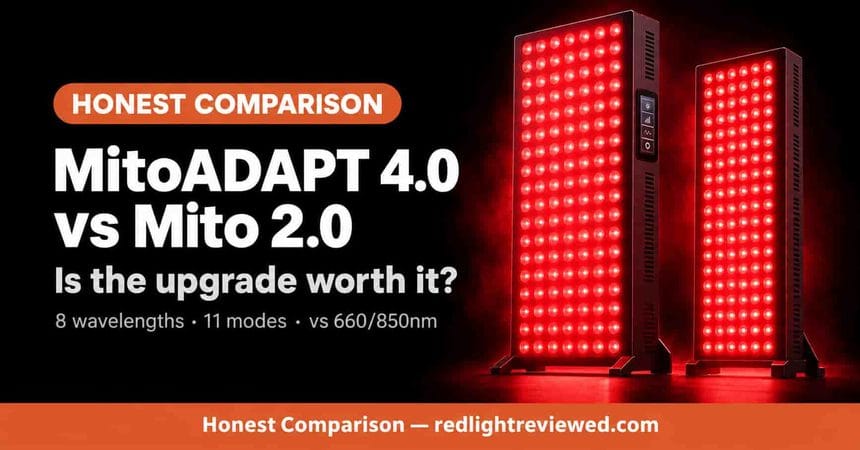
This MitoADAPT review answers the question most shoppers land on after researching Mito Red Light: is the flagship MitoADAPT 4.0 worth roughly twice the money of the brand’s simpler Mito 2.0 panels? The ADAPT is Mito’s most technically ambitious panel — eight wavelengths, a dual-chip LED design, and 11 selectable modes — and it is sold only through Mito’s own website. The 2.0 series sticks to the two most-studied wavelengths, 660nm red and 850nm near-infrared, and it is the Mito line you can actually buy on Amazon.
Table of Contents
We compared both lines on published specs, Mito’s own lab data, and independent measurements to settle which one makes more sense for a typical home user — and who genuinely benefits from the upgrade.
For most people, the Mito 2.0 series is the smarter buy. It delivers the two wavelengths with the deepest research base, costs about half as much at each size, and ships through Amazon with Prime logistics and easy returns. The MitoMID 2.0 is the sweet spot for face-and-upper-body sessions.
The MitoADAPT 4.0 earns its price only if you specifically want spectrum control — the ability to run amber, deep red, or 940nm NIR in isolation — plus the longer 3-year warranty. The full picture is more nuanced, so here is the breakdown.
MitoADAPT 4.0 — What You Need to Know
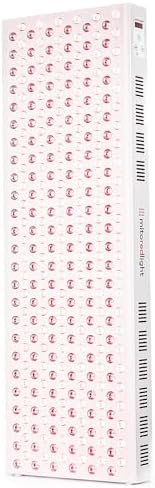
The MitoADAPT 4.0 comes in three sizes: the MIN (9″ × 12″), MID (12″ × 27″), and MAX (12″ × 36″). Each uses what Mito calls a TruDUAL™ chip: every lens houses two LED chips, giving the MAX 288 lenses and 576 chips. Those chips are split across eight independent circuits covering 590nm (amber), 630nm, 660nm, 670nm, 810nm, 830nm, 850nm, and 940nm.
That circuit design is the real innovation. Instead of the usual fixed “red, NIR, or both” switch, the ADAPT offers 11 pre-set combinations, so you can run a red-heavy skin protocol one day and a deep-NIR recovery session the next. Control happens through a touchscreen and a companion app.
On paper, Mito rates the ADAPT at more than 56–60 mW/cm² at 6 inches, depending on size, measured with a spectroradiometer. Independent testing by Light Therapy Insiders on the MAX 4.0 recorded a peak of 74 mW/cm² and a 58 mW/cm² average across a 9-point grid, with about 133 watts of optical output. That same test flagged two weaknesses: the amber channel peaked closer to 599nm than the advertised 590nm, and total power ranked mid-pack among the premium panels they have measured.
Other strengths are real: IEC 60601-1 medical electrical safety certification, ETL certification, FDA Class II registration (registration, not clearance), flicker-free output, no detectable EMF at 6 inches, and a 3-year warranty with a 60-day return window.
Its limitations: it costs roughly double the equivalent 2.0 panel, you cannot control individual wavelengths (only the 11 presets), a stand is sold separately for the larger sizes, and it is not currently available on Amazon — Mito’s own store is the only reliable source.
Mito 2.0 Series — What You Need to Know
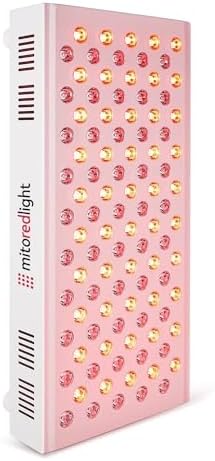
The Mito 2.0 lineup is deliberately simple. Every panel pairs 660nm red with 850nm near-infrared, with three modes: red only, NIR only, or both together. Sizes scale by LED count: the MitoMIN 2.0 (60 LEDs, 12″ × 9″), MitoMID 2.0 (100 LEDs, 19″ × 9″), MitoMAX 2.0 (200 LEDs, 36″ × 9″), and MitoMEGA 2.0 (300 LEDs).
Mito publishes energy output per 10-minute session on the Amazon listings: about 21,700 joules for the MIN, 37,500 for the MID, and 68,000 for the MAX. For the MAX, that works out to roughly 113 watts of light output — about 85% of what independent testing measured on the ADAPT MAX, at a much lower price.
The 2.0 panels include a digital timer and quiet cooling fans, are third-party lab tested, and are FSA/HSA eligible. On Amazon, the MIN 2.0 has the largest review base of the line and holds a rating around 4.5 stars, with the MID and MEGA rated higher on smaller samples.
The trade-offs: no amber, 630nm, or 940nm; no app or preset protocols; a shorter 2-year warranty; and a single-chip design that delivers less total power per panel inch than the ADAPT. For a user who wants a proven red/NIR panel and does not plan to experiment with spectrum, none of those gaps matter much.
Head-to-Head on Key Criteria
Wavelength range Winner: MitoADAPT 4.0 — eight wavelengths versus two. If you want amber for skin tone or 940nm for deeper NIR experiments, only the ADAPT has them.
Evidence-backed core wavelengths Winner: Tie — both panels include 660nm and 850nm, the two wavelengths with the largest body of photobiomodulation research. Most published skin and muscle-recovery studies use wavelengths in the 630–670nm and 810–850nm bands; the added wavelengths on the ADAPT have a thinner evidence base.
Power and coverage per dollar Winner: Mito 2.0 — the MAX 2.0 delivers roughly 85% of the ADAPT MAX’s measured output for around half the price. The ADAPT is more powerful, but not proportionally.
Controls and flexibility Winner: MitoADAPT 4.0 — 11 presets, touchscreen, and app control versus a three-mode switch.
Warranty and certifications Winner: MitoADAPT 4.0 — a 3-year warranty versus 2 years, plus IEC 60601-1 medical-grade electrical certification.
Buying experience Winner: Mito 2.0 — available on Amazon with fast shipping and Amazon’s returns process, in addition to Mito’s own 60-day guarantee. The ADAPT is direct-only.
The Science: Do More Wavelengths Mean Better Results?
Red and near-infrared light are believed to act on cytochrome c oxidase, an enzyme in the mitochondria that helps cells produce ATP. That is the mechanism behind the “photobiomodulation” label, and it is why wavelengths cluster in two windows: red (roughly 630–670nm) for skin-level effects and NIR (roughly 810–850nm) for deeper tissue.
Controlled trials support red light for skin. A widely cited 2014 study in Photomedicine and Laser Surgery found that participants receiving red-light treatment showed improved skin complexion and measured collagen density compared with controls. For muscle performance and recovery, several meta-analyses of photobiomodulation using NIR wavelengths suggest modest benefits when light is applied before exercise, though protocols vary widely.
The evidence for adding more wavelengths is weaker. Amber (590nm) has some small studies in cosmetic skin care, and 940nm penetrates deeply, but there is no strong clinical evidence that eight wavelengths outperform a well-dosed 660/850 combination. In practice, dose — irradiance × time — matters more than wavelength count. If you want to go deeper, our guides to red light therapy wavelengths, irradiance, and dosingcover the numbers.
That is the core reason the 2.0 series wins for most buyers: it covers the part of the spectrum where the research is strongest.
2.0 energy figures are from Mito’s Amazon listings. ADAPT irradiance is Mito’s spectroradiometer rating; power draw is electrical input, not light output. ADAPT wavelengths: 590, 630, 660, 670, 810, 830, 850, 940nm.
Who Should Buy Which
Choose the MitoADAPT 4.0 if:
You want to run different protocols (skin, recovery, deep NIR) from one panel
You value amber and 940nm specifically and understand the evidence is still emerging
A 3-year warranty and medical-grade electrical certification matter to you
Budget is secondary and you are comfortable buying direct from Mito
Choose the Mito 2.0 if:
You want the proven 660nm + 850nm combination without paying for extras
You prefer buying on Amazon with Prime shipping and simple returns
You are new to red light therapy and want a straightforward routine
You want the most light output per dollar within the Mito brand
Consider neither if:
You need a full-body panel under $300 — look at our best red light therapy panels for budget options
Your main goal is facial skin care — a dedicated LED face mask is more convenient for daily use
Which Mito 2.0 Size Makes Sense?
MitoMIN 2.0 — targeted areas: face, neck, a single joint. Best entry point and the most-reviewed model.
MitoMID 2.0 — face plus chest or upper back; the best balance of coverage and price for most people.
MitoMAX 2.0 — torso-length coverage for recovery and larger areas, usable on a door mount.
MitoMEGA 2.0 — the highest LED count of the line, for users who want broader body coverage in fewer sessions.
Dual-chip design with strong independently measured irradiance
3-year warranty, IEC 60601-1 and ETL certified
Cons:
Roughly double the price of the equivalent 2.0 panel
Not available on Amazon
No individual wavelength control; amber measured slightly off-spec in independent testing
Stand sold separately for larger sizes
Mito 2.0
Pros:
Proven 660nm + 850nm combination
Strong light output per dollar
Sold on Amazon, FSA/HSA eligible
Simple three-mode operation
Cons:
Only two wavelengths
No app or preset protocols
2-year warranty
Our Verdict
Mito 2.0: 4.5/5 — best choice for most home users. It covers the wavelengths with the strongest research at about half the cost, and buying through Amazon is simple. Start with the MitoMID 2.0 for face and upper body, or the MitoMAX 2.0 for larger areas.
MitoADAPT 4.0: 4.2/5 — excellent engineering for a narrower audience. It is the right panel if you want to experiment with spectrum and value the longer warranty. It is hard to justify for a standard red/NIR routine.
The questions buyers ask most when choosing between MitoADAPT 4.0 and Mito 2.0.
For most home users, no. Both include 660nm and 850nm, the wavelengths with the strongest research, and the 2.0 costs roughly half as much per size. The ADAPT is worth it if you specifically want spectrum control (amber, 670nm, 940nm), 11 preset modes, and a 3-year warranty.
Buying decision
Not reliably. At the time of writing, the MitoADAPT 4.0 is sold through Mito Red Light’s own website, and the only Amazon listing we found was marked unavailable. The Mito 2.0 series (MIN, MID, MAX, MEGA) is available on Amazon.
General
Size and coverage. The MID 4.0 is 12″ × 27″ with 216 dual-chip lenses; the MAX 4.0 is 12″ × 36″ with 288. Both use the same eight wavelengths and 11 modes, with similar irradiance at 6 inches. The MAX covers more of the body per session, so it suits full-torso or recovery use.
Buying decision
There is no strong clinical evidence that more wavelengths produce better results. Most research uses wavelengths in the 630–670nm red and 810–850nm near-infrared ranges. Dose (irradiance multiplied by time) and consistency matter more than wavelength count.
Science
No red light panel is “FDA approved.” Mito lists the ADAPT as an FDA Class II registered device, which is different from FDA clearance. It also holds IEC 60601-1 medical electrical safety and ETL certifications.
Safety
The MitoMIN 2.0 suits face, neck, or a single joint. The MitoMID 2.0 is the best all-rounder for face plus upper body. Choose the MitoMAX 2.0 or MitoMEGA 2.0 if you want larger-area coverage for recovery.
Usage
Skin-related changes in studies are usually measured after 8–12 weeks of consistent sessions (several times per week). Some users notice recovery or comfort effects sooner. Results vary between individuals, and consistency matters more than which Mito model you choose.
Results
Our pick for most people: MitoMID 2.0Proven 660/850nm, face + upper body coverage, sold on Amazon.
⚠️ Affiliate Disclosure: This article contains affiliate links. If you purchase through our links, we may earn a commission at no extra cost to you. Read our full disclosure policy.
Red light therapy devices are not intended to diagnose, prevent, or treat any medical condition. Individual results may vary. Consult a healthcare provider before starting any new health regimen.