PlatinumLED BioMax Review: Is It Worth It vs Mito 2.0?
Spread the love
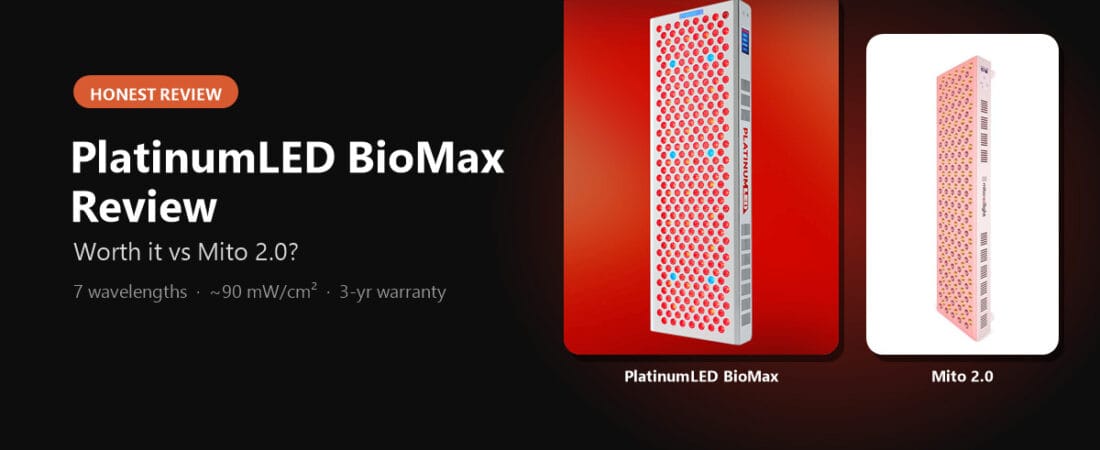
This PlatinumLED BioMax review looks at one of the most powerful consumer red light therapy panels you can buy, and at a question many shoppers run into halfway through their research. The BioMax is sold only on PlatinumLED’s own website, while Mito Red Light’s 2.0 panels, built in the same sizes, are on Amazon. Is the BioMax worth paying more for and buying direct?
We compared the BioMax lineup on published specs, independent lab measurements, and warranty terms, then matched each size against its closest Mito 2.0 equivalent. We did not run our own hands-on tests; where we quote output figures, we say who measured them.
PlatinumLED BioMax vs Mito 2.0 at a Glance
PlatinumLED’s high-output panel vs Mito’s best-selling red/NIR line, compared on the specs that matter.
The PlatinumLED BioMax is a genuinely high-output panel with a broader spectrum than most competitors, a 3-year warranty, and one of the longest track records in the category. It is the better pick if you want maximum irradiance, blue and 1060nm bands, and plan to build a multi-panel setup. For most home users running a standard red and near-infrared routine, the Mito 2.0 series delivers the two wavelengths with the most research behind them, at a lower price, with Amazon’s return process, in the same panel sizes.
PlatinumLED BioMax — What You Need to Know
PlatinumLED started out designing horticultural LED spectra before moving into human light therapy, and the BioMax is now in its 9th generation. The line comes in four sizes: the BioMax 300 (100 LEDs, 19″ × 9″), BioMax 450 (150 LEDs, 19″ × 12″), BioMax 600 (200 LEDs, 36″ × 9″), and BioMax 900 (300 LEDs, 36″ × 12″). Panels link together for full-body setups.
Each panel uses PlatinumLED’s “R+ | NIR+” spectrum: seven bands at 480nm (blue), 630nm, 660nm, 810nm, 830nm, 850nm, and 1060nm. That list looks broad, but the LED mix is heavily weighted. In an independent teardown of the BioMax 900, roughly three-quarters of the LEDs were 660nm and 850nm, with only a handful at 480nm and 1060nm. That is not a flaw, since 660nm and 850nm are the most-studied wavelengths, but it means the extra bands play a supporting role rather than transforming the treatment.
Output is where the BioMax stands out. Light Therapy Insiders measured the BioMax 900 at about 90 mW/cm² at 6 inches and 75 mW/cm² at 12 inches, with around 186 watts of total draw, among the highest figures in their consumer panel testing. PlatinumLED states the BioMax carries FDA Class II medical device status and publishes EMF data showing no readable EMF from 4 inches away. The warranty is 3 years. Returns are accepted within 60 days, but independent reviewers report a 20% restocking fee, so check the current policy before ordering.
BioMax Pro: PlatinumLED also sells a newer BioMax Pro line in the same dimensions, so stands stay compatible. It adds roughly 30% more LEDs, individual control of each wavelength band, adjustable pulsing, preset smart modes, and a “zero-gap” edge design for seamless multi-panel setups. An independent test of the BioMax Pro Ultra measured about 101 mW/cm² on average. It costs more than the standard BioMax, and even reviewers who liked it questioned whether most users need the extra output.
Mito Red Light 2.0 — What You Need to Know
Mito Red Light, founded in 2018 in Scottsdale, Arizona, keeps the 2.0 series deliberately simple: 660nm red and 850nm near-infrared only, three modes (red, NIR, or both), a digital timer, and quiet cooling fans. Mito states every 2.0 panel is independently tested for irradiance and spectral output, and the whole line is FSA/HSA eligible.
The sizes line up almost exactly with the BioMax range: MitoMIN 2.0 (12″ × 9″), MitoMID 2.0 (19″ × 9″), MitoMAX 2.0 (36″ × 9″, 200 LEDs), and MitoMEGA 2.0 (36″ × 12″, 300 LEDs). Mito rates a 10-minute session at 37,500 joules for the MID, 68,040 for the MAX, and 106,560 for the MEGA, which works out to roughly 63, 113, and 178 watts of light energy. The warranty is 2 years, and because the panels are sold on Amazon, returns follow Amazon’s standard process.
If you want Mito’s more advanced spectrum panel, see our MitoADAPT review. Note that the ADAPT line is sold on Mito’s website rather than Amazon. For the brand as a whole, read our Mito Red Light review.
BioMax sizes and LED counts from independent reviews of the 8th/9th generation; Mito sizes and LED counts from the Amazon listings. BioMax panels are sold only on PlatinumLED’s website.
BioMax 300 ↔ MitoMID 2.0. Both are 19″ × 9″, a good size for face, neck, and upper chest.
BioMax 450 has no direct Mito 2.0 twin (19″ × 12″). The MitoMID 2.0 is the closest in height; the MitoMAX 2.0 if you want more coverage.
BioMax 600 ↔ MitoMAX 2.0. Both are 36″ × 9″ with 200 LEDs, the most popular size for half- to most-of-body coverage.
BioMax 900 ↔ MitoMEGA 2.0. Both are 36″ × 12″ with 300 LEDs. Mito’s own rating (~178 W of light energy) and the independent BioMax 900 measurement (~186 W of total power draw) are in the same range, although the two figures are measured differently and are not a like-for-like comparison.
Head-to-Head on Key Criteria
Light output
Winner: PlatinumLED BioMax. It has the stronger independent irradiance data, and the BioMax Pro pushes output higher still. The gap matters most if you want shorter sessions or stand farther from the panel.
Wavelengths
Winner: BioMax for range, tie for the research that matters. The BioMax adds 480nm, 630nm, 810nm, 830nm, and 1060nm, but both panels deliver 660nm and 850nm, the pair used in most photobiomodulation studies. Our wavelengths explained guide covers why more bands do not automatically mean better results.
Controls and features
Winner: BioMax (especially the Pro). Group or individual wavelength control, an app, and, on the Pro, pulsing and preset modes. Mito 2.0 offers three modes and a timer, which is enough for a standard routine.
Warranty and returns
Winner: split. BioMax has the longer warranty (3 years vs 2). Mito 2.0 has the simpler return path, under Amazon’s standard return policy.
Price and buying convenience
Winner: Mito 2.0. Independent coverage puts the BioMax at a premium over comparably specced Mito panels, and it is only sold direct. The Mito 2.0 panels are sold and shipped through Amazon and are FSA/HSA eligible.
Does Higher Irradiance Mean Better Results?
Not automatically. What matters in photobiomodulation is the dose (irradiance multiplied by time) delivered consistently over weeks. A higher-output panel reaches the same dose faster or from farther away, which is a real convenience, but it does not unlock effects a lower-output panel cannot reach with slightly longer sessions. Very high doses can even be less effective, a pattern researchers describe as a biphasic response.
That is why the BioMax’s advantage is best understood as efficiency and flexibility, not better outcomes. If you value 8-minute sessions from 12 inches away, it delivers. If you are happy with 10–15 minutes closer to the panel, the Mito 2.0 reaches comparable doses. Our guides to irradiance and red light therapy dosing go deeper into the numbers.
Who Should Buy Which
Choose the PlatinumLED BioMax if:
You want the highest independently measured output in this comparison
You are interested in 480nm blue or 1060nm bands in addition to red and NIR
You plan a multi-panel full-body setup (consider the BioMax Pro for its zero-gap edges)
A 3-year warranty matters more to you than an easy return path
Choose Mito 2.0 if:
You want the proven 660nm + 850nm combination without paying for extra bands
You prefer buying on Amazon, with Amazon’s shipping and return process
You want to use FSA/HSA funds on a panel that is listed as eligible
You are buying your first panel and want the simplest controls
Among the highest independently measured irradiance of consumer panels
Seven wavelength bands, with the option to switch off blue light
3-year warranty and published EMF data
Modular design for multi-panel setups; Pro version adds pulsing and individual band control
PlatinumLED BioMax — Cons
Not sold on Amazon; direct purchase only
Reported 20% restocking fee on returns
Premium price versus comparable Mito panels
Most of the LED count is still 660nm and 850nm, so the extra bands add less than the spec list suggests
Mito 2.0 — Pros
660nm + 850nm, the most-studied wavelength pair
Same sizes and LED counts as the BioMax 600 and 900 at the larger end
Sold on Amazon; FSA/HSA eligible; third-party tested
Simple three-mode controls
Mito 2.0 — Cons
No blue, 630nm, 810nm, 830nm, or 1060nm
2-year warranty
No app, pulsing, or preset protocols
Our Verdict
PlatinumLED BioMax: 4.3/5. It is one of the strongest consumer panels on raw output, with a broad spectrum, a 3-year warranty, and a long track record, held back by direct-only buying, a reported restocking fee, and a premium over panels that deliver the same core wavelengths.
For most readers, the Mito 2.0 is the smarter buy. Pick the size that matches the BioMax you were considering (MitoMID 2.0 for the BioMax 300, MitoMAX 2.0 for the BioMax 600, MitoMEGA 2.0 for the BioMax 900) and you get the proven 660/850nm combination on Amazon. Choose the BioMax if maximum output and extra bands are worth the premium to you. For more on the brand, see our PlatinumLED review.
Frequently asked questions
The questions buyers ask most about the PlatinumLED BioMax and how it compares with Mito 2.0.
It is worth it if you want maximum output, extra wavelength bands (480nm and 1060nm), and a 3-year warranty, and you are comfortable buying direct. For a standard red and near-infrared routine, a Mito 2.0 panel of the same size delivers the same core 660nm and 850nm wavelengths for less, and it is sold on Amazon.
Buying decision
No. At the time of writing, the BioMax and BioMax Pro are sold only through PlatinumLED’s own website. If you prefer to buy on Amazon, the Mito 2.0 series comes in matching sizes: MitoMID 2.0 for the BioMax 300, MitoMAX 2.0 for the BioMax 600, and MitoMEGA 2.0 for the BioMax 900.
General
Width and LED count. Both are 36 inches tall, but the BioMax 600 is 9 inches wide with 200 LEDs, while the BioMax 900 is 12 inches wide with 300 LEDs. The 900 covers more of the body in one session; the 600 is lighter and easier to mount on a door or stand.
Buying decision
Roughly 30% more LEDs in the same dimensions, individual control of each wavelength band, adjustable pulsing, preset smart modes, and a zero-gap edge design for seamless multi-panel setups. It costs more, and for a single-panel home routine the standard BioMax already has very high output.
General
There is no strong clinical evidence that more wavelengths produce better results. Most photobiomodulation research uses red (around 630–670nm) and near-infrared (around 810–850nm) light, and in the BioMax roughly three-quarters of the LEDs are 660nm and 850nm anyway. Dose and consistency matter more than the number of bands.
Science
No red light panel is “FDA approved.” PlatinumLED states the BioMax carries FDA Class II medical device status. Confirm the exact regulatory status for the model you are considering on the current product page or in the FDA’s public databases.
Safety
Most users follow roughly 5–15 minutes per area, a few times per week, at 6–12 inches from the panel. Because the BioMax has high output, it reaches a typical dose faster than lower-powered panels. Follow the manufacturer’s guidance and increase gradually. Results vary between individuals.
Usage
Our pick on Amazon: MitoMAX 2.0Same size and LED count as the BioMax 600, with 660/850nm.
⚠️ Affiliate Disclosure: This article contains affiliate links. If you purchase through our links, we may earn a commission at no extra cost to you. Read our full disclosure policy.
Red light therapy devices are not intended to diagnose, prevent, or treat any medical condition. Individual results may vary. Consult a healthcare provider before starting any new health regimen.